
 Swan Bradshaw
Athens
October is a great month to visit: warm days, cooler evenings, and fewer cruise crowds than summer. The October forecast is mostly high 60s to high 70s°F, with some showers.
When you are walking through Athens, remember it is not one city stacked neatly. It is the same rock used, ruined, and reused for about 3,500 years.
Democracy and the Persian wreck
In 508 BCE Cleisthenes reorganized Athens into the system we call democracy. Twenty years later Persia invaded. Athens defeated the Persians at Marathon in 490 BC. Ten years later, after evacuating the city, they won the naval battle of Salamis in 480 BC in the strait still visible from Piraeus. However, the Persians burned the Acropolis During that battle. The Parthenon you see today is the replacement, begun in 447 BCE under Pericles and finished, sculptures included, by 432. It was a temple of Athena, the city treasury, and a victory monument. The statues were painted. The white marble is the ruin, not the original.
The Fall
“The fall” is the long decline of Athens’ power after its golden age.
• In 404 BCE, Athens lost the Peloponnesian War to Sparta. That ended its run as the dominant Greek city.
• It remained culturally important (a center of learning and ideas), but it lost political independence.
• First Macedon (under Philip and Alexander) took control of Greece.
• Then Rome conquered the region. In 86 BCE the Roman general Sulla sacked Athens.
• Later, the Roman emperor Hadrian, who loved Greek culture, rebuilt and added major monuments in the city (his library, the arch that still stands, and the huge Temple of Olympian Zeus).
So “the fall” is Athens going from an independent power to a subject city under larger empires, even while its cultural prestige lasted and later rulers still invested in its famous sites.
A small capital that exploded
The War of Independence began in 1821. Athens, then a town of a few thousand, became the capital in 1834 under a Bavarian king, Otto, which is why so much of the center is planned and neoclassical rather than medieval. After the 1922 Asia Minor disaster, refugees roughly doubled the city in a few years. That is modern Athens: occupation and famine in World War II, civil war, the 1967–74 junta, the 2004 Olympics, the debt crisis. The new Acropolis Museum opened in 2009 specifically so you can see the Parthenon sculptures in the order they once had on the building.
Traveling Tips
Book the Acropolis before you fly (or book a tour that includes admission). Entry is timed and capped. Buy only on the Ministry site, hhticket.gr. Adult tickets are €30 year-round on that site. The old multi-site pass was dropped in 2025, so the Agora, Olympian Zeus, and the Roman Agora are separate tickets. The Acropolis Museum is also separate, and worth as much time as the hill. Third-party pages still quote old prices. Confirm hours for your exact date: early October the rock is open about 8:00–18:30, and from October 16 about 8:00–18:00, last entry half an hour before close.
Go at opening, or late. Cruise groups from Piraeus fill the hill from about 10 to 2. The south gate, off Dionysiou Areopagitou near Acropolis metro, is usually quieter than the main west gate. The marble is polished and slick when wet. Wear shoes with grip, bring water, and expect almost no shade. There is a lift on the south side if you would rather not climb.
The museum explains the hill. See it the same day if you can. The top-floor gallery is aligned with the Parthenon, so you are looking at the sculpture and the building it came from at once.
If you have two or three days, do them in this order:
1. Acropolis at opening, then the museum.
2. Down through the Ancient Agora (the intact Temple of Hephaestus, and the reconstructed Stoa of Attalos), Roman Agora, Tower of the Winds, and Plaka. Anafiotika, the little whitewashed village on the north slope, feels like an island dropped onto the hill.
Plaka (Πλάκα) is Athens’ oldest and most famous historic neighborhood—the “Neighborhood of the Gods.” It sits on the northern and eastern slopes of the Acropolis, between Monastiraki and Syntagma, and has been continuously inhabited for thousands of years. It’s a maze of narrow, winding pedestrian streets lined with neoclassical houses, Byzantine churches, cafés, tavernas, and souvenir shops. The area feels layered with history: ancient paths, Roman remains, Ottoman-era elements, and 19th-century buildings. Adrianou Street is the main artery. It’s very walkable and atmospheric, especially in the evening when the Acropolis is lit up. Plaka is also packed with traditional Greek tavernas and cafés (many tourist-oriented, some long-standing local favorites). It’s right next to Monastiraki, so the two areas blend together for exploring.
3. Temple of Olympian Zeus and Hadrian’s Arch, then the Panathenaic Stadium, the all-marble stadium of the 1896 Olympics. The National Archaeological Museum is the other essential stop if you care about what came before the Parthenon: Mycenaean gold and the classical bronzes.
Key sights and places
Acropolis means “high city”: a fortified hilltop in a Greek town. The Acropolis usually means Athens but many Greek cities have their own acropolis.
Background
People have lived on this big limestone hill (the Acropolis) since very early times. There are old wells from the Stone Age, and later a Mycenaean palace with huge “Cyclopean” stone walls from the Bronze Age. At first it was mainly a fortress and home for kings who needed a high, defensible place. From around the 8th century BC it slowly turned into a sacred area dedicated to Athena, the goddess who protected the city of Athens.
There were already temples on the hill in the 500s BC. After the Greeks won the Battle of Marathon in 490 BC, Athens began building a bigger, grander temple. In 480 BC the Persians invaded, burned the buildings, and destroyed what was there.
Most of the ruins you see today come from a big rebuilding project led by Pericles in the 440s–430s BC (the Golden Age of Athens). Some of the money came from the Delian League (an alliance of Greek city-states that Athens controlled). The main buildings from that project were:
• the Parthenon — the main temple for the goddess Athena Parthenos. It also served as a treasury where the city stored gold and valuables.
• the Propylaea — the grand entrance gateway you walk through to enter the Acropolis.
• the Temple of Athena Nike — a small temple celebrating victory.
- the Erechtheion — a more complex building that housed several older religious cults. Its famous porch has statues of young women (the Caryatids) used as columns.
Over the centuries the buildings were reused. The Parthenon became a Christian church dedicated to the Virgin Mary, then an Ottoman mosque. The whole hill was turned into a fortress again. In 1687 a Venetian cannonball hit gunpowder the Ottomans had stored inside the Parthenon and blew out the middle of the building. In the early 1800s Lord Elgin removed many of the sculptures (the “Elgin Marbles”). They are now in the British Museum in London, and Greece has long asked for them back. After Greece became independent in the 1800s, the Acropolis was turned into an archaeological site and carefully protected. Today it is the symbol of classical Athens and a UNESCO World Heritage site.
In short: it started as a fortress, became Athena’s sacred hill, was rebuilt as a marble showpiece in the Golden Age, was later used as a church, mosque, and fort, and is now the famous ruin that stands for ancient Greece.
Book the earliest entry time you can get—crowds and heat build quickly. The marble is slippery, so wear shoes with good grip. You pay once and can visit the whole hilltop. On the south slope below the rock you’ll also find the Theatre of Dionysus (where ancient plays were performed) and the Odeon of Herodes Atticus (a later Roman theater still used for concerts). Bring a hat and water.
Acropolis Museum
A modern museum right at the base of the hill. It holds the original Caryatid statues and many of the Parthenon sculptures that were removed for protection. You can see the ancient ruins under a glass floor. Separate ticket from the Acropolis. Best to visit after you’ve been up on the rock so you can get out of the sun.
Areopagus Hill
A bare rocky hill just west of the Acropolis. In the Bible, the Apostle Paul preached to the Athenians here. Free to visit and a good place for sunset views if your knees are up for the climb. The rock can be slippery.
Ancient Agora
This was the civic heart of classical Athens—the marketplace, meeting place, and political center where democracy happened and people like Socrates spent time. The Temple of Hephaestus here is the best-preserved ancient temple in the city. It’s quieter than the Acropolis. Plan about 90 minutes, including the small museum on site.
Kerameikos
The ancient cemetery and one of the old city gates, on the way toward the area where potters used to work. Far fewer visitors than the main sites. A good choice if you liked the Agora and want one more set of ruins without the crowds.
Philopappos Hill
A pine-covered hill opposite the Acropolis. There’s a monument on top and pleasant paths. It gives one of the best wide views of the Parthenon without needing a ticket. Nice for a late-afternoon walk.
National Archaeological Museum
Highlights include the Mask of Agamemnon, the bronze Zeus or Poseidon, and the great kouroi.
Roman Agora
Including the Tower of the Winds / Horologion of Andronikos — An octagonal marble tower that functioned as an ancient weather station and clock. Admission ricket to go inside the agora but you can walk all around the outside with great views (it’s not that big) so we didn’t pay to enter.
Choragic Monument of Lysicrates
Elegant 4th-century BC marble monument.
Anafiotika
A tiny whitewashed Cycladic-style village tucked against the Acropolis rock, built in the 19th century by workers from the island of Anafi.
Sunset from Filopappou Hill, across from the Acropolis, is the best free view in the city. Lycabettus is the higher one.
Monastiraki
A lively, historic square and neighborhood at the foot of the Acropolis, named for a small Byzantine-era monastery that once stood there. It sits at the crossroads of ancient and modern Athens — right next to the Roman Agora and the Ancient Agora, with the Acropolis rising above. Today it’s a busy hub of shops, flea-market stalls, cafés, and street life, popular with both locals and visitors.
Syntagma
The central square of modern Athens, named after the Greek Constitution (“Syntagma” means “constitution”). It is dominated by the Hellenic Parliament building, formerly the royal palace. The square is the main gathering place for national events, demonstrations, and the daily changing of the Evzones guard. It is the city’s civic and political heart, with major hotels, offices, and metro connections radiating from it.
Getting around
Metro Line 3 runs from the airport to Syntagma in about 45 minutes, and also to Piraeus port (where the cruise ships dock). From a cruise ship, the terminal matters: some are a walk to the metro, some want a taxi. Use the official taxis, not a random driver who approaches you. Uber works great in Athens, spotty or nonexistent in other parts of Greece.
Pickpockets work the metro, especially Monastiraki, Omonia, and the airport line. Keep the phone in a front pocket.
The city itself
Central Athens is walkable and generally safe. Normal precautions. Protests gather at Syntagma, in front of Parliament. They are usually loud and short, and occasionally they close metro stations. Do not stay to watch. Strikes can stop the metro or ferries with a day’s notice.
Traffic does not yield, unlike Poland and Hungary where pedestrians feel confident cars will yield at crossings. Scooters use the sidewalk.
Tap water is safe. Cards work almost everywhere; keep some cash for small tavernas and taxis. Plaka’s photo-menu restaurants are for cruise groups. Eat a street or two off the main lanes, or in Thissio, Koukaki, or Pangrati. Dinner starts late, often after 8:30 but tourist tavernas are open all day and local ones generally after 3 pm.
We were lunch to be in Athens on October 28, Ohi Day, the anniversary of Greece’s 1940 refusal of Mussolini’s ultimatum. Expect parades, some closures, and a patriotic mood. The Acropolis is listed as free that day, but you still need a reserved time slot.
A light jacket is enough at night. Churches want covered shoulders and knees. A short day trip to Sounion, for the Temple of Poseidon at sunset, is the one worth making if you have a free afternoon (it’s a 3 hour round trip so a little more than a half day trip).
Day 1
Left Prague early this morning on a Sky Express flight—smooth, comfortable, and better than expected.
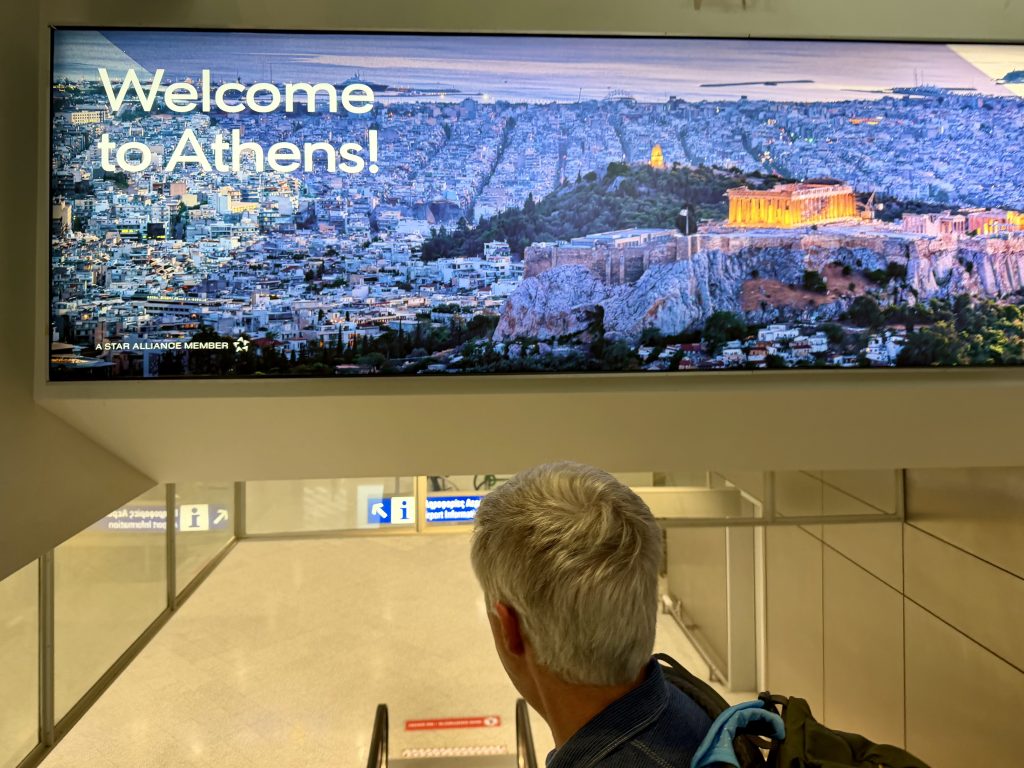
Touched down in Athens around 2 pm and lucked into Stefanos as our driver. He talked nonstop the whole way, giving us a running list of the sights, sounds, and foods we absolutely couldn’t miss.
Athens Marriott
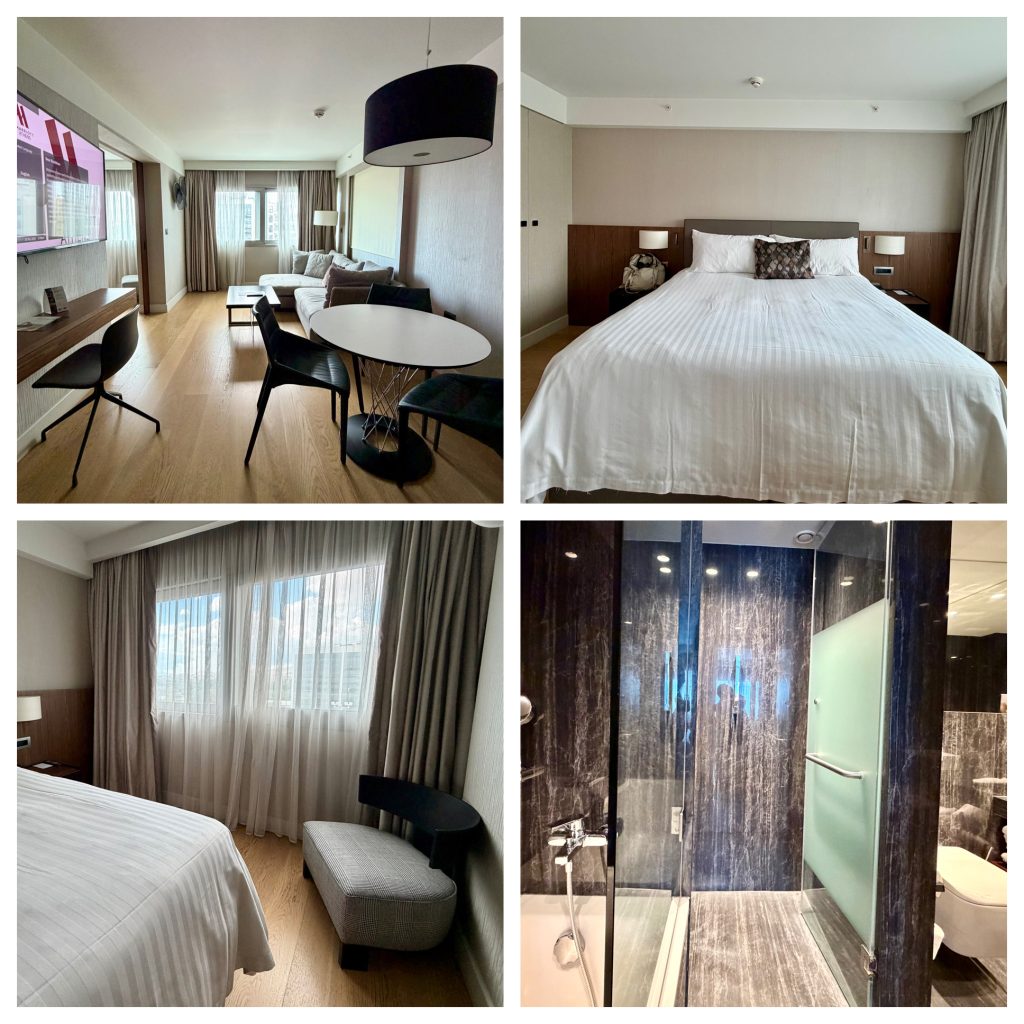
Checked into Athens Marriott.
Temple of Olympians Zeus
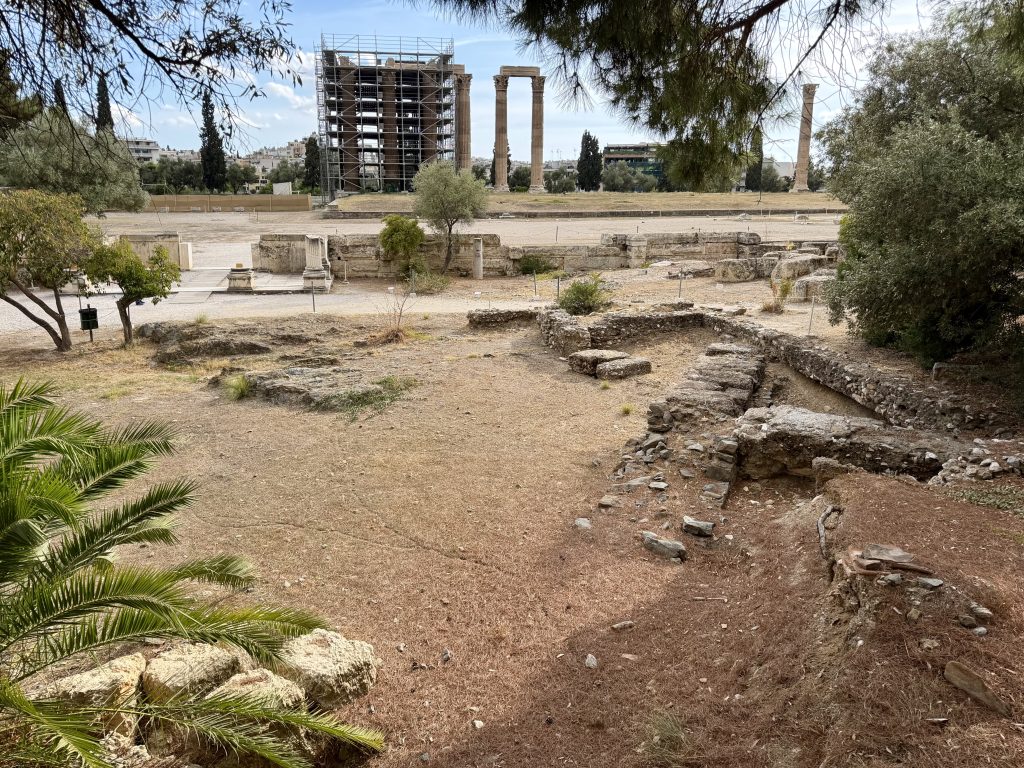
Dropped bags and headed right out to the Temple of Olympian Zeus and Hadrian’s Arch.
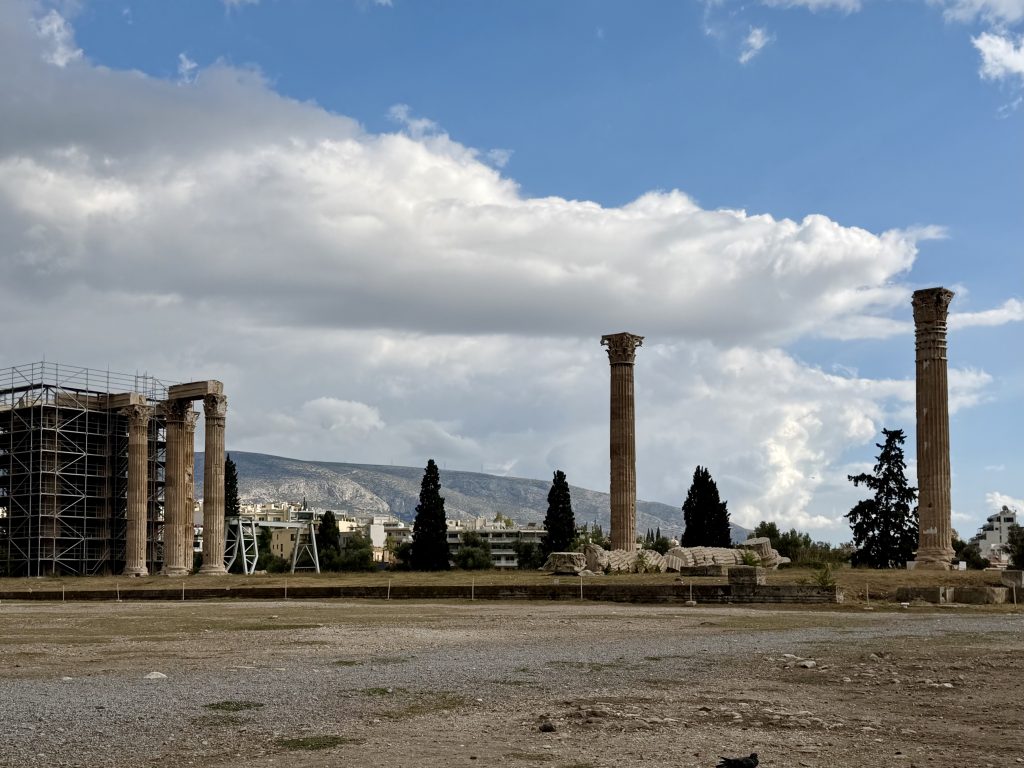
The temple was started in the 6th century BC and only finished under Hadrian in the 2nd century AD; a handful of those massive Corinthian columns still stand.
Hadrian’s Arch
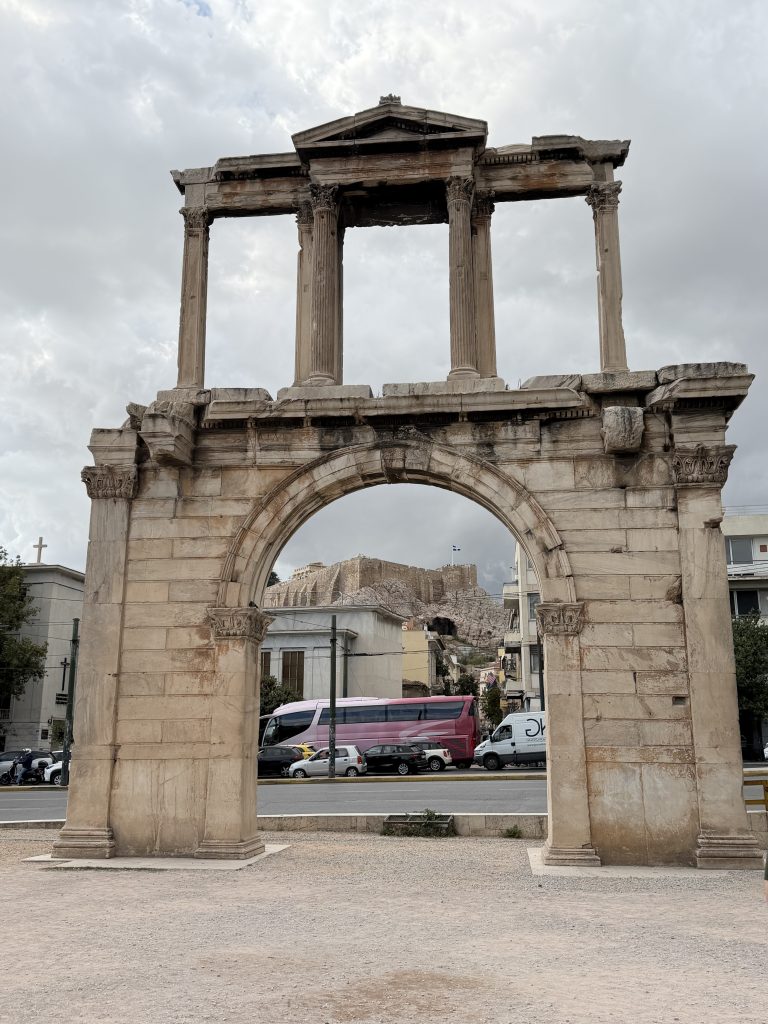
Right beside it, Hadrian’s Arch (131–132 AD) marked the old boundary between ancient Athens and the Roman city he built.
National Garden
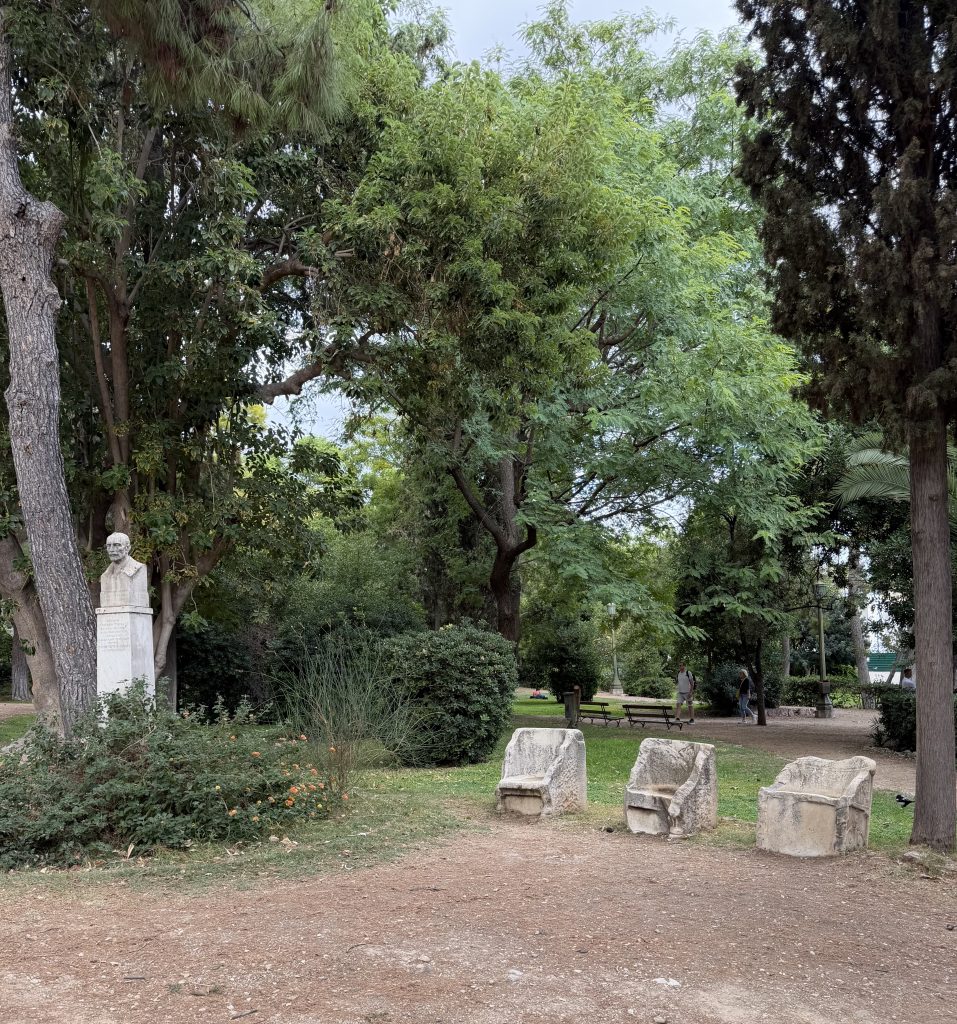
From there we cut into the National Garden—laid out in the 1830s as the royal gardens for the new Greek monarchy. Shaded paths, big trees, and a quiet green pause right next to Syntagma and the Parliament.
Taverna Byzantino
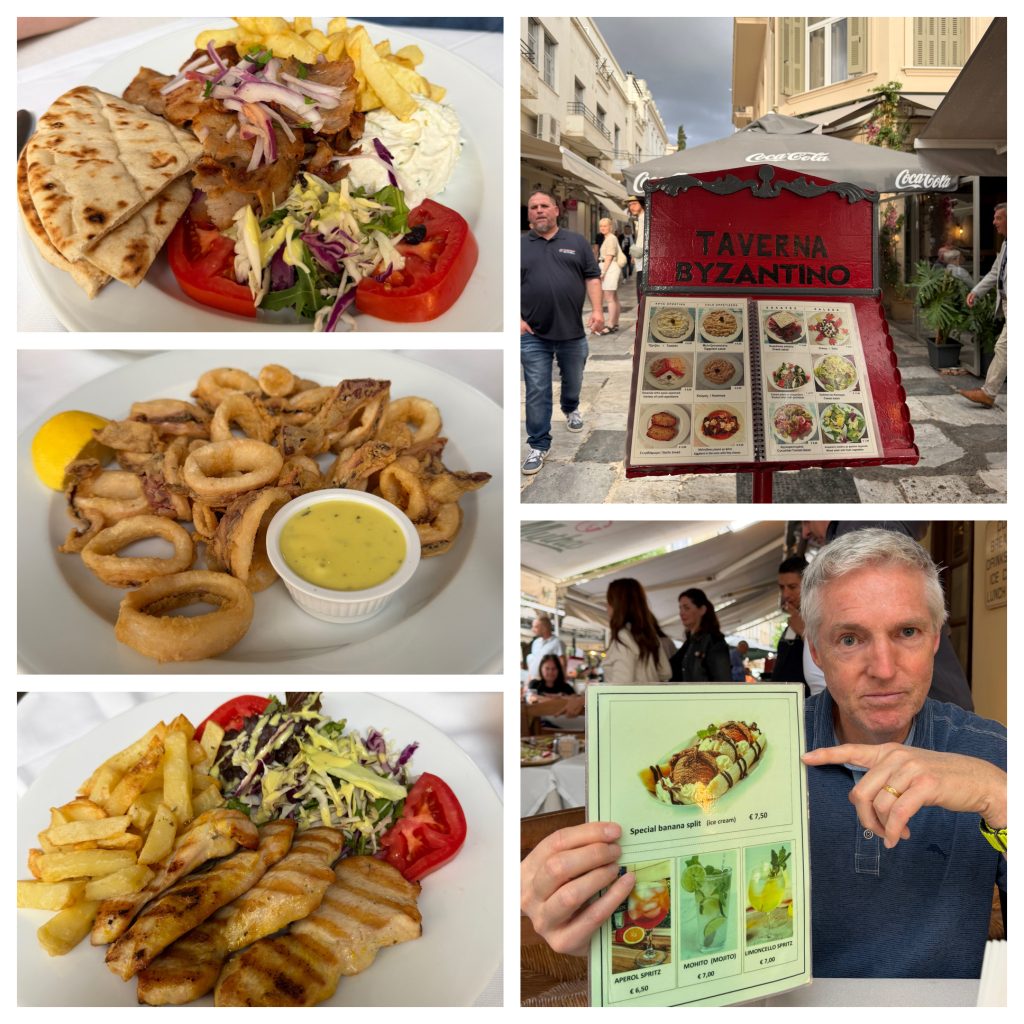
Lunch outdoor at Taverna Byzantino – gyros and souvlaki, very tasty in the middle of the old town. We didn’t get the banana split…but there’s food gelato everywhere and we had our share.
Anafiotika
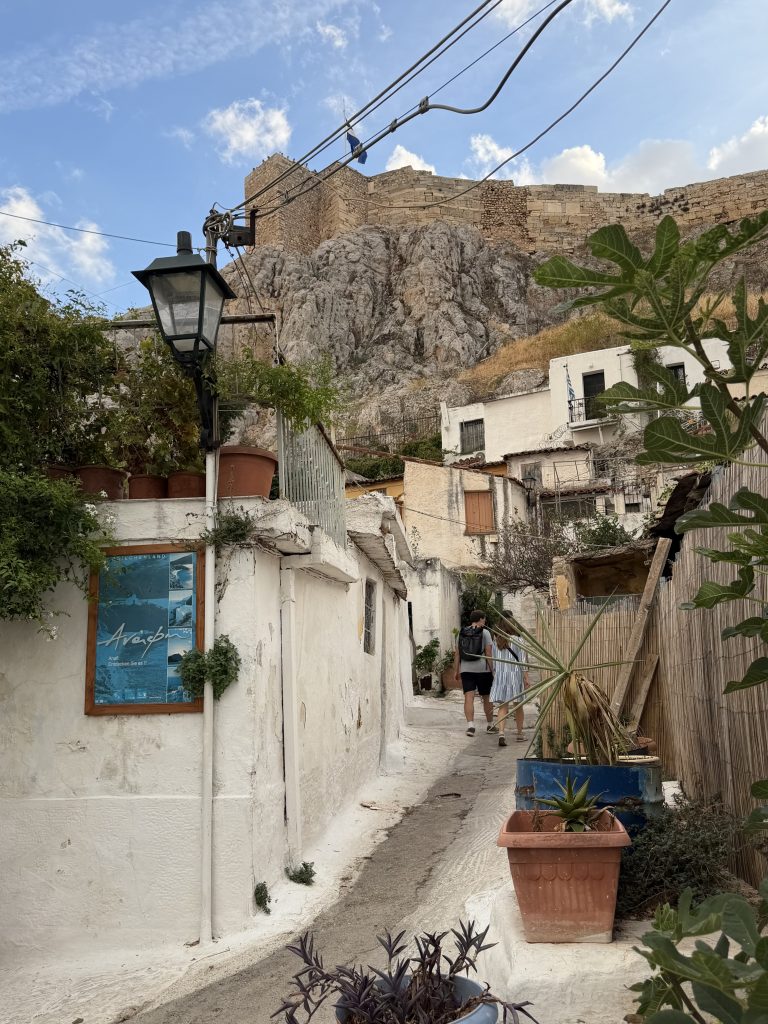
From Plaka we climbed into Anafiotika—the small cluster of whitewashed, Cycladic-style houses on the north slope of the Acropolis.
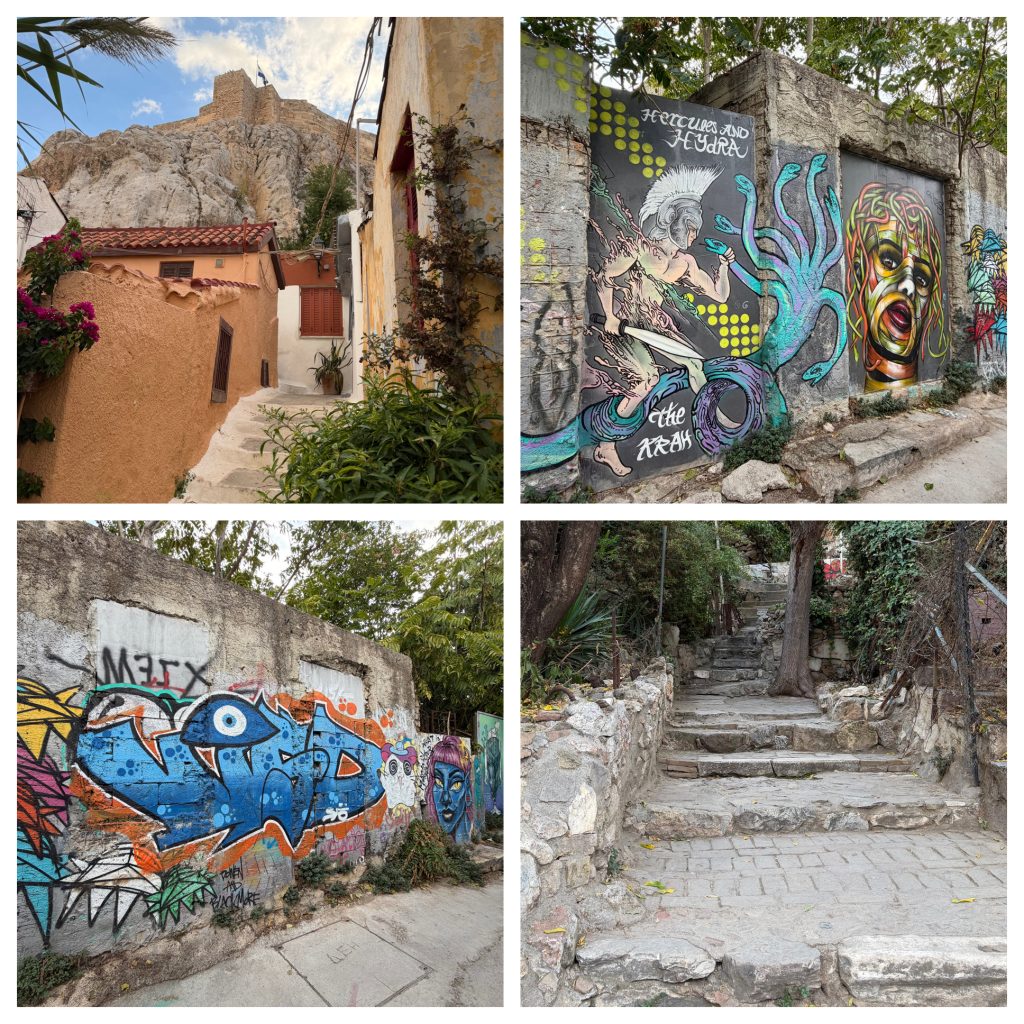
Built in the mid-19th century by craftsmen from the island of Anafi who came to work on the royal palace. Only about 45 houses left; quiet, residential (except for our fellow tourists), a sharp contrast to the streets below.
Mnisikleous/Plaka
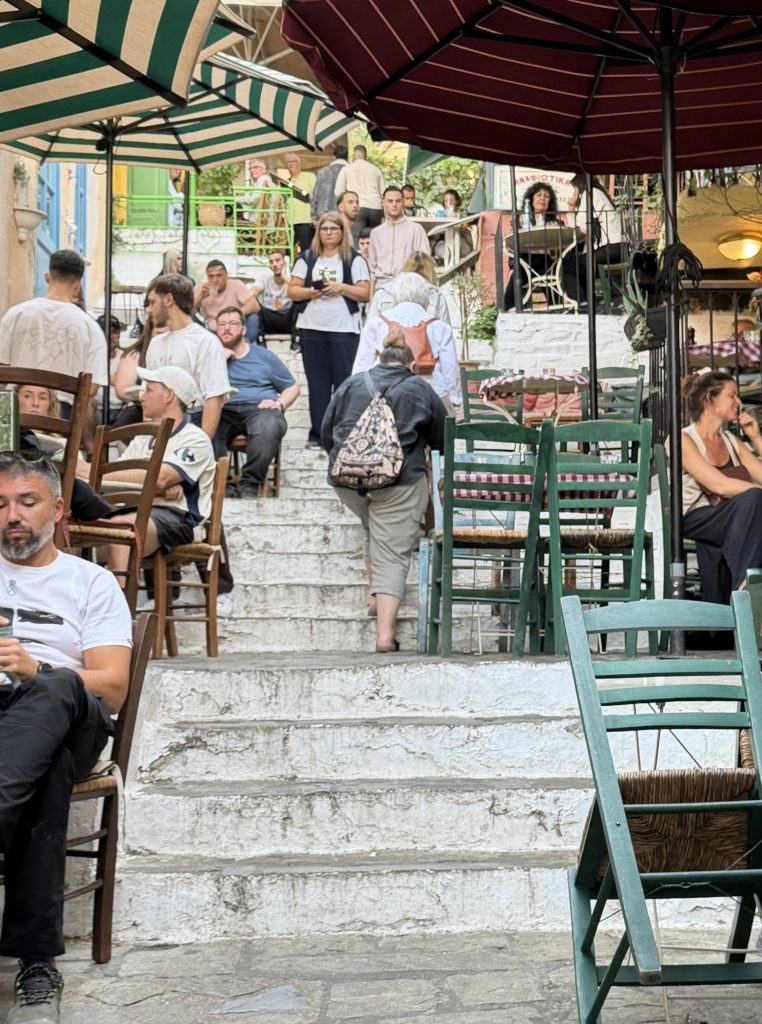
Then into Plaka under the Acropolis, including the well-known Plaka stairs along Mnisikleous Street lined with café tables. Uneven marble, tavernas, shops—centuries of continuous living in one tight neighborhood.
Mitropoleos Square
Metropolitan Cathedral of Athens (Annunciation of the Virgin)
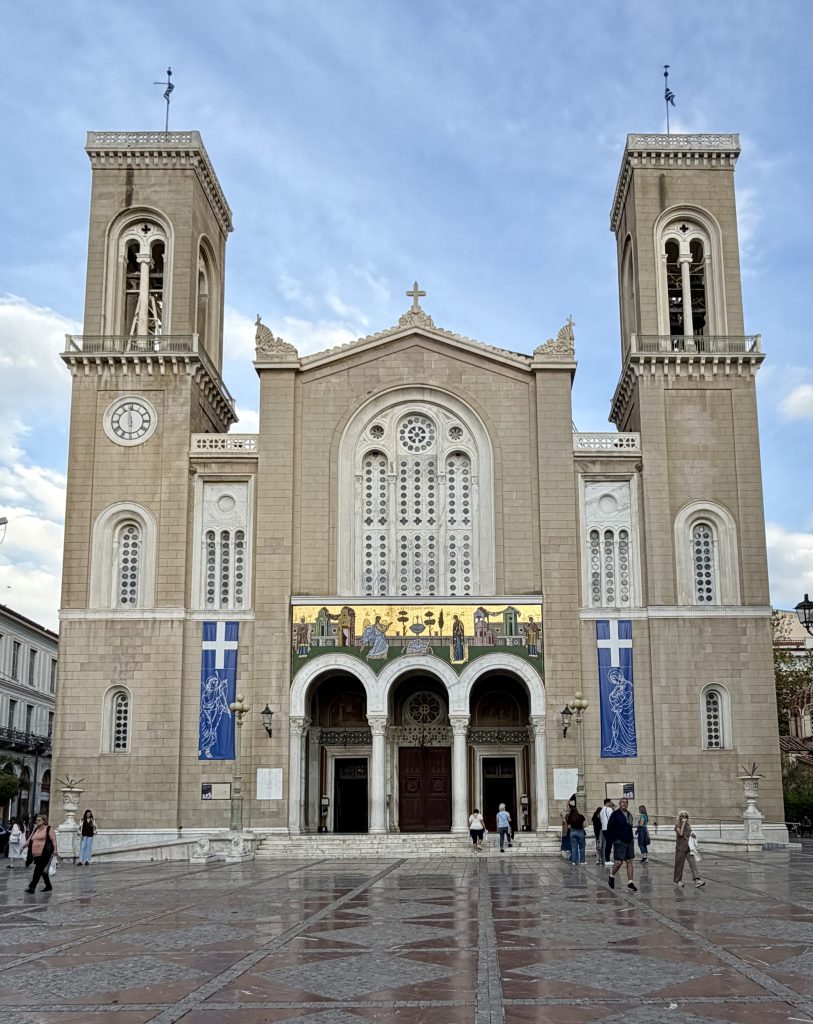
Mitropoleos Square has two churches side by side: the large Metropolitan Cathedral of Athens (Annunciation of the Virgin), begun on Christmas Day 1842. Marble from dozens of older demolished churches went into its walls.
Little Metropolis (Panagia Gorgoepikoos)
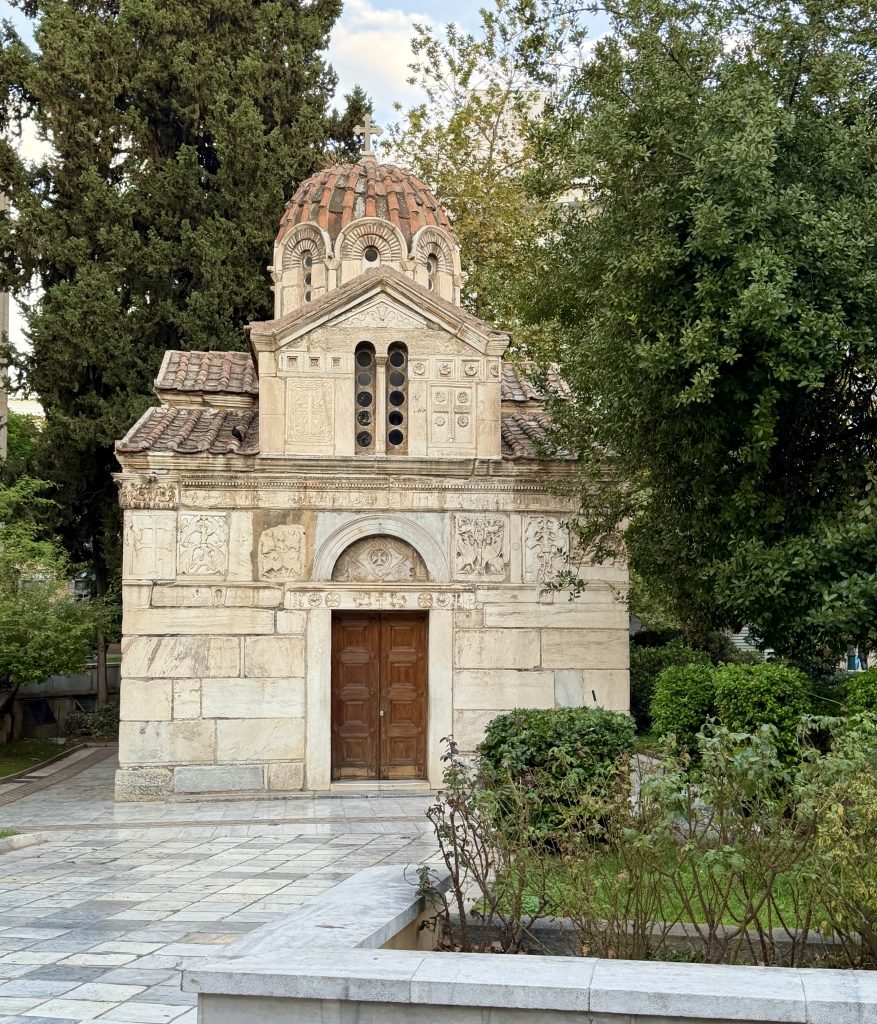
Next to it is the tiny Little Metropolis (Panagia Gorgoepikoos), a late-12th-century Byzantine church built almost entirely of reused ancient and medieval marble blocks on the site of a temple to Eileithyia.
Church of Panagia Kapnikarea
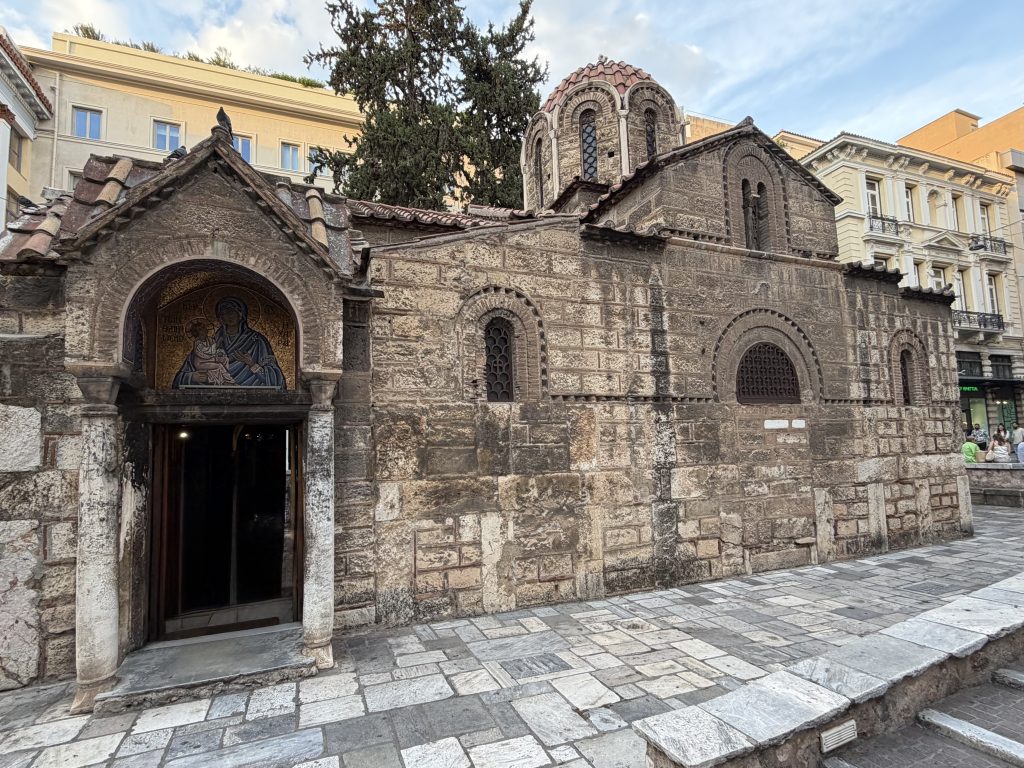
Stopped at the Church of Panagia Kapnikarea, the small 11th-century Byzantine church sitting right in the middle of busy Ermou Street.
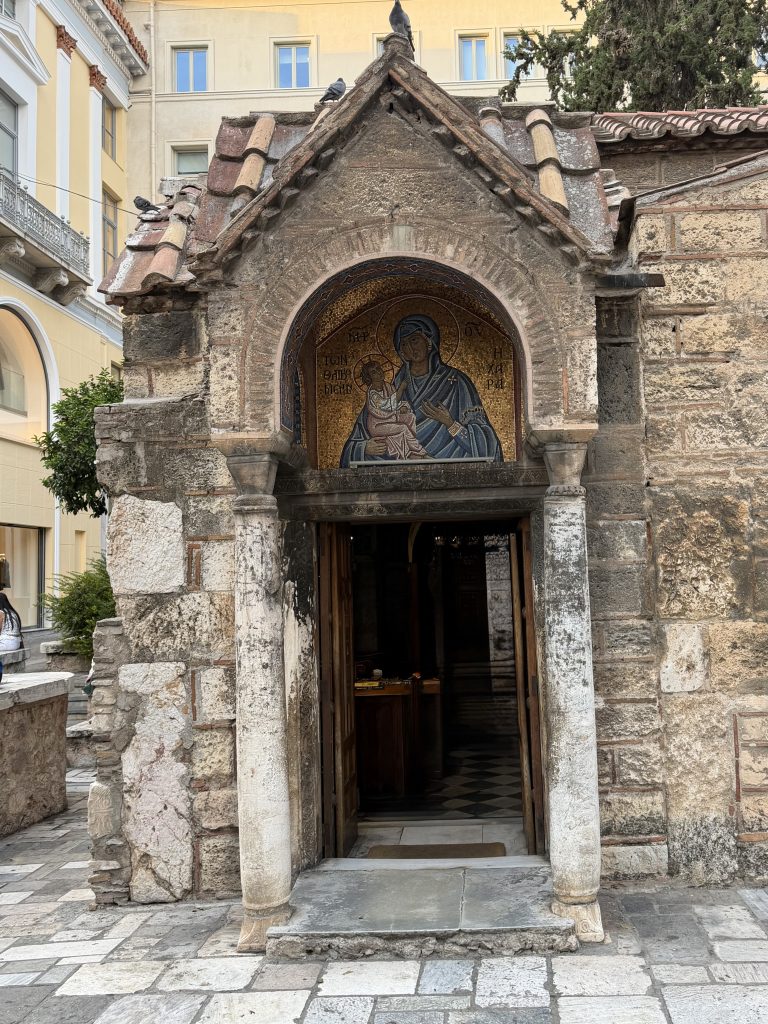
Built around 1050 on the site of an earlier ancient temple and dedicated to the Presentation of the Virgin Mary. It was nearly demolished during the 1830s redesign of Athens but was saved by King Ludwig I of Bavaria. Now it belongs to the University of Athens.
Monastiraki Square
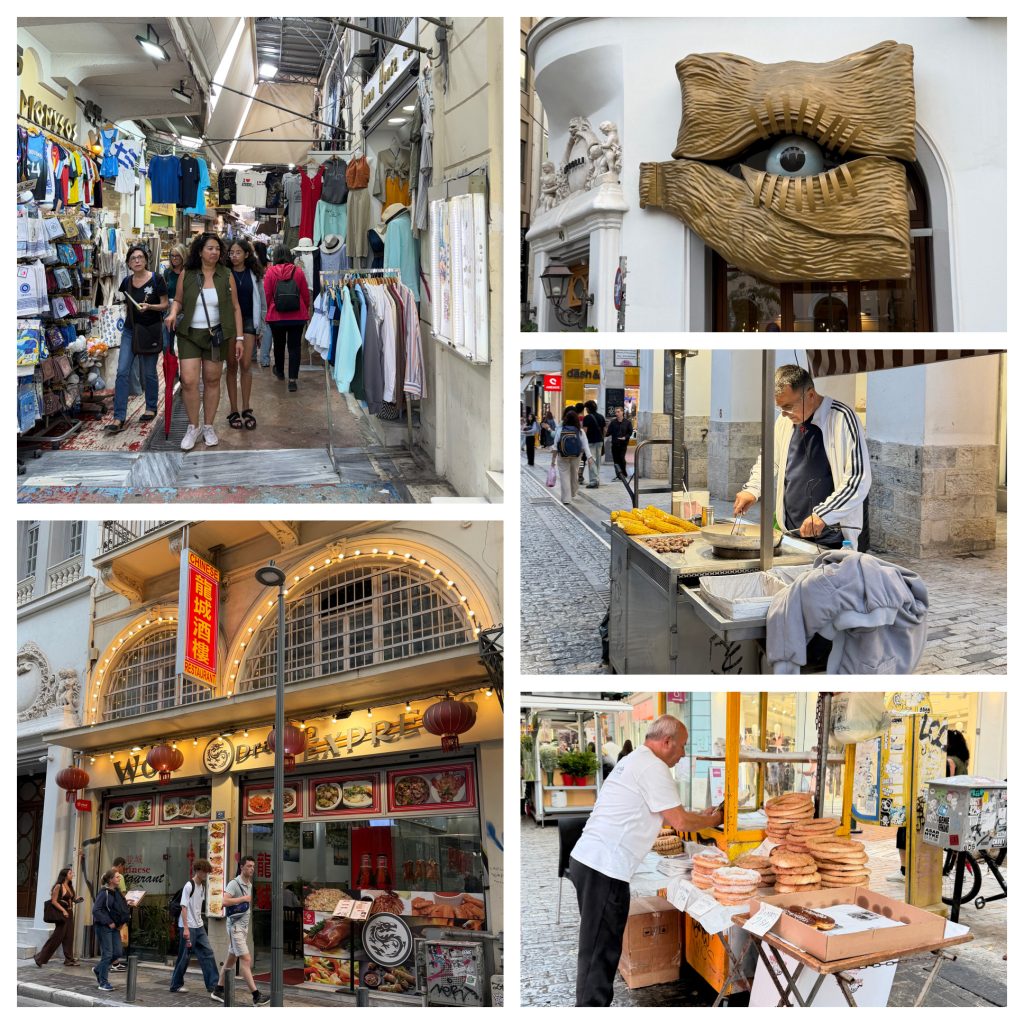
Also passed through Monastiraki Square (flea market and metro hub with views toward the Acropolis).
Syntagma Square
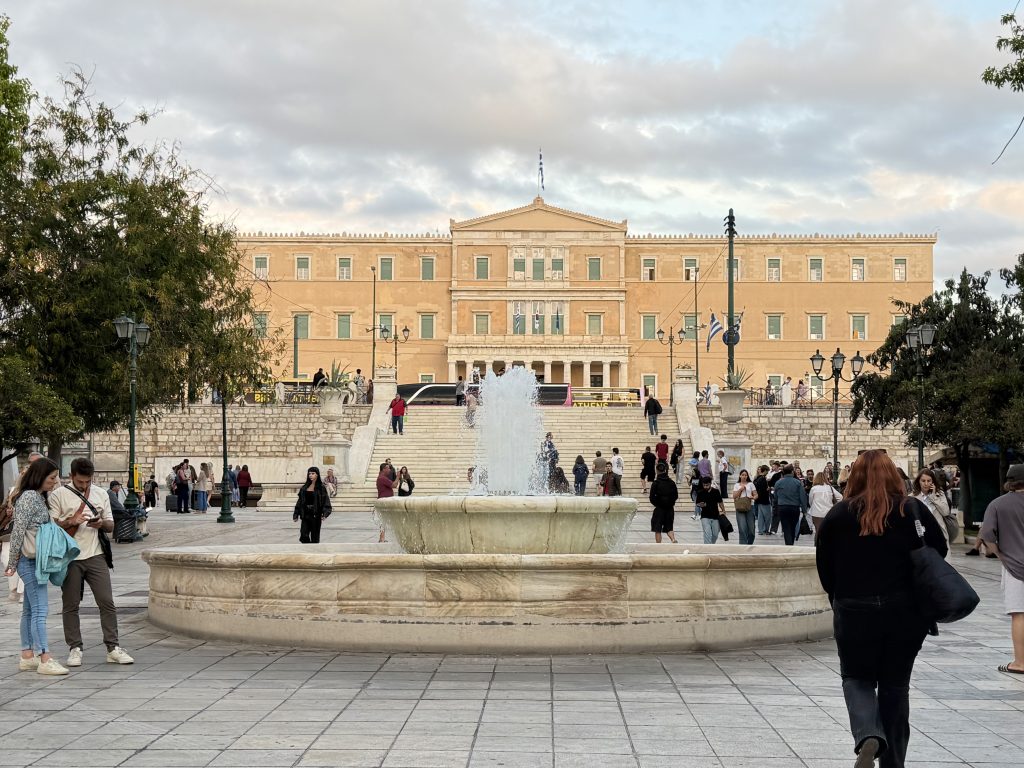
We also went to Syntagma Square, the central square of modern Athens, named for the 1843 constitution granted after an uprising in front of the royal palace. The grand neoclassical building overlooking the square is the former Royal Palace (built 1836–1843 for King Otto), which has housed the Hellenic Parliament since the 1930s; the Evzone (Presidential Guard) changing of the guard takes place hourly in front of the Tomb of the Unknown Soldier at its base.
The current Presidential Palace stands a short walk nearby, past the Parliament and along the edge of the National Garden.
Compact circuit, all within a short walk of the Acropolis base: monumental Roman remains, the National Garden, Plaka’s layered streets and stairs, taverna lunch, Kapnikarea, the two churches on Mitropoleos Square, the quiet Cycladic pocket of Anafiotika, and the livelier squares. Athens day one, done.
Day 2
Walking through 2,500 years before dinner.
Athens Acropolis
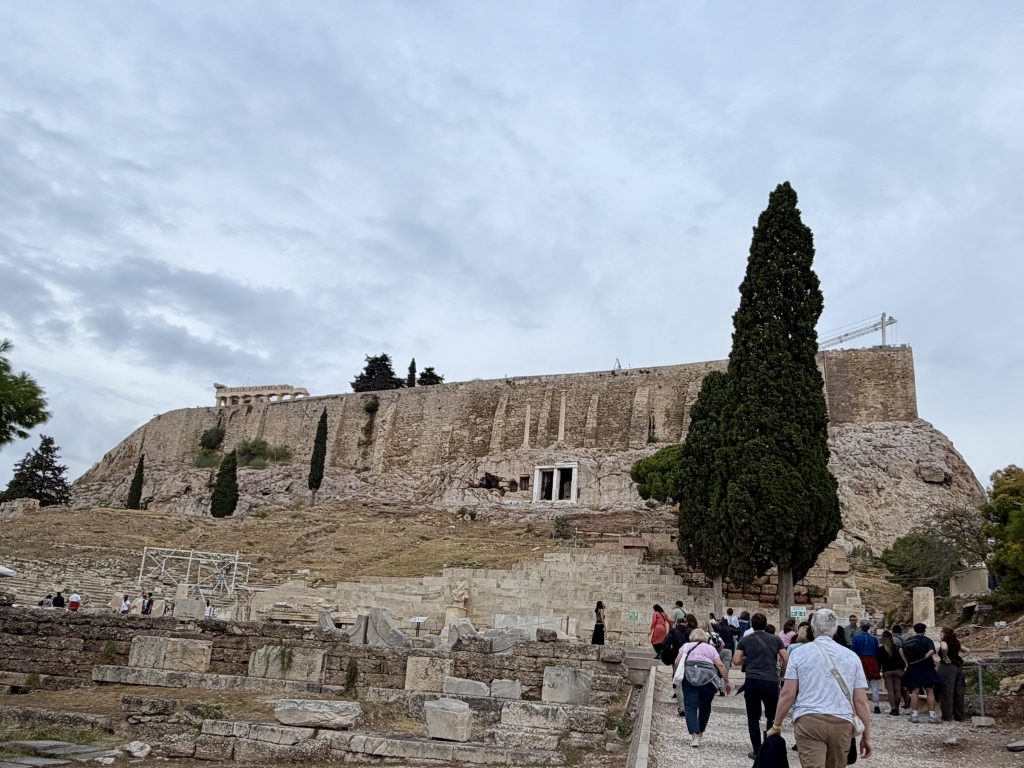
Today started early with a guided tour of the Acropolis—literally “high city” in Greek. For thousands of years this rocky outcrop was the city’s fortress and its most sacred ground. Worship here stretches back to the Bronze Age.
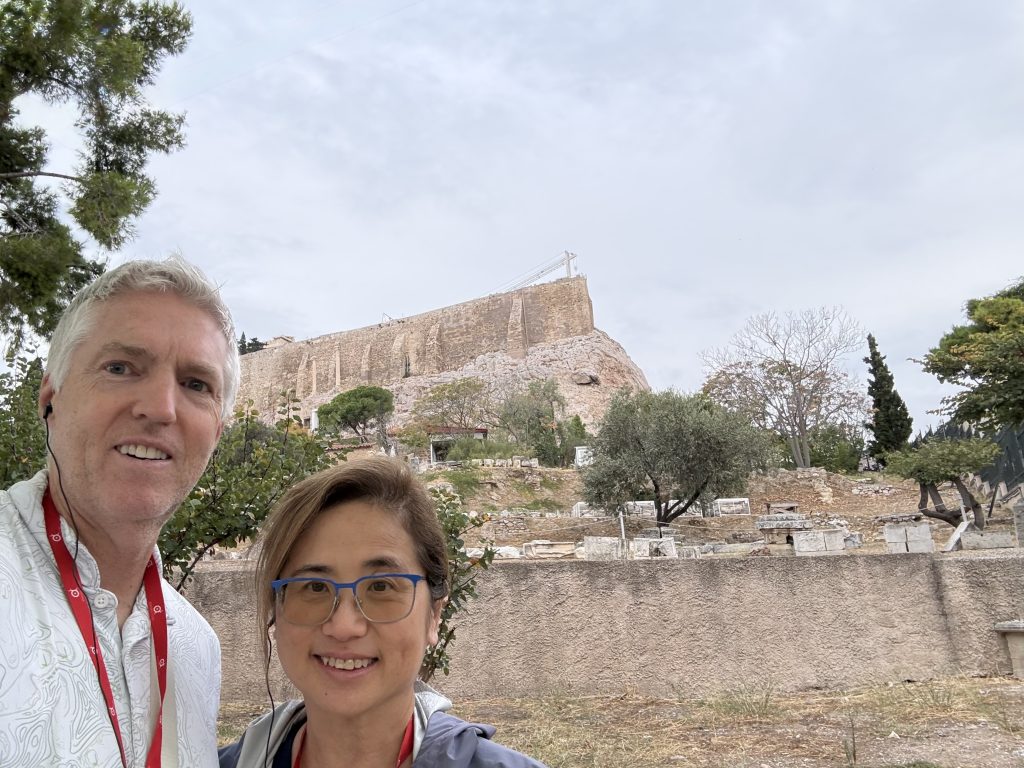
In 480 BC the invading Persians burned everything on it (a fact our guide returned to again and again). About thirty years later, Pericles rebuilt the summit as a monument to Athens’ victory and power, partly funded by tribute from the city’s allies.
Sanctuary of Asclepius
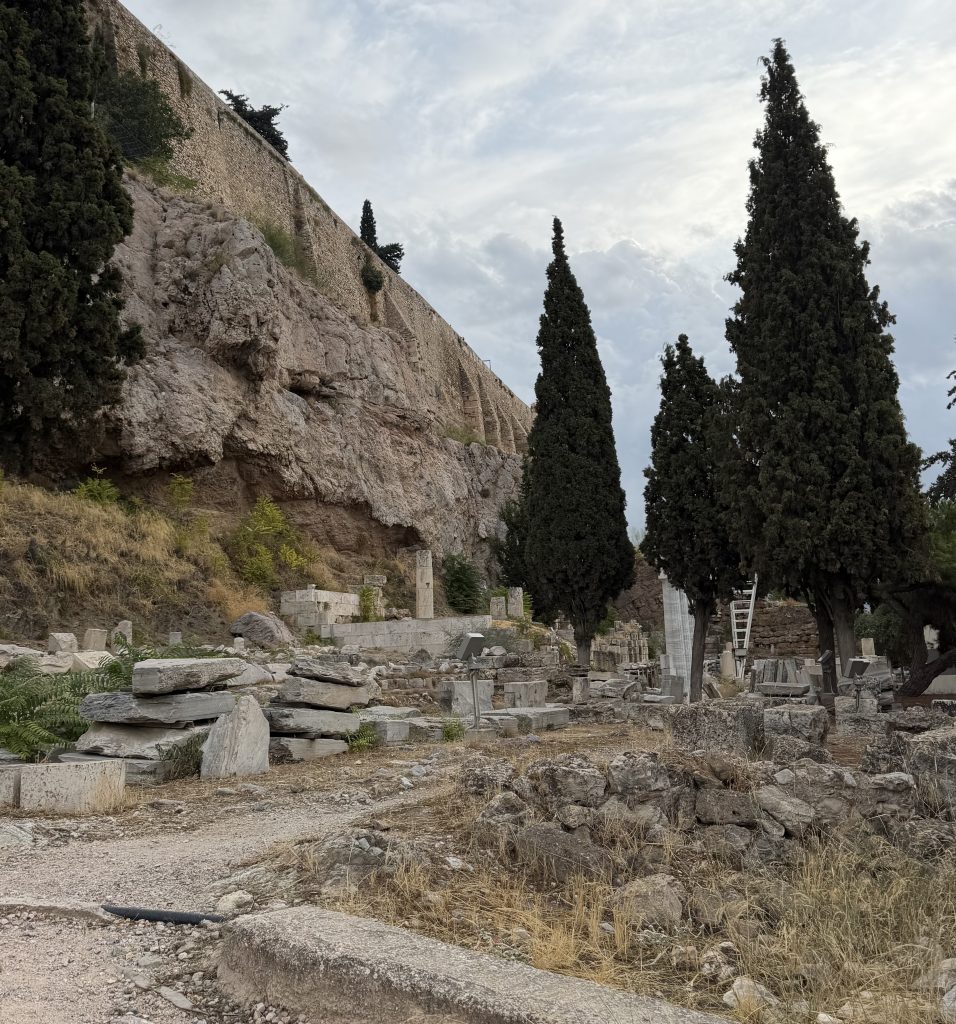
The climb itself is a layered walk through history. On the south slope, before the steep ascent, we passed the Sanctuary of Asclepius, the ancient healing sanctuary where the sick once came for treatment and cures.
Theatre of Dionysus
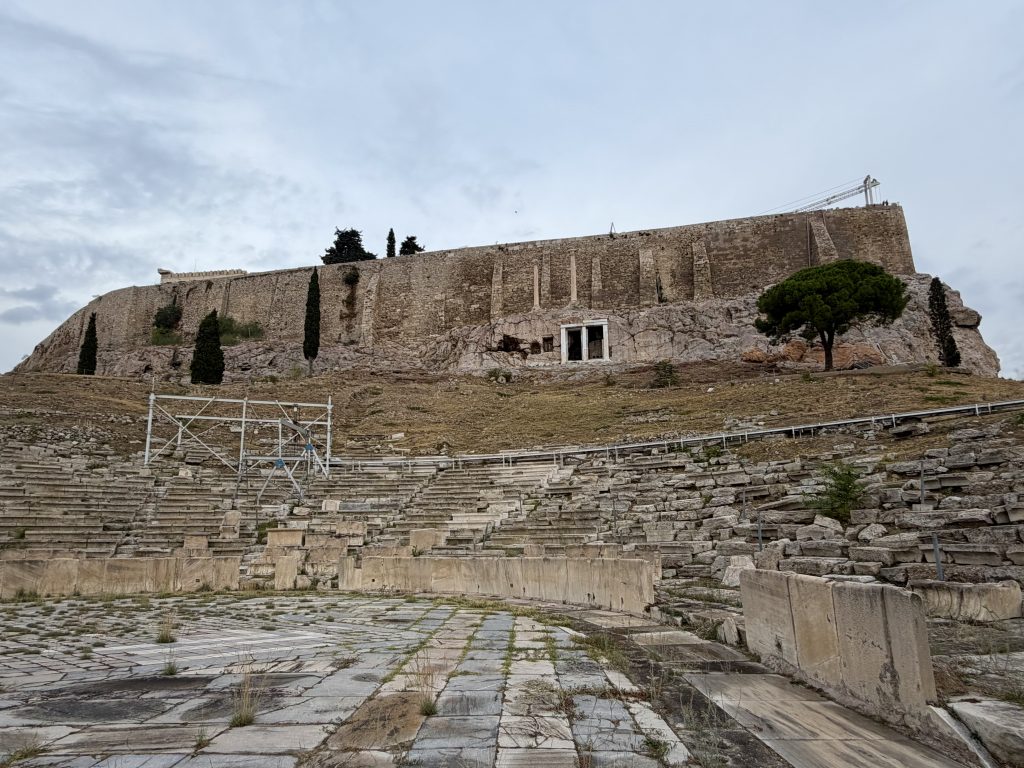
Nearby stands the Theatre of Dionysus, the world’s oldest stone theater, where the great tragedies and comedies of the fifth century BC were first performed.
Apparently it is still used on occasion for important concerts.
Odeon of Herodes Atticus
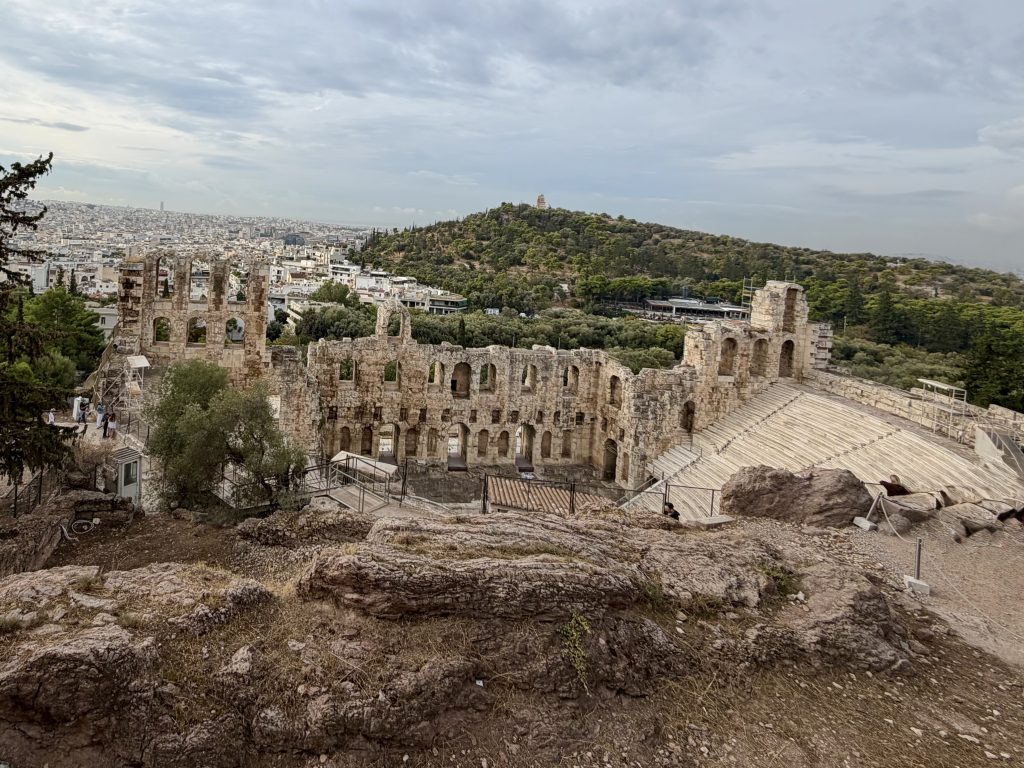
A little farther along the slope is the Odeon of Herodes Atticus, the still-used Roman-era theater with its tall arched façade.
Stoa of Eumenes
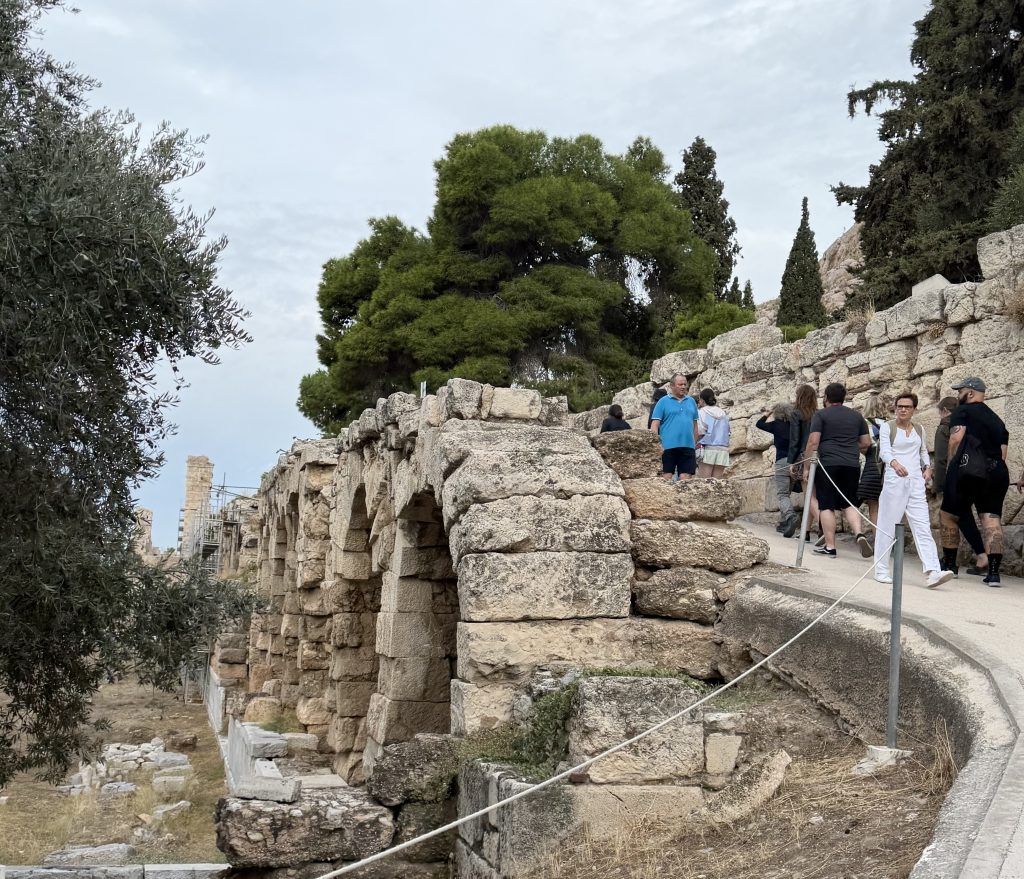
Linking the two performance spaces is the Stoa of Eumenes, a long covered walkway built in the 2nd century BC by King Eumenes II of Pergamon. It gave spectators shade and shelter as they moved between the theaters and also served as a massive retaining wall supporting the slope above. Today mainly its long arched rear wall and foundations remain.
Temple of Athena Nike
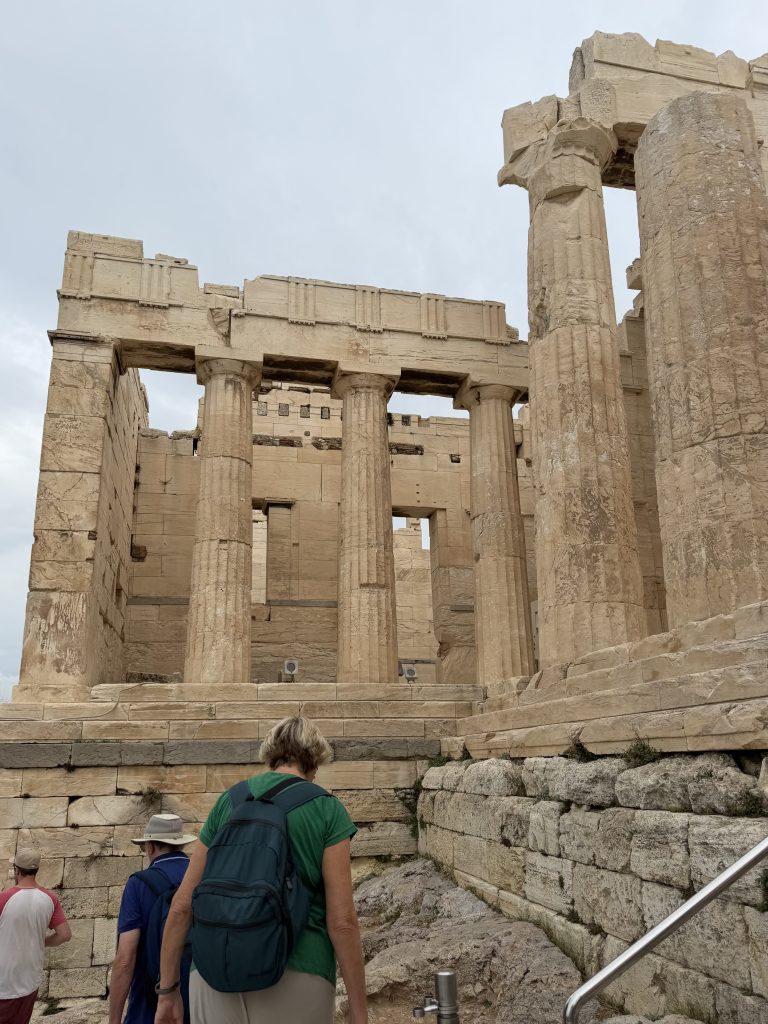
Higher up, the formal western entrance appears: the small Temple of Athena Nike perched on its projecting bastion.
Propylaea
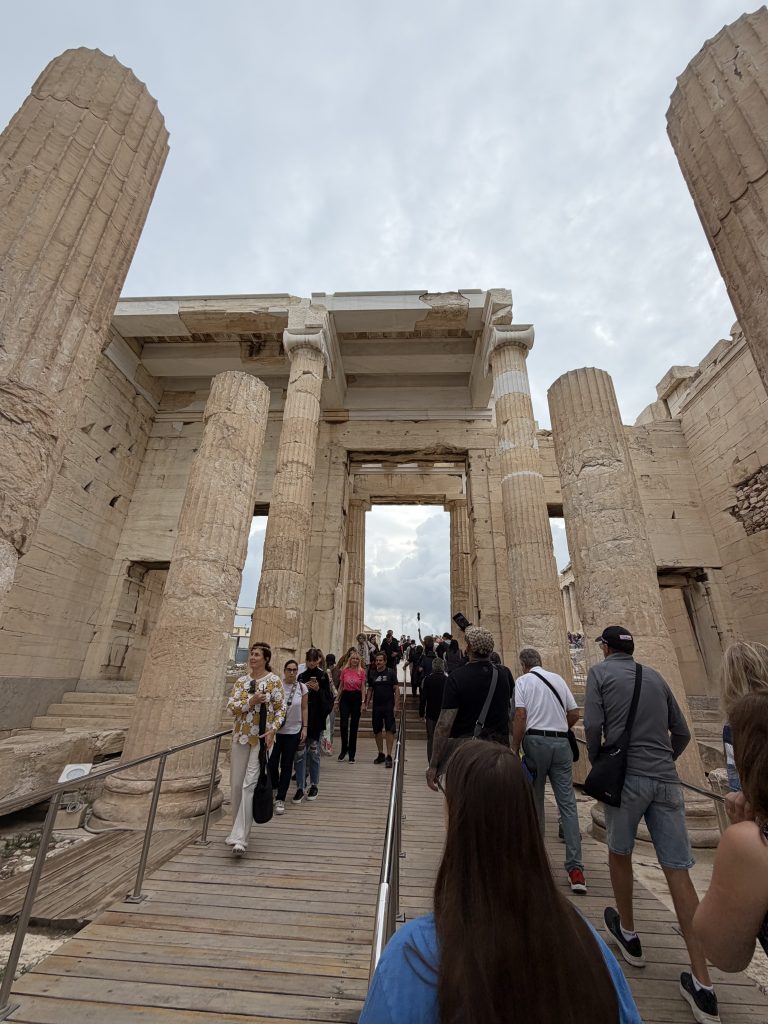
Right beside it stands the monumental Propylaea, the multi-level gateway that served as the main entrance onto the sacred plateau. Together they form the ceremonial threshold of the Acropolis.
Parthenon
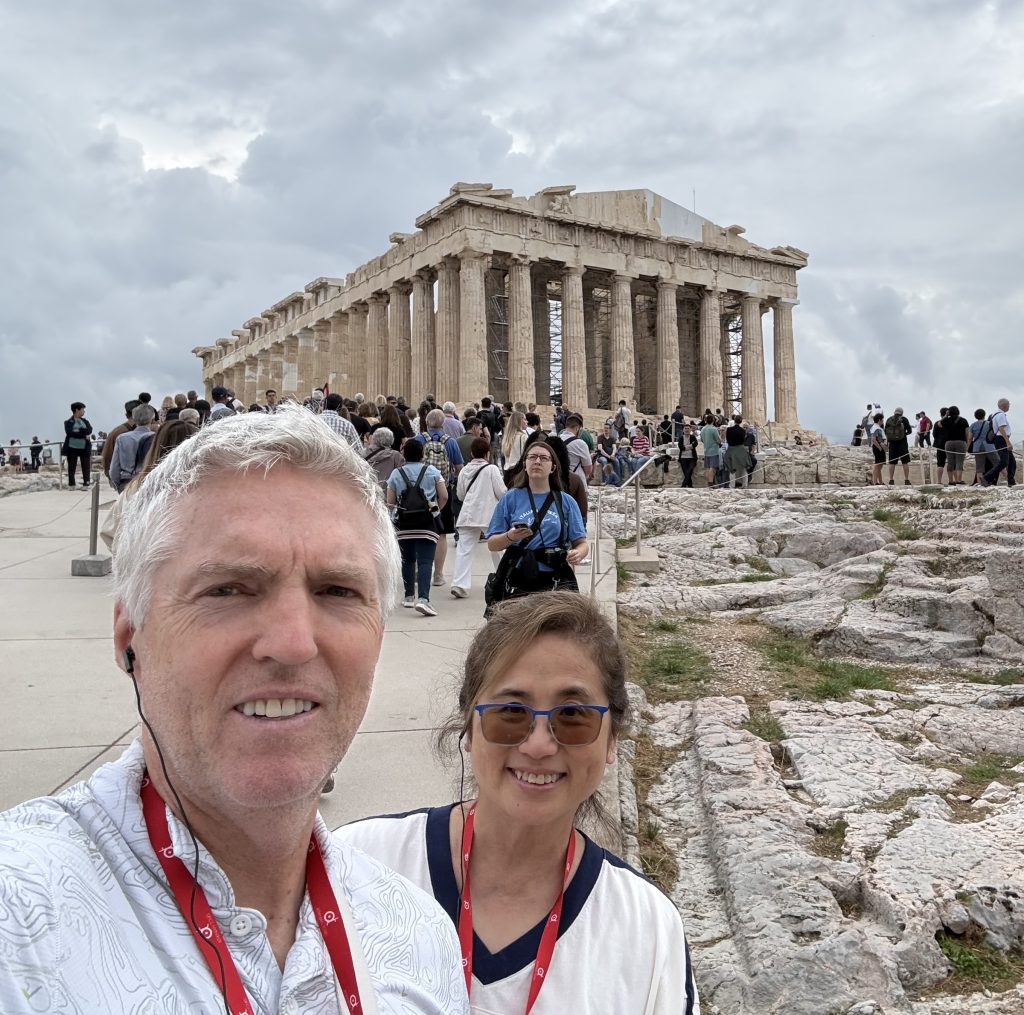
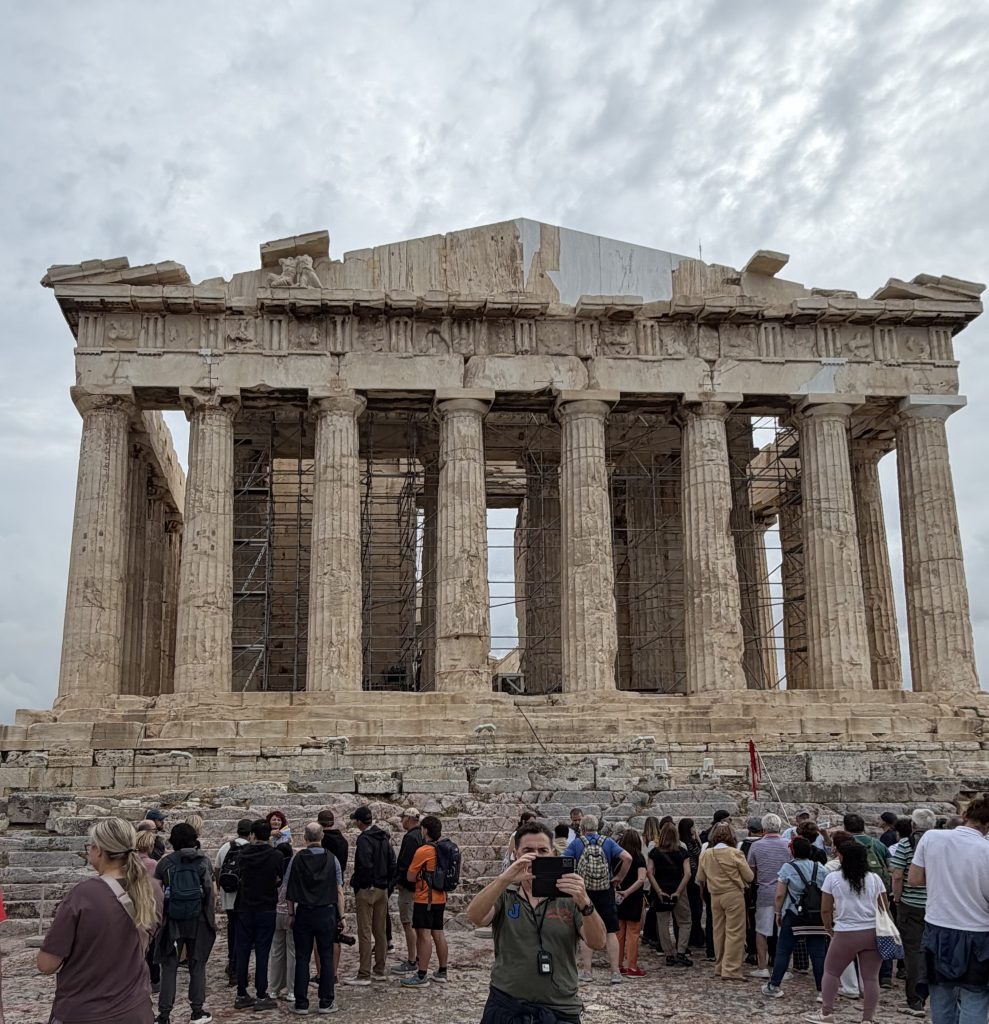
The main event is the Parthenon, a marble temple to Athena, the city’s patron goddess and namesake. It rose in just nine years (447–438 BC) and once held a colossal gold-and-ivory statue of her nearly forty feet tall. Built during Athens’ Golden Age—the same era that produced democracy, theater, and philosophy—it has become a symbol of Western civilization itself. The builders were brilliant: almost no line is straight; the columns bulge slightly and lean inward so the whole structure looks perfectly true from below.
Athena won the patronage of the city over Poseidon because her gift—the first olive tree—was judged more useful than his saltwater spring. An olive tree still grows beside the Erechtheion, the smaller temple on the north side of the plateau, on the traditional site of that contest.
The Parthenon later served as a Christian church, then a mosque. In 1687 the Ottomans were storing gunpowder inside when a Venetian cannonball struck it and blew out the middle. That single explosion did more damage than two thousand years of weather. Restoration work continues today.
Erechtheion
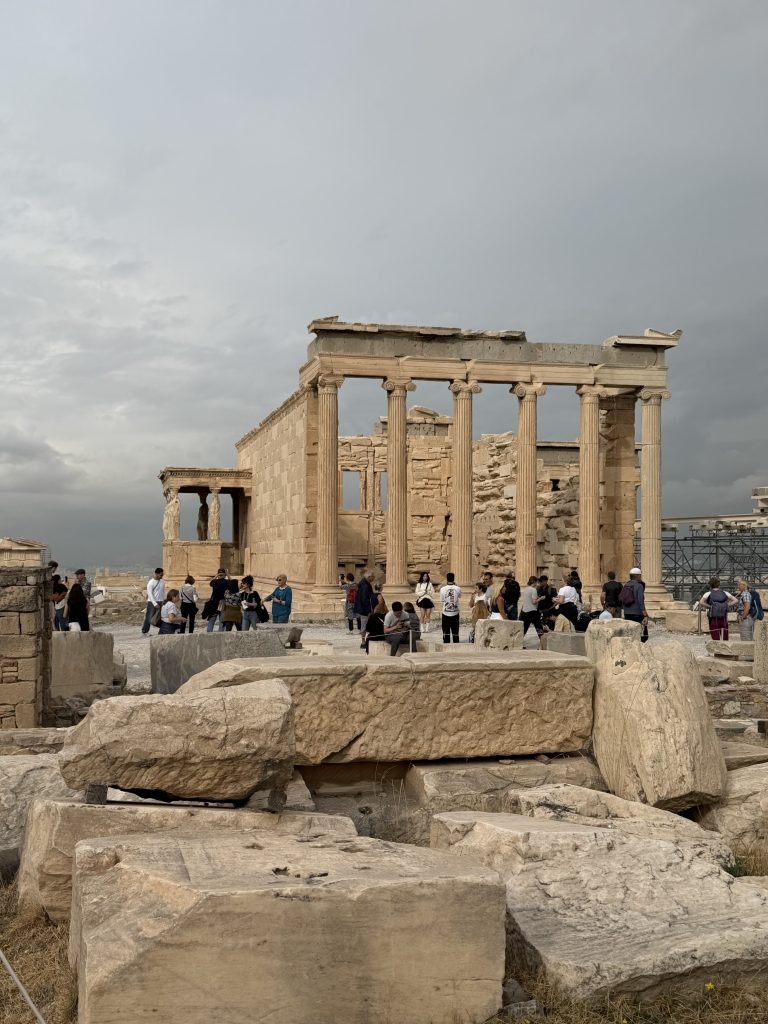
Next the Erechtheion, right next to Parthenon. It is the more complex and irregular temple on the north side of the Acropolis, built in the late 5th century BC.
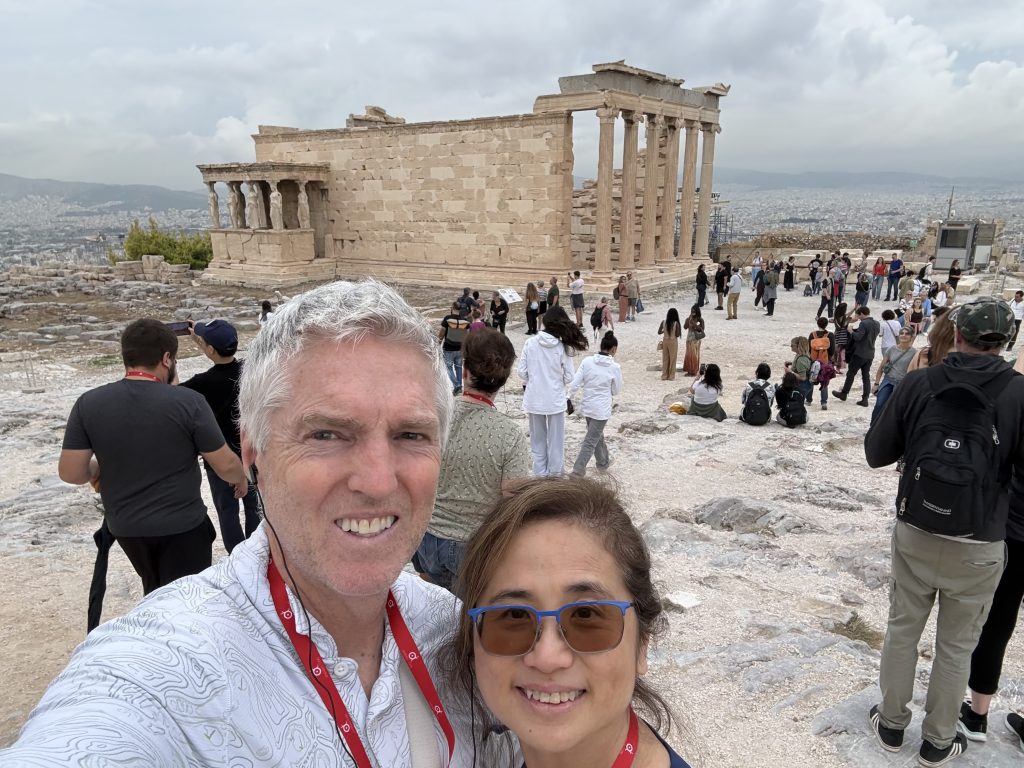
Unlike the symmetrical Parthenon, it was designed to house several older cults and sacred spots on uneven ground, including the traditional site of the contest between Athena and Poseidon.
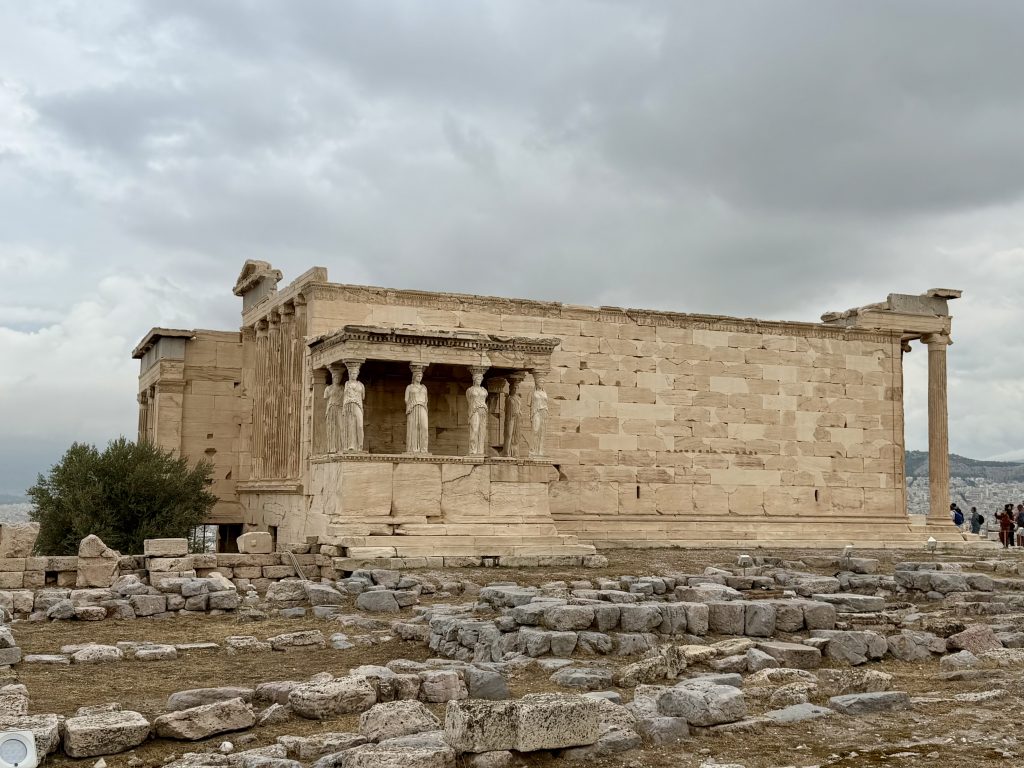
Its most famous feature is the south porch, where six statues of young women—the Caryatids—serve as columns supporting the roof. The figures stand in a graceful, slightly varied pose, each carrying the weight on one leg. The ones you see on the building today are copies; five of the original Caryatids are in the Acropolis Museum, and one is in the British Museum.
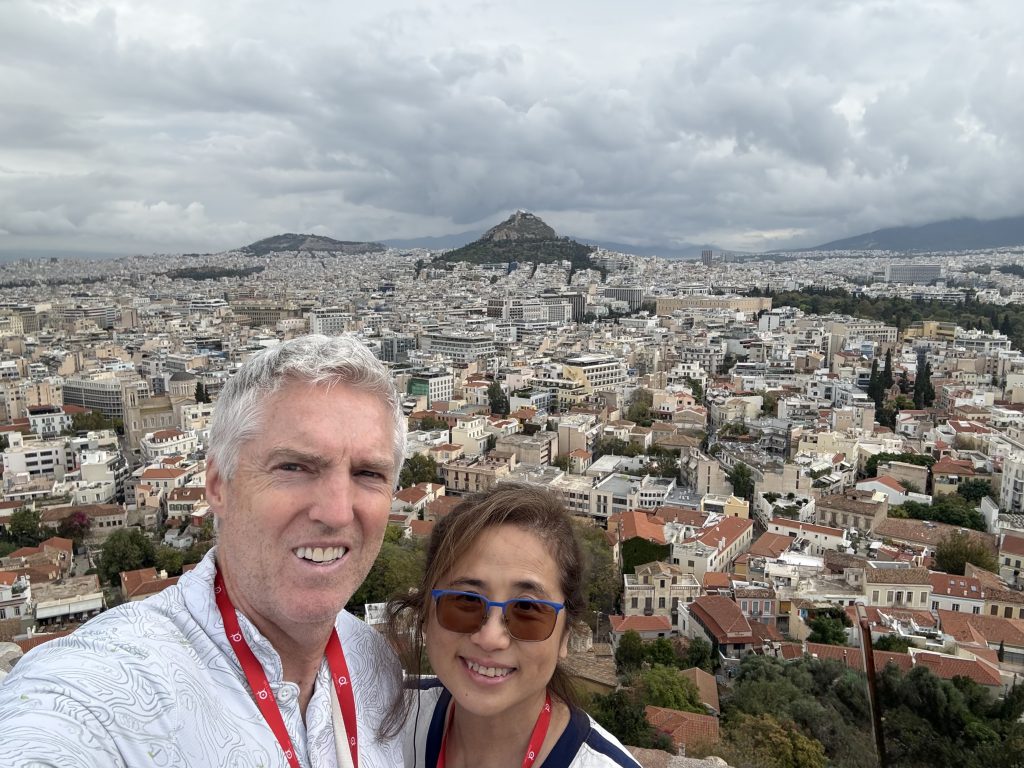
Acropolis Museum
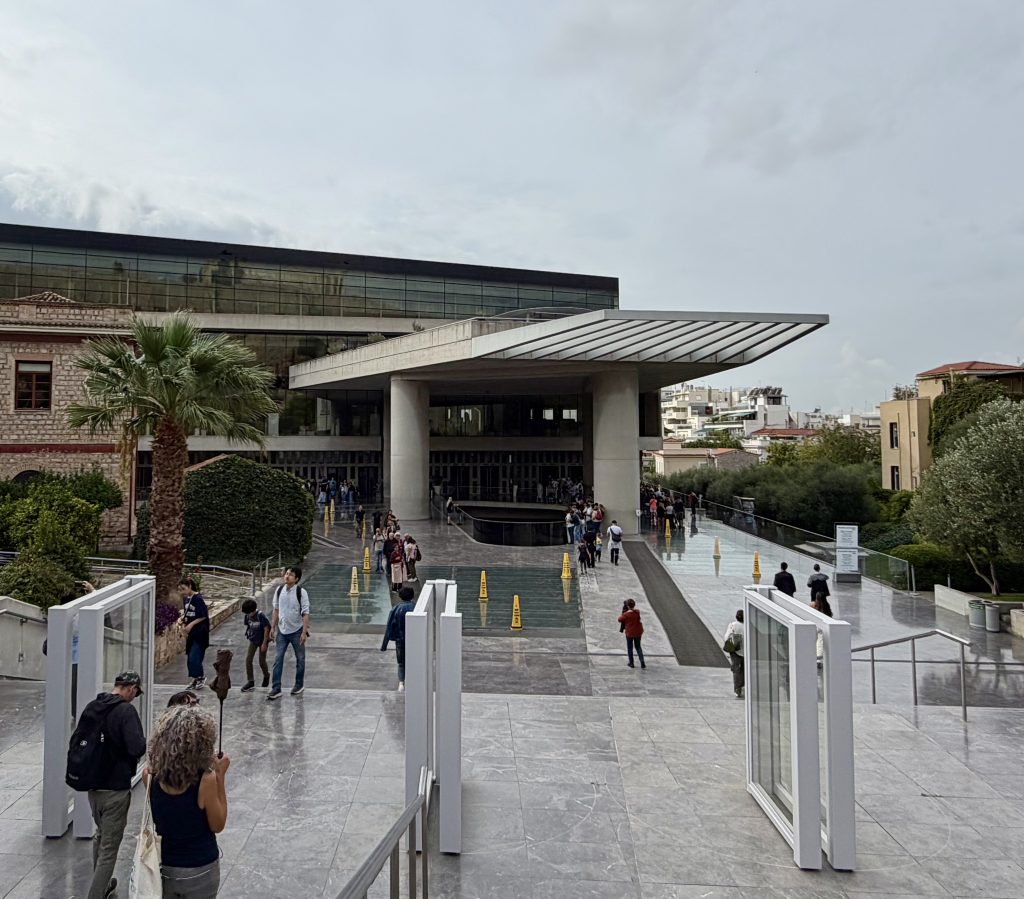
Next came the Acropolis Museum, also guided and equally impressive. Opened in 2009 at the foot of the hill, it houses the original sculptures and treasures found on the Acropolis. Most of what remains on the hill itself are replicas; the real pieces are protected indoors.
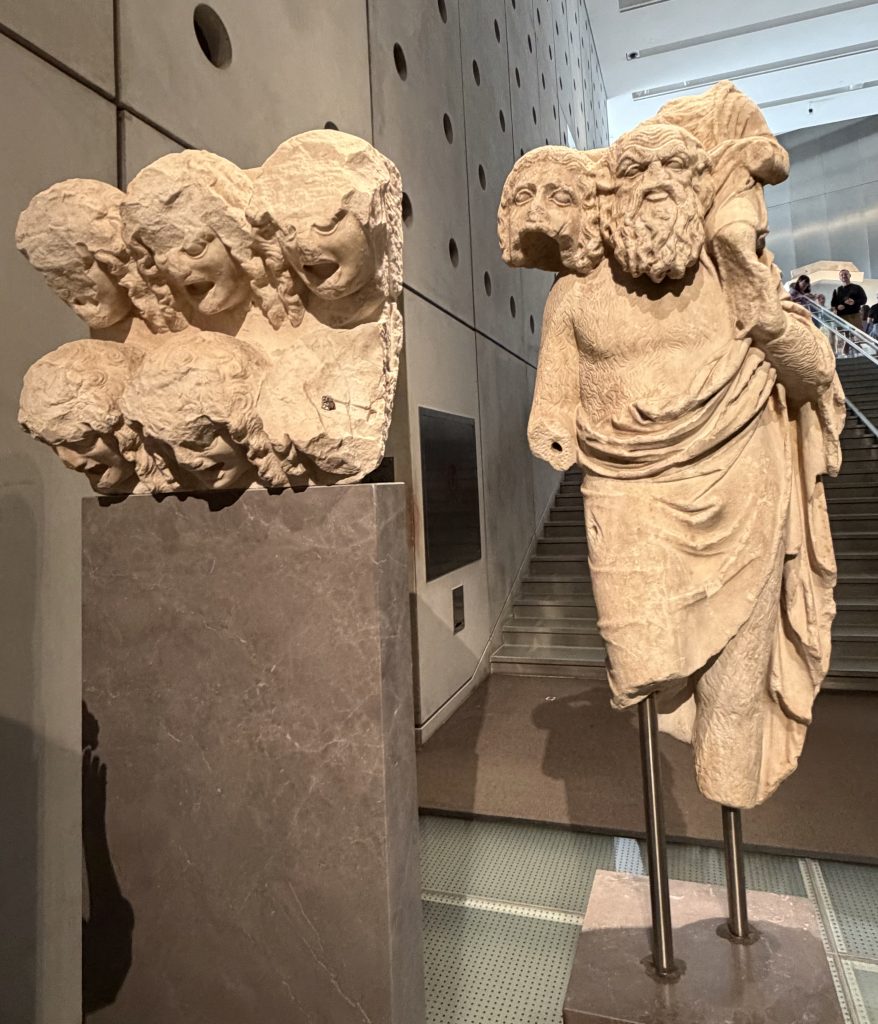
Just inside, the museum opens into a long, wide gallery whose floor rises in a gentle, continuous slope. The design deliberately echoes the ancient path people followed as they climbed the rock. Glass panels set into the floor let you look straight down onto the excavated streets, houses, and workshops of the ancient neighborhood that once stood at the base of the hill, so you walk “up” while literally suspended above the past.
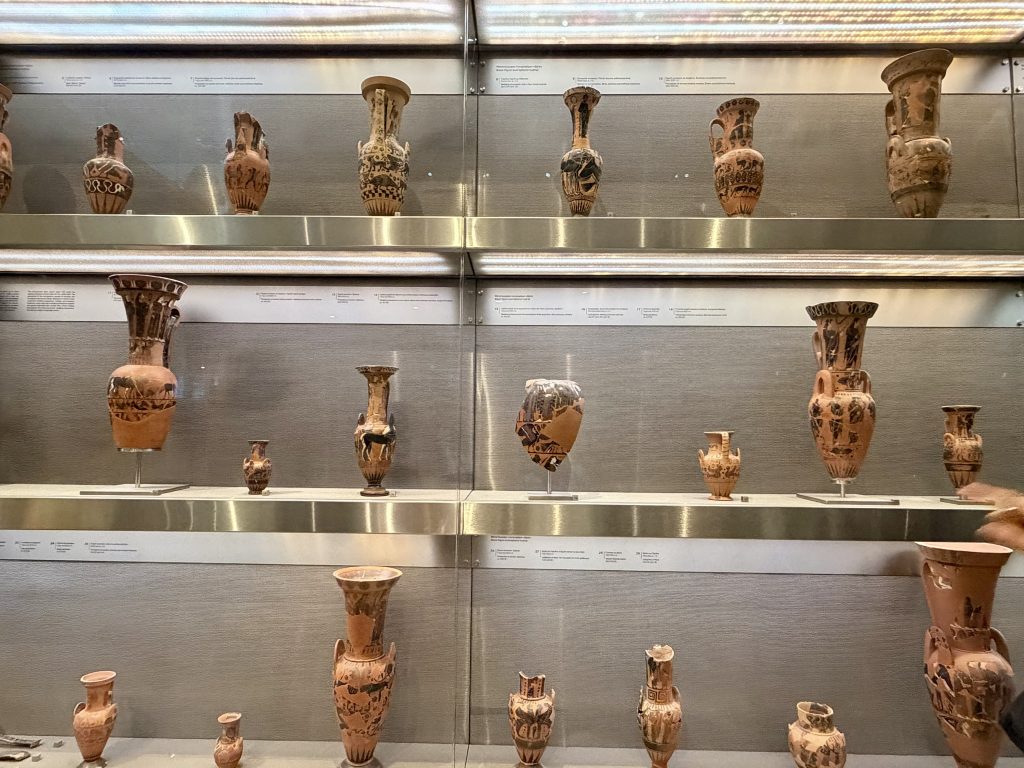
Along both sides are everyday and sacred finds from those slopes—votive offerings, household pottery, theatrical masks, and objects from the small sanctuaries and residences that formed the transition zone between the city and the sacred summit. The upward tilt is subtle but unmistakable; it turns the simple act of moving through the first gallery into a quiet reenactment of the ascent that defined the site for centuries. This sloping gallery is the official starting point of the permanent collection before you continue upward to the Archaic sculptures and, ultimately, the Parthenon Gallery.
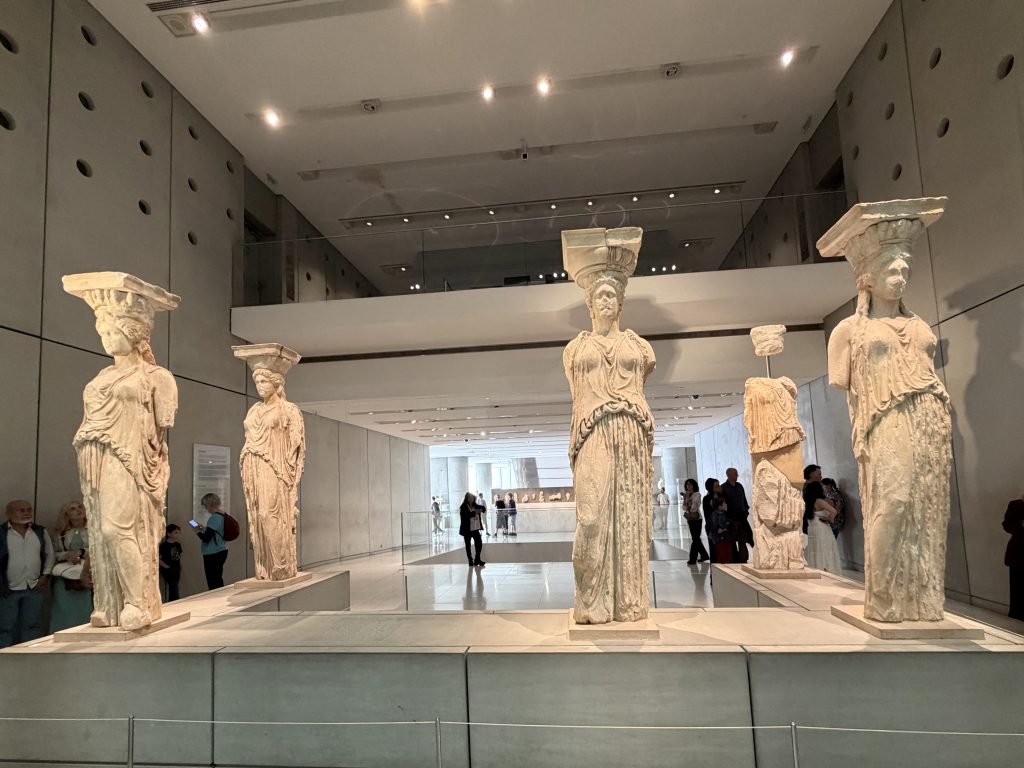
The top floor is set at the exact angle of the Parthenon, so you can look up at the temple itself while standing beside its sculptures. Gaps in the frieze mark the pieces removed to London in the early 1800s; they remain in the British Museum and are still a live controversy here (another point our guide returned to more than once).
LEGO Exhibition of The Acropolis
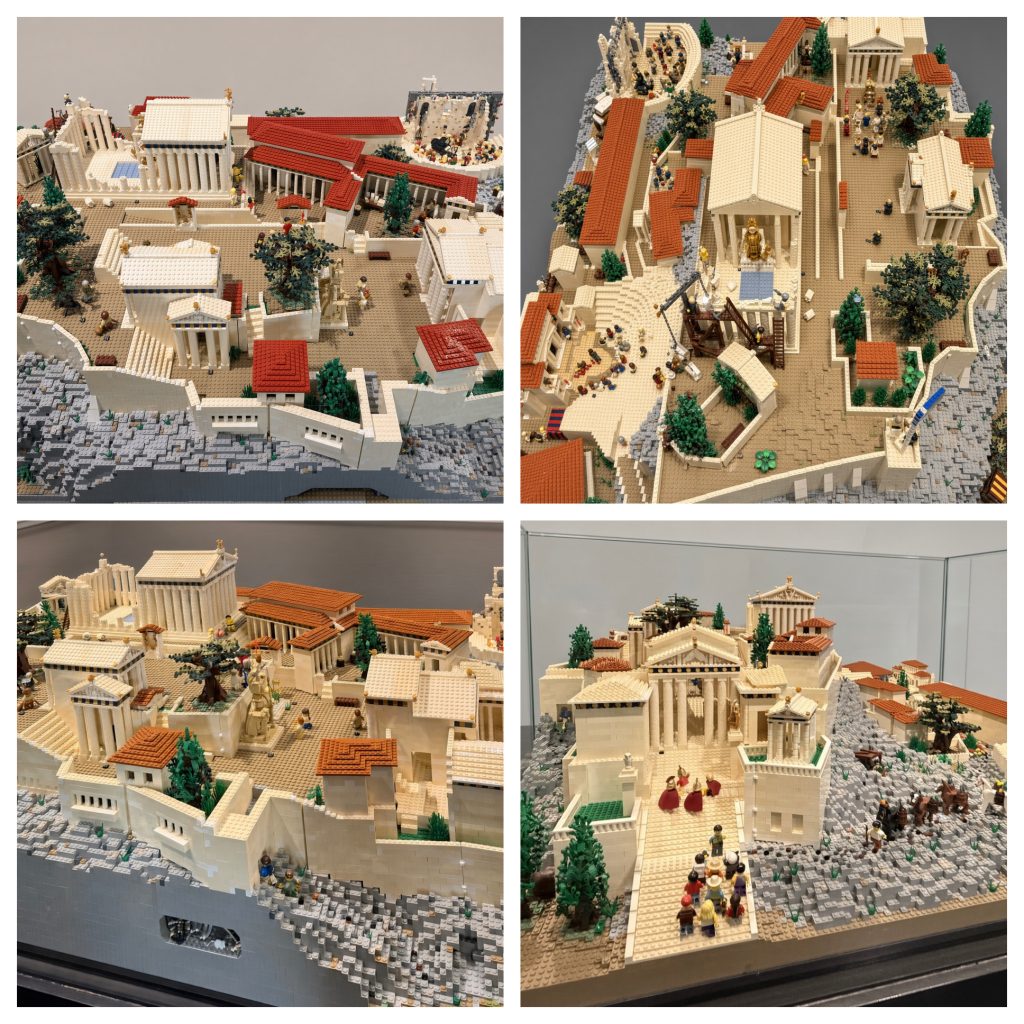
As we near the conclusion of our tour of the Acropolis Museum, the tour guide has escorted us over to a wonderful glass case which included a scaled mock up of the entire Acropolis complex, completed by an Australian group of school children entirely with Lego! Apparently it took them six months to build, and they provided it to the city of Athens, and it made its way to the museum. It was quite incredible to behold.
The forecast called for rain and we caught a light sprinkle early, but then the skies cleared and stayed dry all morning. Perfect weather.
GAGA GOOD

Lunch was a pleasant surprise: GAGA GOOD, a tiny Chinese place right behind the museum. Unexpected and excellent.
Day 3
Areopagus Hill
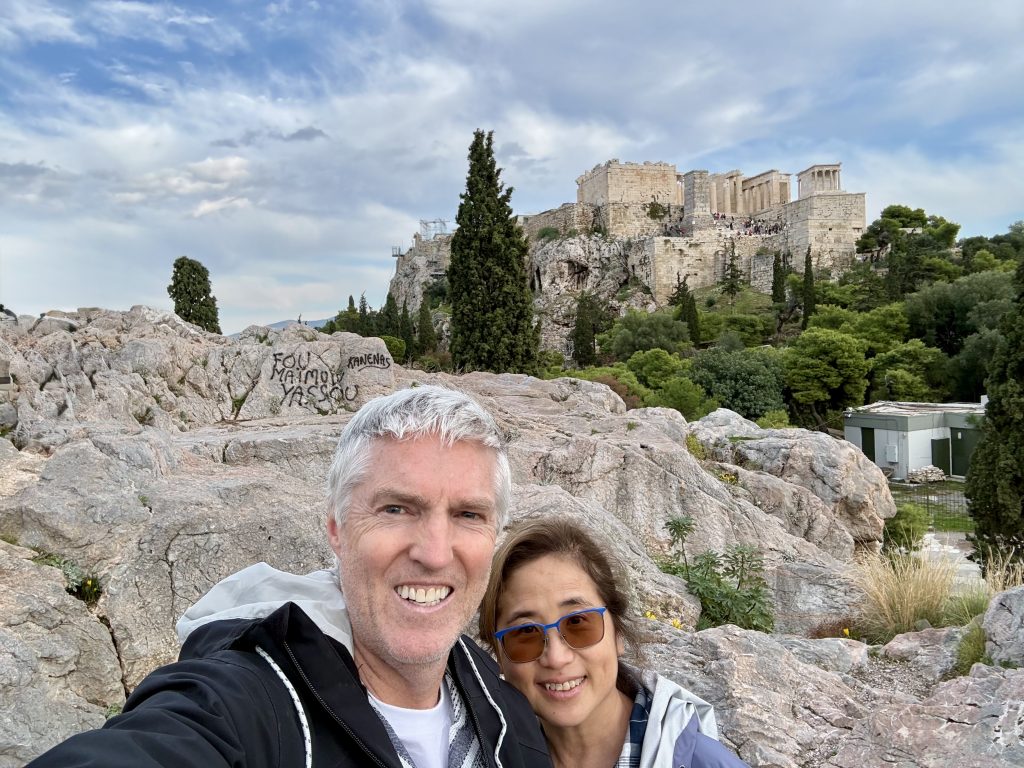
Also called Mars Hill, a bare rocky outcrop just below the Acropolis whose name means “Rock of Ares.” Myth says the gods held a trial for Ares here. In historical times it became the meeting place of Athens’ council of elders and its high court for murder cases—one of the earliest courts in the world.
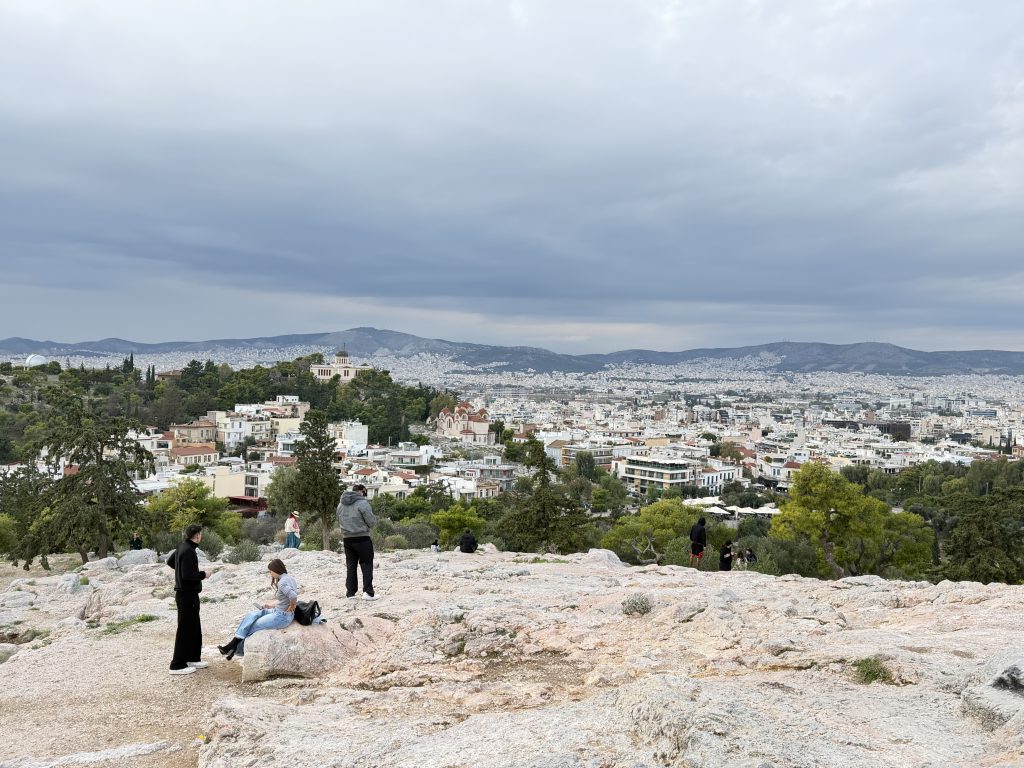
Around 51 AD the apostle Paul gave a famous speech here (Acts 17). He had noticed an altar in the city inscribed “To an Unknown God,” and he told the Athenians that this unknown God was the true Creator, who “does not live in temples made by human hands” (bold words with the Parthenon rising behind him). He quoted their own poets—“in him we live and move and have our being”—and called them to repent because of Jesus’ resurrection. Some scoffed, some wanted to hear more, and a few believed. A bronze plaque with the speech in Greek is set into the rock today. The view of the Acropolis from here is one of the best in the city.
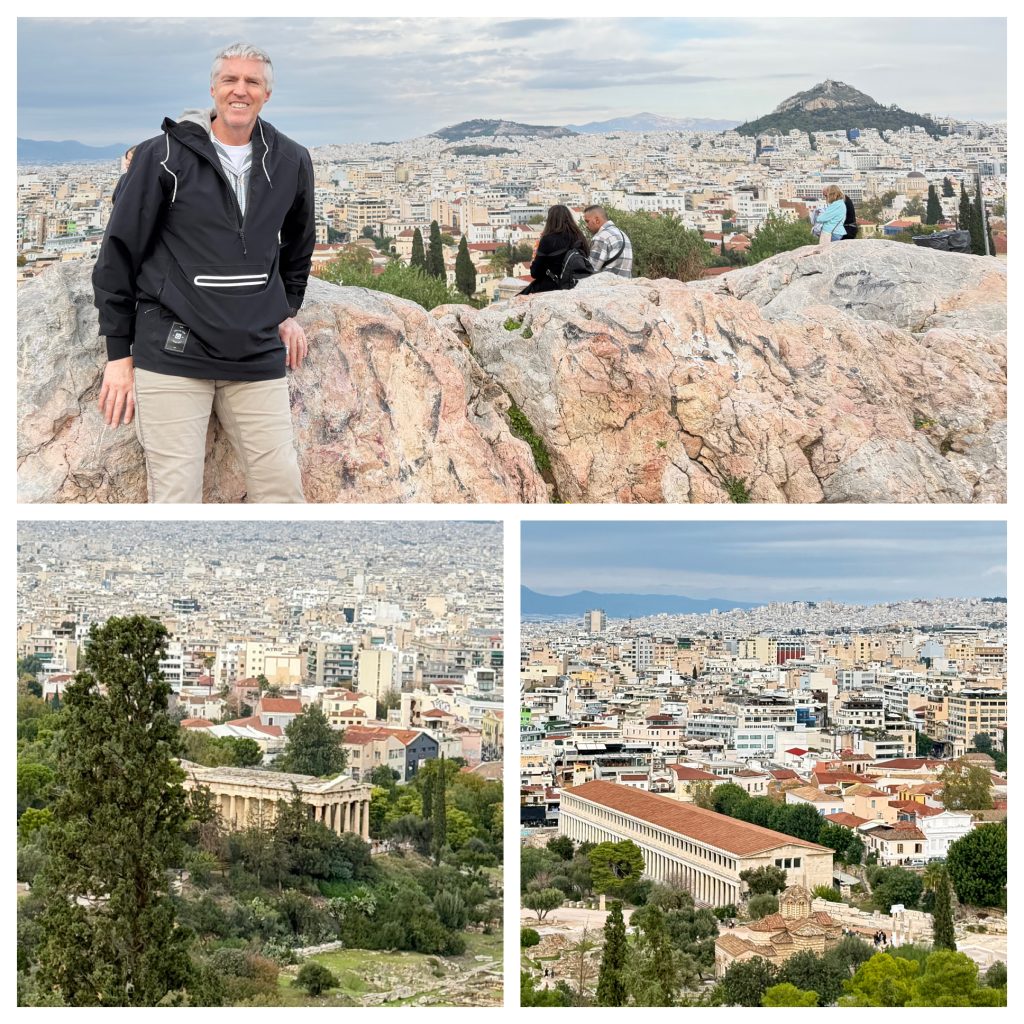
The Temple of Hephaestus stands out clearly on its own hill to the northwest, its full colonnade still intact, while farther north the remaining columns and Stoa of Attalos are also visible among the later buildings.
From there we walked down to the Ancient Agora, the heart of everyday life in ancient Athens for centuries. It was market, town hall, and courthouse all in one—the place where citizens shopped, argued, voted, and gossiped. This is where democracy played out after Cleisthenes’ reforms in 508 BC. Socrates spent his days here asking uncomfortable questions; he was tried and sentenced to death nearby in 399 BC.
Temple of Hephaestus
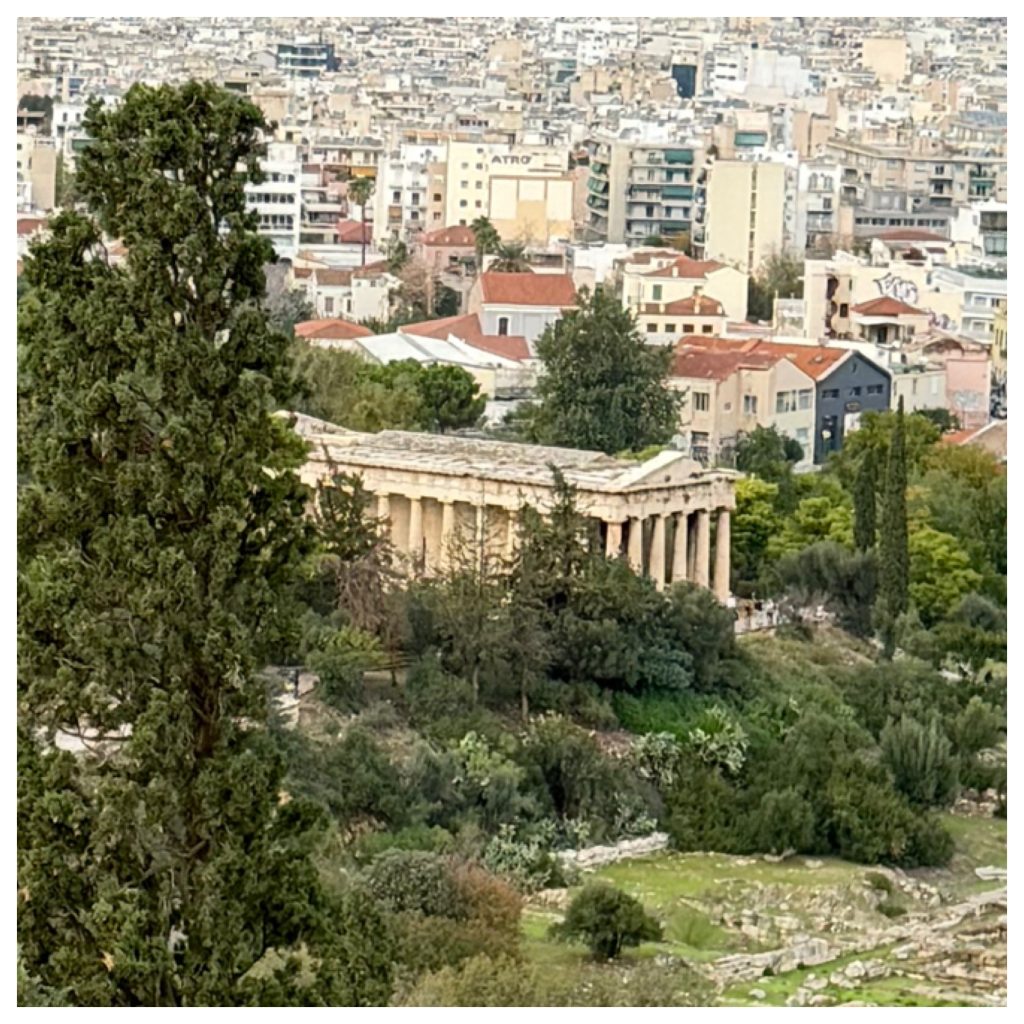
Built between about 449 and 415 BC in the Doric order, this temple was dedicated jointly to Hephaestus, god of metalworking, and Athena Ergane, patroness of crafts. It is the best-preserved ancient Greek temple in the world, with all thirty-four of its columns still standing. Its survival is due in part to its conversion into a Christian church in the seventh century, which protected the structure for centuries. From Mars Hill it appears almost complete, the pediment and entablature clearly readable against the trees of the Agora.
Church of the Holy Apostles
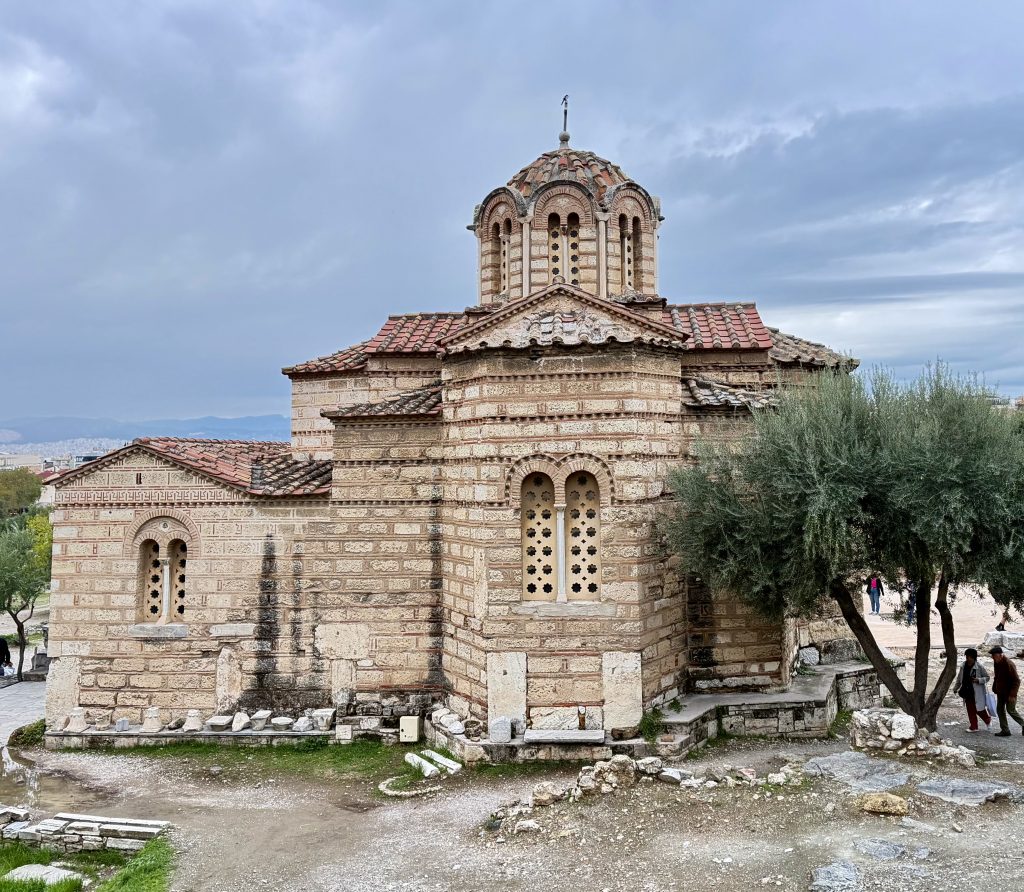
Walking down from Mars Hill we passed this small Byzantine church that sits within the Ancient Agora. Built in the tenth or eleventh century, it is one of the best-preserved Byzantine churches in Athens. Its central dome, brick-and-stone construction, and patterned arched windows are characteristic of the period. The building was carefully restored in the 1950s and remains a quiet presence among the classical ruins.
Ancient Agora
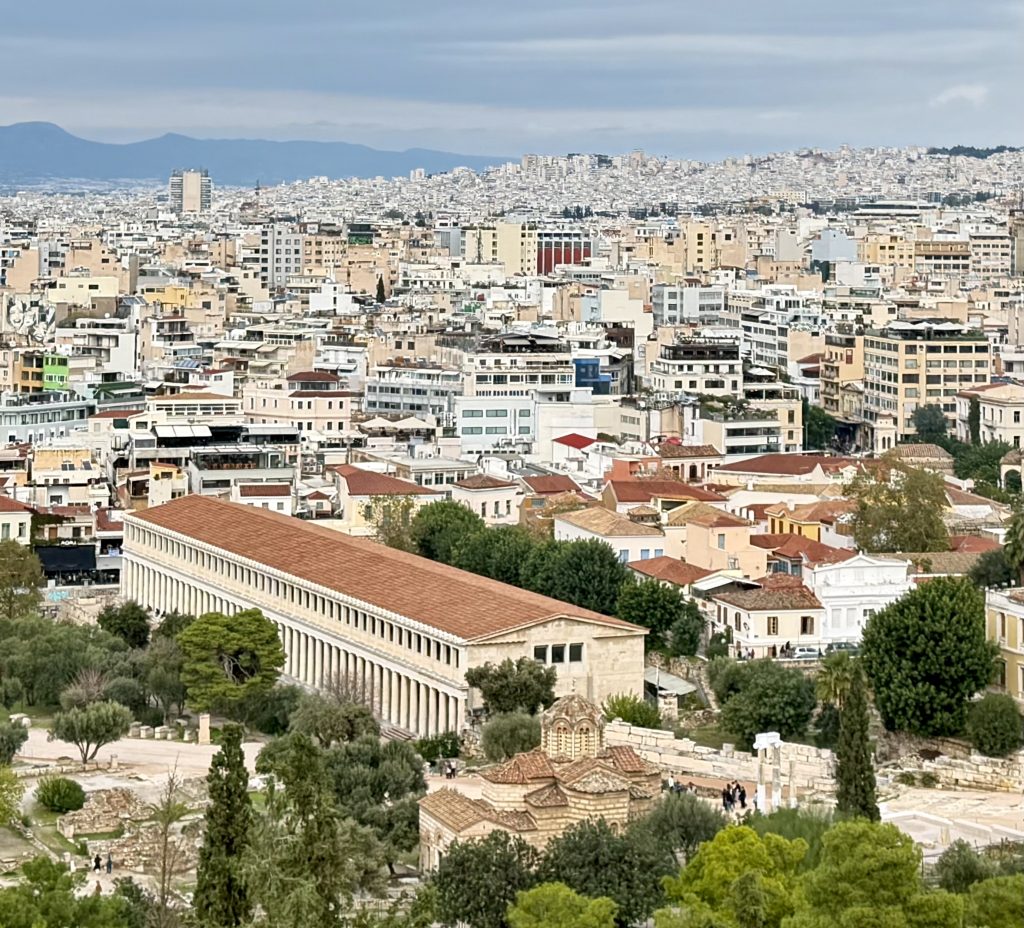
This was the civic and commercial heart of classical Athens, the place where citizens gathered for public business, philosophy, and daily trade. Excavations have revealed the foundations of stoas, temples, and administrative buildings spanning many centuries.
The reconstructed Stoa of Attalos now houses the site museum, while the open space of the Agora itself, with its scattered column drums and foundations, stretches between the Temple of Hephaestus and the church we had just passed.
From the elevation of Mars Hill the scale of the enclosure is apparent even though the interior layout is harder to read from a distance.
Roman Agora
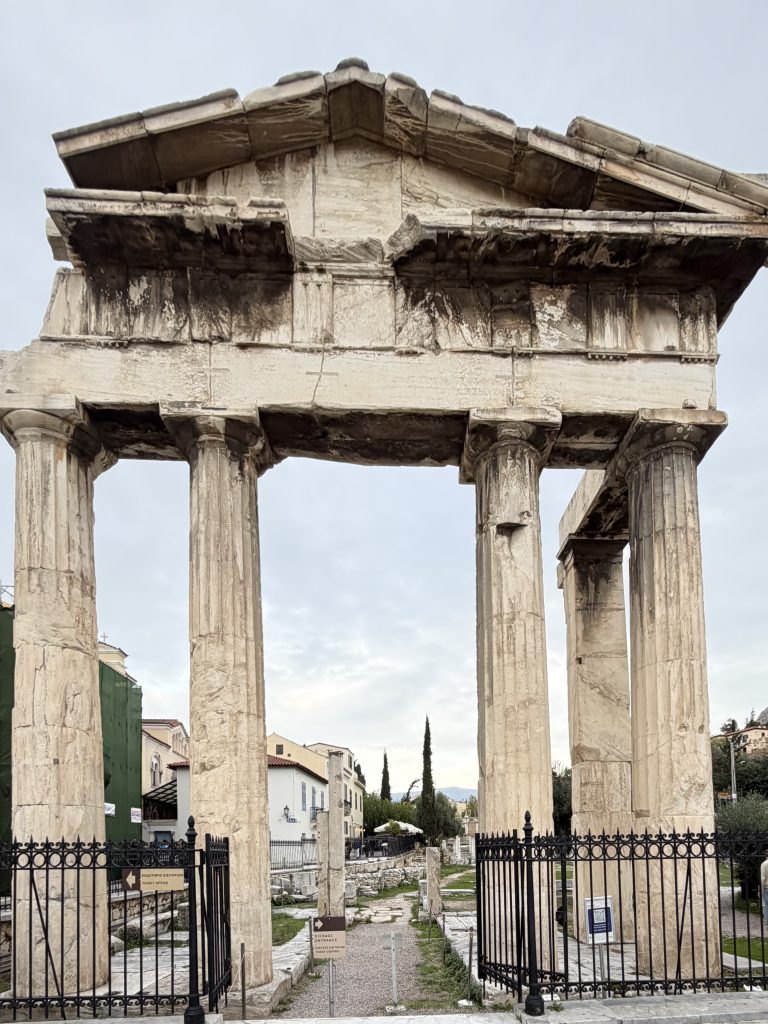
Immediately east of the Ancient Agora lies the Roman Agora, begun in the late first century BC under Julius Caesar and completed under Augustus. It served as the commercial marketplace of Roman Athens.
The surviving Gate of Athena Archegetis and the Tower of the Winds mark the site, the latter an octagonal marble structure that once housed a water clock and weather vane. Together with the nearby Library of Hadrian, it forms the Roman-period civic quarter that succeeded the older Greek agora.
Another great day. Athens delivered.
Day 4
Today, we visited Hadrian’s Library, Athens Flea Market, Stoa of Attalos, Ancient Agora, and had a wonderful lunch at a Greek Restaurant.
Hadrian’s Library
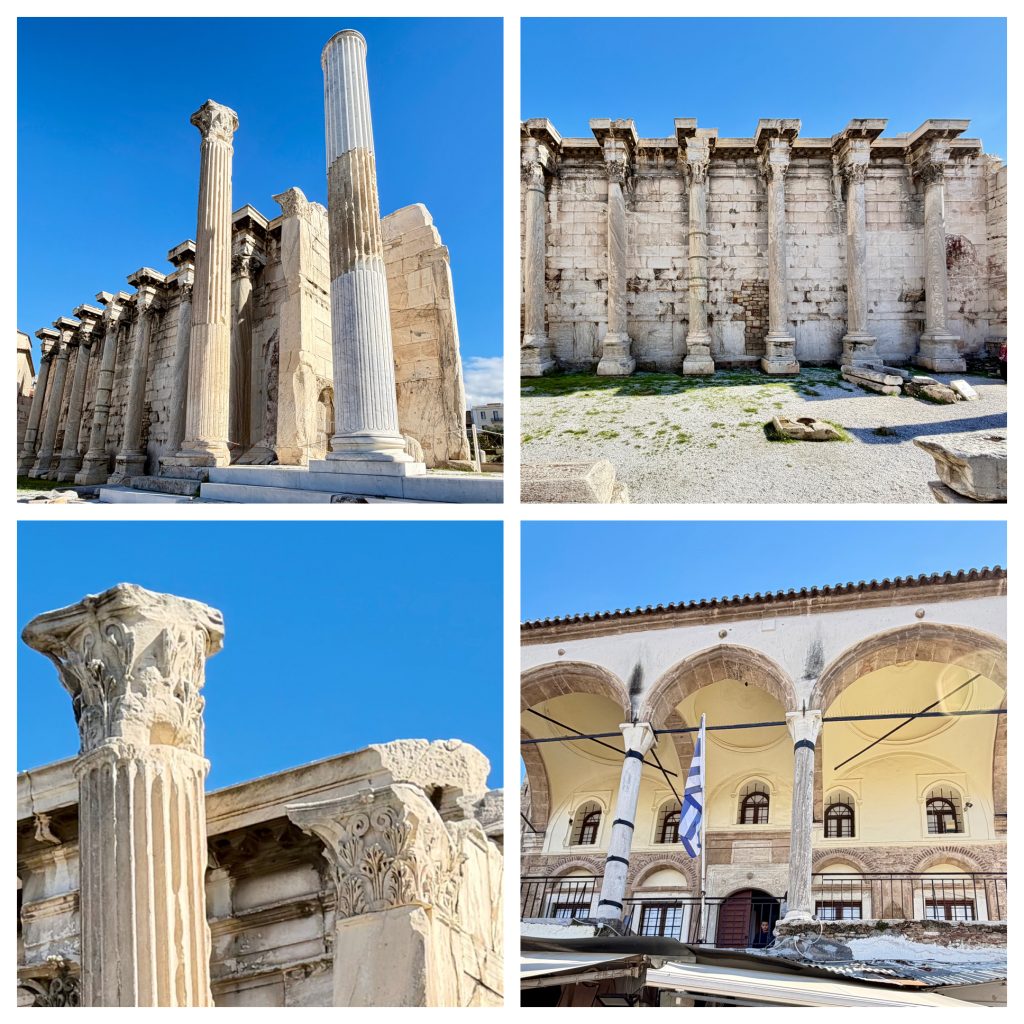
Constructed around 132 AD by the Roman emperor Hadrian, this large complex once contained a colonnaded courtyard with a long ornamental pool, reading rooms, and lecture halls. The surviving west façade with its tall Corinthian columns of Karystos marble is especially striking.
The site later held several Byzantine churches, including a tetraconch whose foundations remain inside the courtyard.
Stoa of Attalos in the Ancient Agora of Athens
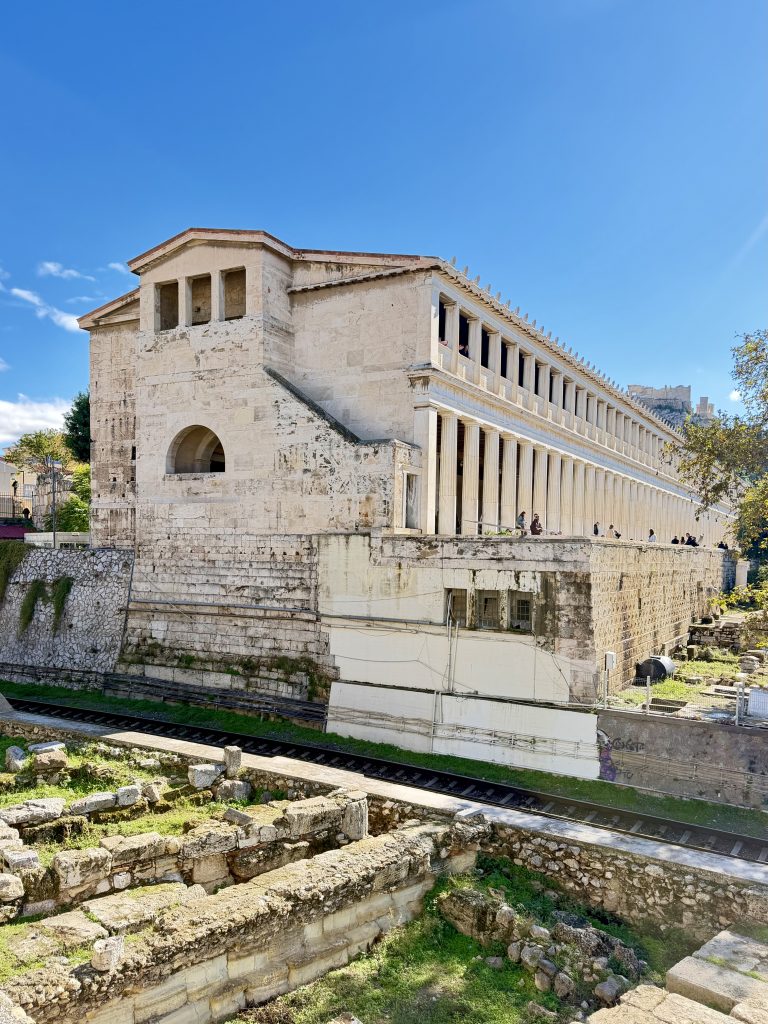
This long, two-story colonnaded building is the reconstructed Stoa of Attalos, built around 150 BCE by King Attalos II of Pergamon as a gift to Athens. It served as a covered walkway and commercial space with shops on both levels. Destroyed in the 3rd century CE, it was fully rebuilt in the 1950s and now houses the Museum of the Ancient Agora. The Acropolis is visible in the background, and the nearby railway tracks are a familiar feature of the site.
Places we couldn’t get to but on our list for next time:
Cape Sounion and Temple of Poseidon
Cape Sounion forms the southernmost tip of the Attica peninsula, about 70 km southeast of Athens. High cliffs rise roughly 60 meters above the Aegean Sea, and the site is dominated by the Temple of Poseidon, a Doric temple built around 444–440 BC during the Golden Age of Athens under Pericles, in the same period as the Parthenon. It replaced an earlier Archaic temple that was likely destroyed by the Persians around 480 BC.
Constructed of local white marble from the nearby Agrileza quarries, it originally had 34 columns—six across the short sides and thirteen along the long sides—of which about fifteen still stand. The design closely resembles the Temple of Hephaestus in Athens and may have been the work of the same architect. A large bronze cult statue of Poseidon, roughly six meters tall, once stood inside the cella.
Nearby are the remains of a fortified enclosure and a smaller Temple of Athena. Worship at the cape goes back centuries earlier, and the location served both as a religious sanctuary and a strategic landmark that guided sailors approaching Athens while inviting offerings to the god of the sea. After the Battle of Salamis the Athenians reportedly dedicated a captured Persian trireme here as a trophy to Poseidon.
According to legend, King Aegeus of Athens watched from these cliffs for the return of his son Theseus from Crete after the encounter with the Minotaur. Theseus had agreed to raise white sails if he succeeded and leave black sails if he failed; he forgot to change them, and Aegeus, seeing the black sails, threw himself into the sea in despair. The sea was thereafter called the Aegean in his memory.
In 1810–1811 the poet Lord Byron carved his name into the base of one of the columns during his Grand Tour; the inscription remains visible, though modern visitors are no longer permitted to add their own. Homer’s Odyssey mentions Sounion as the place where Menelaus’s helmsman Phrontis died and was buried while rounding the cape. The white marble columns were intended to be visible far out at sea, signaling to returning Athenian ships that they were nearing home.
The western exposure and open horizon make the site one of the most celebrated sunset viewpoints in mainland Greece, with the columns glowing gold before silhouetting against the sun and sea. Excavations have also yielded the Sounion Kouros, an Archaic statue now in the National Archaeological Museum, and fragments of the temple’s frieze depicting scenes such as the Centauromachy and the deeds of Theseus. The compact ruins, the cliff-top setting, the mythological associations, and the light at sunset are what make the place memorable.
Day 5
Returning back to the US! We left Athens on an 8 am Aegean air flight to Frankfurt which meant leaving the hotel at 5 am. Flight was smooth, but we only had an hour to connect in Frankfurt which was tight, different terminal and you have to clear immigration when leaving the EU so that took extra time. Got to our gate just in time as they were closing the gate but we managed to get on. Made us recall trips when Kevan was still united Global service level due to all his travel – one time we were late arriving and they whisked us off the plane and chauffeured us across the tarmac in a Maybach to our next flight! Monaco luck this time but we sure hit our steps in!