
 Swan Bradshaw
Warsaw here we come!
Brief History of Poland
Poland’s recorded history begins in 966, when Duke Mieszko I accepted Christianity and unified Slavic tribes into a recognizable state. His son, Bolesław I the Brave, became the first crowned king in 1025. After a long period of fragmentation, Casimir III the Great—the last king of the Piast dynasty, Poland’s first ruling dynasty—strengthened the realm in the 14th century.
In 1386 Poland entered a union with Lithuania through marriage. That partnership became the Polish-Lithuanian Commonwealth in 1569—one of Europe’s largest and most powerful states, famous for its elected kings and noble liberties. By the late 18th century internal weakness and pressure from neighbors led to three partitions (1772, 1793, 1795) by Russia, Prussia, and Austria. Independent Poland disappeared from the map for 123 years.
Poles kept national identity alive through language, the Catholic Church, and failed uprisings. After World War I, Poland regained independence in 1918. In 1939 Nazi Germany and the Soviet Union invaded, starting World War II; Poland suffered enormous losses, including the near-total destruction of its Jewish population. After 1945 it became a Soviet-aligned communist state.
The Solidarity movement of the 1980s helped end communist rule in 1989. Since then Poland has been a democracy, joined NATO (1999) and the EU (2004), and grown rapidly. Politics today swing between more liberal, pro-EU governments and conservative-national ones.
In short: a medieval kingdom that became a great power, vanished for more than a century, was reborn twice in the 20th century, and is now a mid-sized EU member with a strong sense of historical resilience
Interesting facts
• Poland adopted Europe’s first written constitution in 1791 (the second in the world after the U.S.). It lasted only about a year before the country was partitioned off the map for 123 years.
• Malbork Castle is the largest castle in the world by land area. The Teutonic Knights built it in the 13th century.
• Marie Curie (Maria Skłodowska) was born in Warsaw. She remains the only person to win Nobel Prizes in two different sciences. Nicolaus Copernicus, who argued the Earth orbits the Sun, was also Polish.
• Warsaw’s Old Town is a near-total reconstruction. The city was roughly 85–90% destroyed in World War II; the rebuilt historic center is now a UNESCO site.
• Europe’s heaviest land animal, the European bison (wisent), still lives in Białowieża Forest, one of the last fragments of primeval forest on the continent. Poland also hosts a large share of Europe’s white storks.
• The country has 17 UNESCO World Heritage Sites, including the Wieliczka Salt Mine (with an entire underground chapel carved from salt) and Auschwitz-Birkenau.
What to know before you visit
Entry and documents
U.S. citizens can stay visa-free for up to 90 days in any 180-day period in the Schengen Area. Your passport should be valid for at least three months beyond your planned departure from Schengen. Bring proof of onward travel and sufficient funds if asked. ETIAS authorization for non-EU visitors has been discussed for 2026—check official sources closer to your trip rather than unofficial sites.
Money
Poland 🇵🇱 uses the złoty (PLN), not the euro. Cards work almost everywhere in Warsaw and larger cities, but keep some cash for small shops, markets, or older establishments. ATMs are plentiful and reliable.
October weather in Warsaw
Expect highs around 50–55°F (10–13°C) and lows near 40°F (4–5°C), with a decent chance of rain and noticeably shorter days. Pack layers, a waterproof jacket, and comfortable walking shoes. Fall color in parks like Łazienki is often at its peak in early-to-mid October.
Getting around
Trains are excellent and reasonably priced—use the PKP Intercity app or website for Warsaw–Kraków or other routes. Warsaw itself has an easy metro, tram, and bus system; a multi-day pass is cheap. Uber and Bolt work well.
Food and drink
Pierogi (dumplings with savory or sweet fillings), bigos (hunter’s stew), żurek (sour rye soup), and gołąbki (cabbage rolls) are everyday staples. “Milk bars” (bar mleczny) serve traditional, inexpensive meals. Vodka is culturally important; if you’re offered a shot, the toast is “Na zdrowie.” Tap water is safe in cities, though restaurants rarely serve it.
Etiquette
A firm handshake and eye contact are standard greetings. In someone’s home, offer to remove your shoes. If you bring flowers, an odd number is the custom (even numbers are associated with funerals). Dress modestly in churches. Tipping 10–15% is normal in restaurants when service is good. Poles tend to be reserved at first and then very hospitable.
Safety and practicalities
Poland is generally very safe. Watch for pickpockets in crowded tourist spots and on public transport, the same as in any European capital. Public drinking is restricted. English is widely spoken in Warsaw, Kraków, and other tourist areas; a few Polish phrases (“Dzień dobry,” “Dziękuję,” “Proszę”) are appreciated.
Day 1
Arrived in Warsaw at the Warsaw Chopin Airport (Polish: Lotnisko Chopina w Warszawie).
People here smoke a lot, wearing a mask may not be a bad idea to filter out the smell.
We took the UBER to the hotel, about 35 mins.
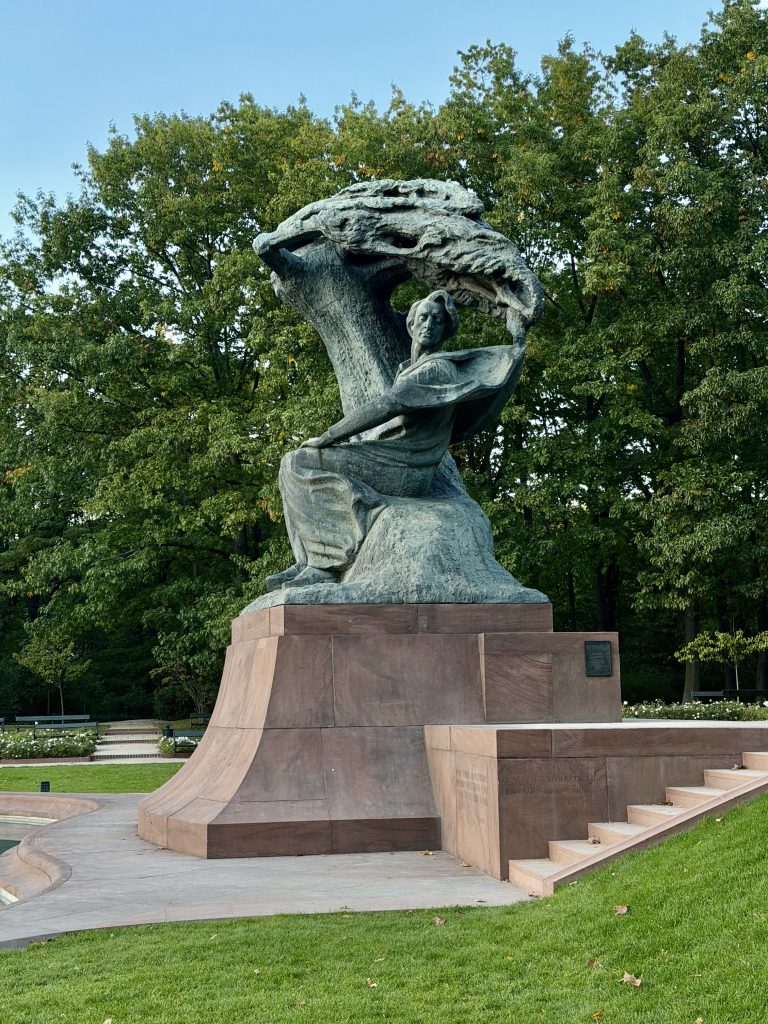
Checked into Hotel Bristol, we then visited Łazienki Park. We went through the Palace on the Isle where we visited the ballroom, Solomon room, the old bath house (a tradition left behind by the Ottomans), then walked all over the majestic grounds — Mallards on the water, and a beautiful male Mandarin duck with a reddish bill, red squirrels in the trees, and some humongous fish! Also saw the Myślewicki Palace, the old Orangery, Chopin monument, the Chinese garden, and the other palace buildings along the various paths. Really a great place to walk around, lots of people just jogging and strolling and enjoying the grounds.
Our Poland stay is off to a great start, I am impressed by the cleanliness of the city and the beautiful architecture. Lots of energy here. To be honest, I arrived not expecting to be wowed by the cuisine choices but so far it’s been pretty good!
The Royal Route
Hotel Bristol
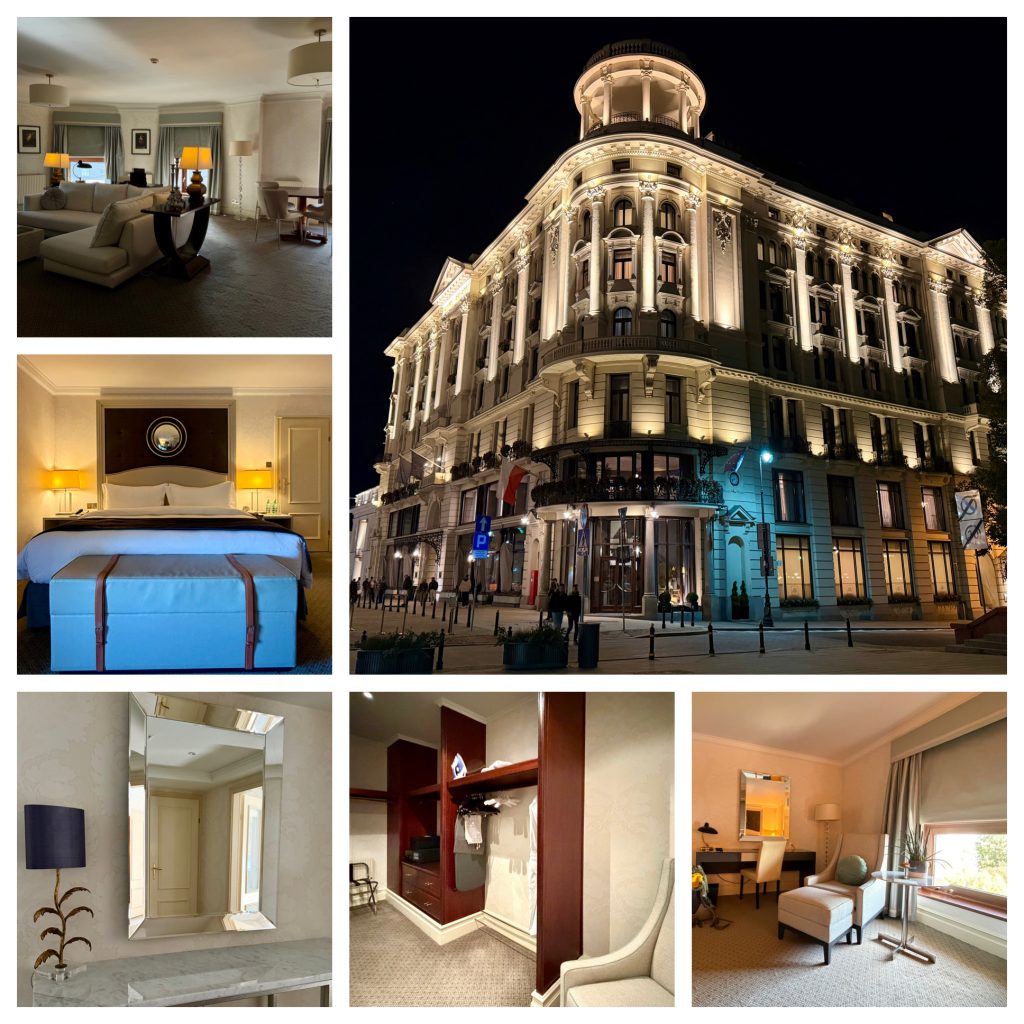
Hotel Bristol is a Marriott Luxury Collection Hotel on Krakowskie Przedmieście (the Royal Route), next to the Presidential Palace and about an 8–10 minute walk from Old Town and Castle Square. It is a 1901 neo-Renaissance building in a great location, one of the few grand buildings that survived WWII. Art Nouveau Column Bar is
Parks and palaces
Łazienki Park
Warsaw’s finest palace-and-garden park: 76 hectares of lakes, bridges, peacocks, and neoclassical buildings. The centerpiece is the Palace on the Isle, sitting in the water. Grounds are free and open until 21:00; interiors have ticketed hours. In early October the trees turn gold and the palace reflection at dusk is the main reason to go.
Best green space in the city. Outdoor Chopin concerts in warmer months; October is quieter for walking. Easy continuation south along Nowy Świat.
Palace on the Isle
Enter via the nearest gate (Agrykola / Łazienki Królewskie bus stop side is usually fastest). Walk directly to the Palace on the Isle (Pałac na Wyspie). Buy tickets at the on-site desk or machine if you haven’t already. Last entry is typically 17:30.
Palace on the Isle interior
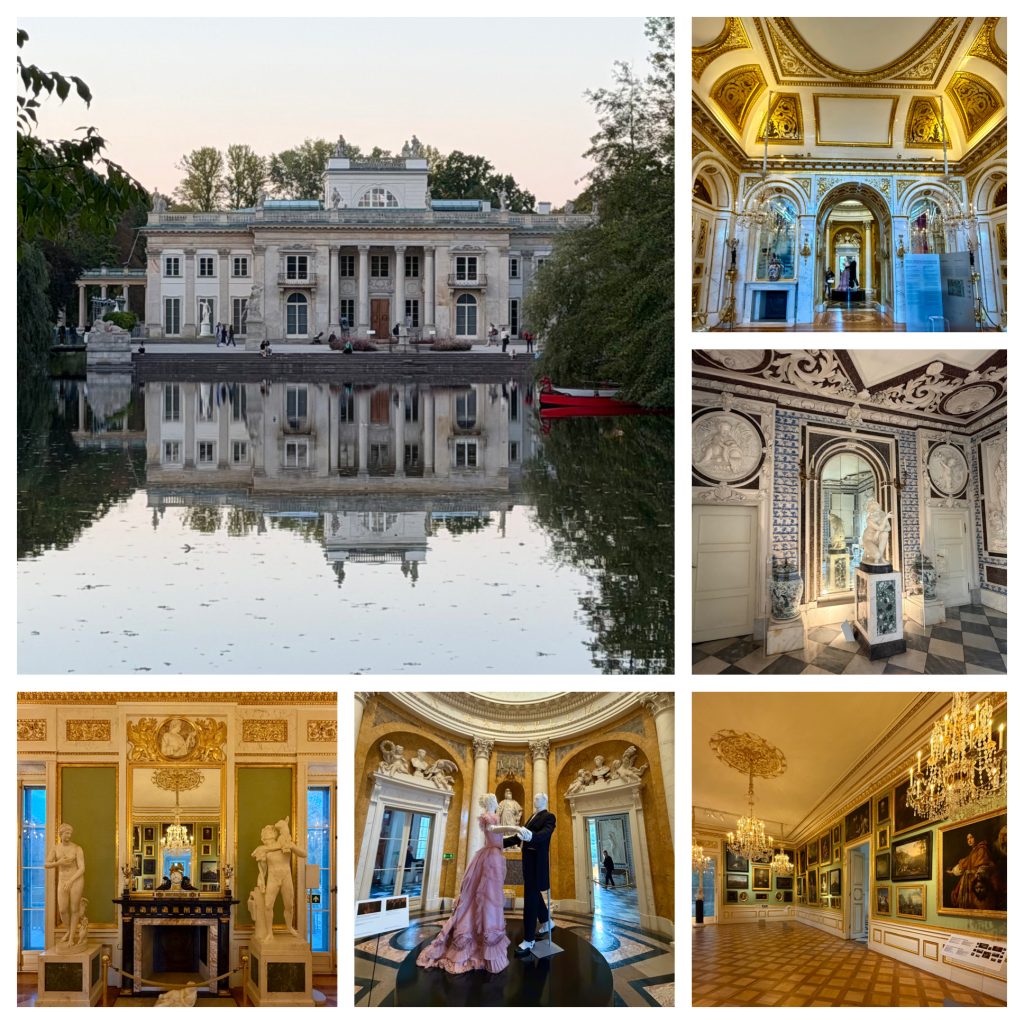
This is the one structure worth prioritizing. You’ll see the ballroom, Solomon Room, and the neoclassical rooms that sit right on the water. It’s a short visit (30–40 minutes is enough). You’re inside during the last light of the day, which looks good from the windows onto the lake.
If the queue is long or you miss last entry, skip the interior and spend the same time photographing the palace from the bridges and the far bank — the exterior + reflection is the postcard shot anyway.
Lake circuit and Chopin Monument
Old Orangery (Stara Pomarańczarnia)
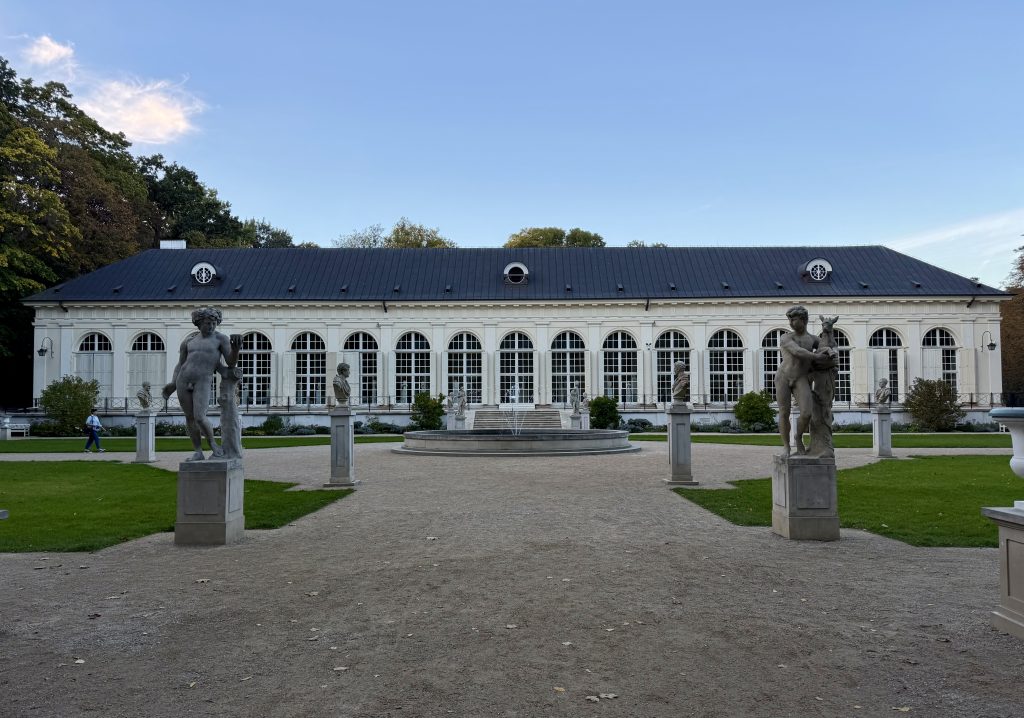
It is on similar Thursday hours and is included with some palace tickets.
Amphitheatre
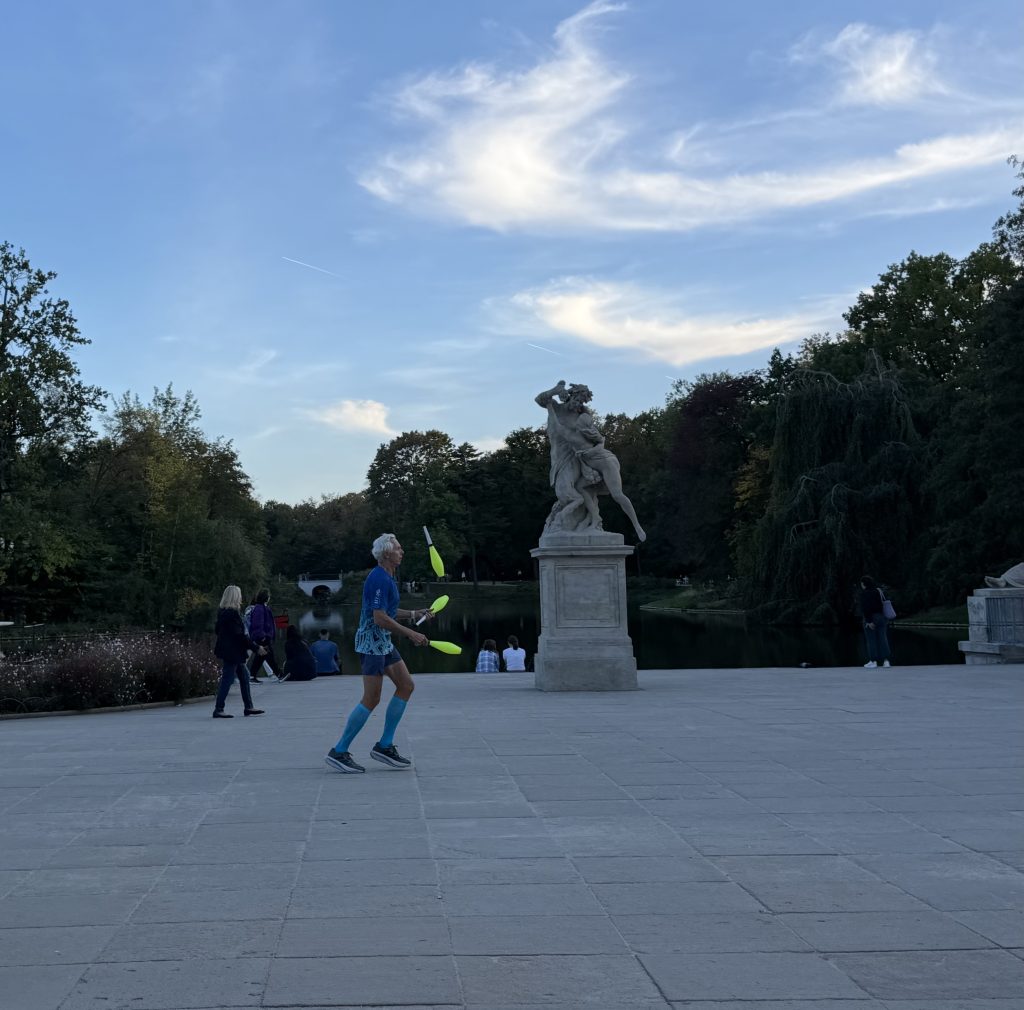
Łazienki Park was beautiful in the good weather, with fine scenery around the ponds and paths. Plenty of people were out cycling and jogging. One man jogged past while juggling three pins. Along the water we saw several kinds of ducks and fish, and red squirrels in the grass and trees.
Red Squirrels
Man Juggling While Jogging
Dinner at Bistro Spartit
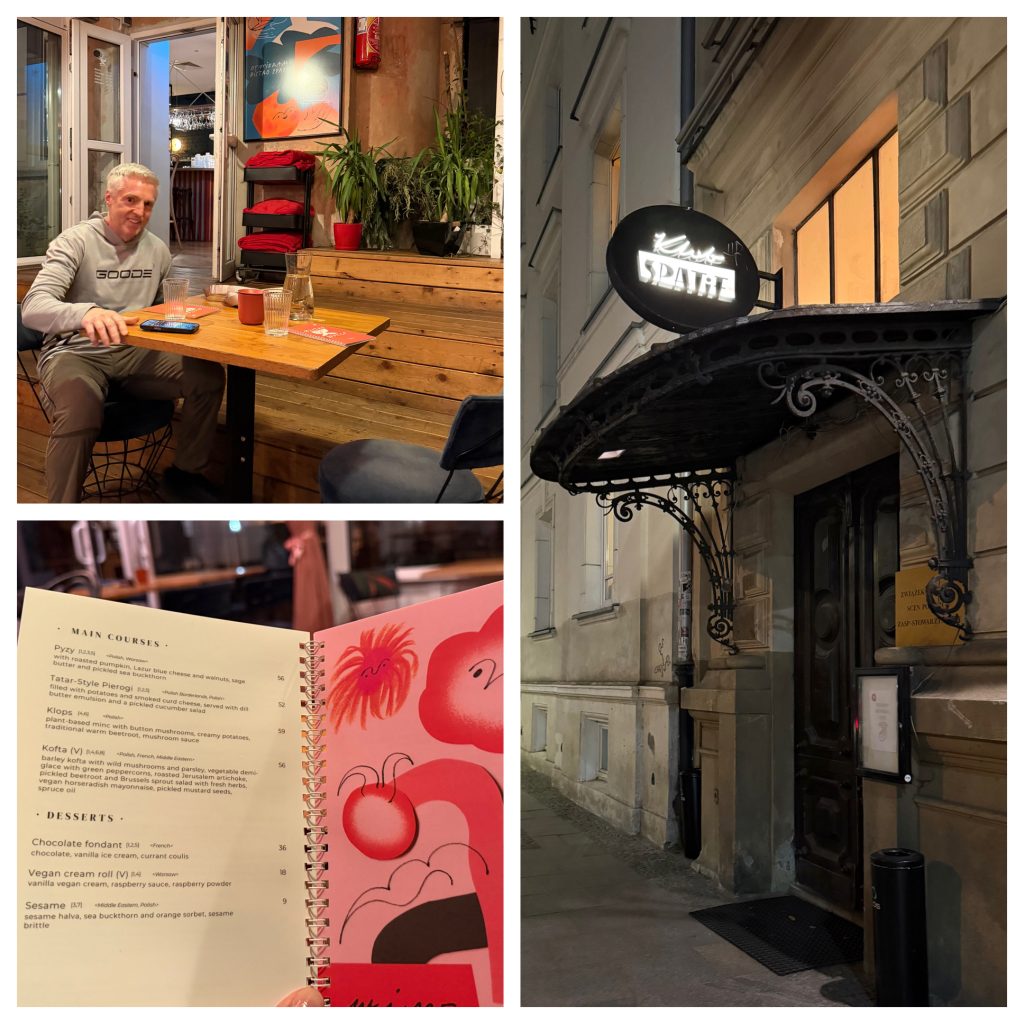
Our first meal in Warsaw was at the Bistro SPATiF, a small restaurant tucked in the back of a club which is apparently the old artists’ club on Aleje Ujazdowskie, about halfway between the Palace on the Isle and the hotel Bristol. The club was a writers’ and actors’ hangout for decades. The bistro is the quieter room behind it: short menu but it turned out to be quite the lucky find.
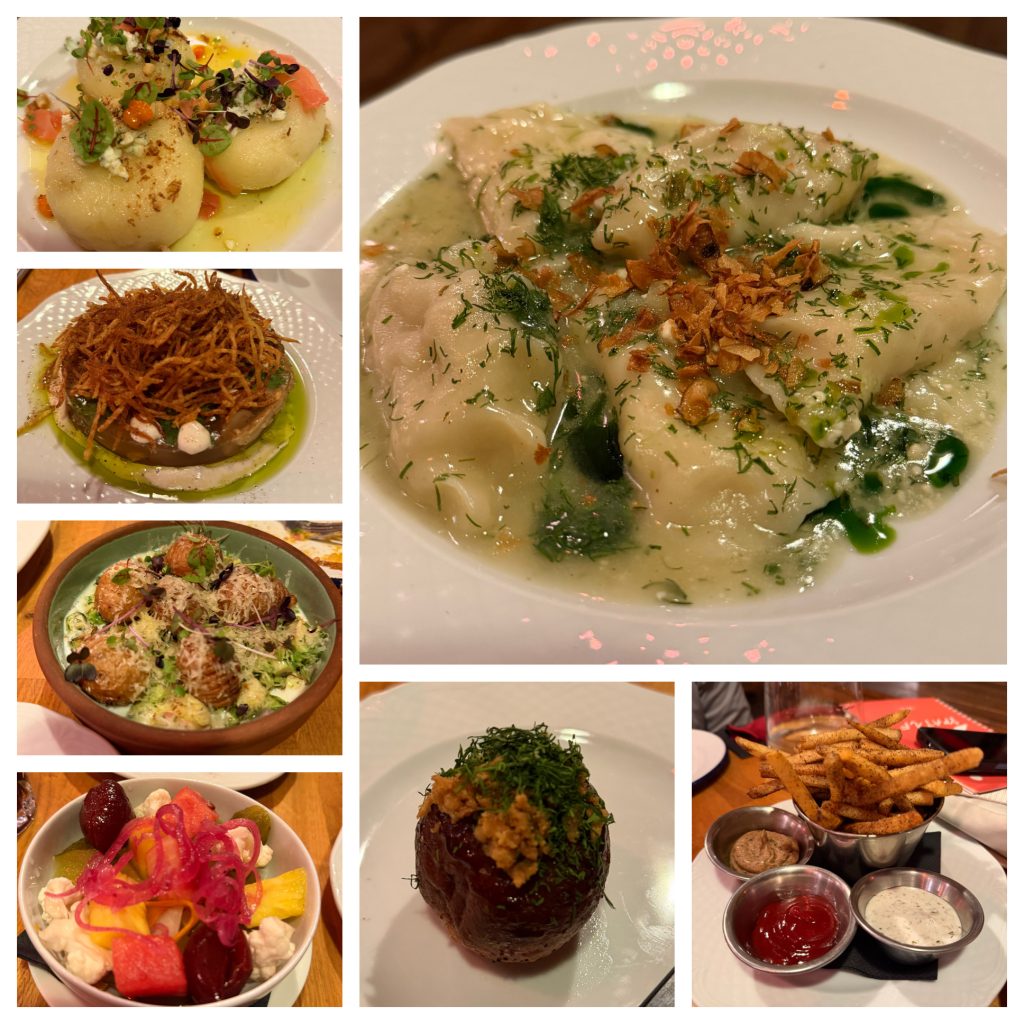
Warsaw cuisine on small plates. We had Hasselback potatoes (ziemniaki wachlarzowe), a savory potato doughnut with poppy seed (pączek ziemniaczany), wild forest mushrooms (grzyby leśne), potato dumplings with pumpkin (pyzy), Tatar-style pierogi, and fries with a wild-mushroom mayonnaise.
Polish at the center, with the Jewish and borderland threads this kitchen likes to pull in. A very good start to our stay!Dinner was My favorite was French fries with mushroom seasoning. Three homemade sauces namely mushroom mayonnaise, ketchup, and tartar sauce were served. The mushroom sauce was heavenly!
After dinner, we walked back to the hotel and came across these amazing structures…
Nicolaus Copernicus Momument
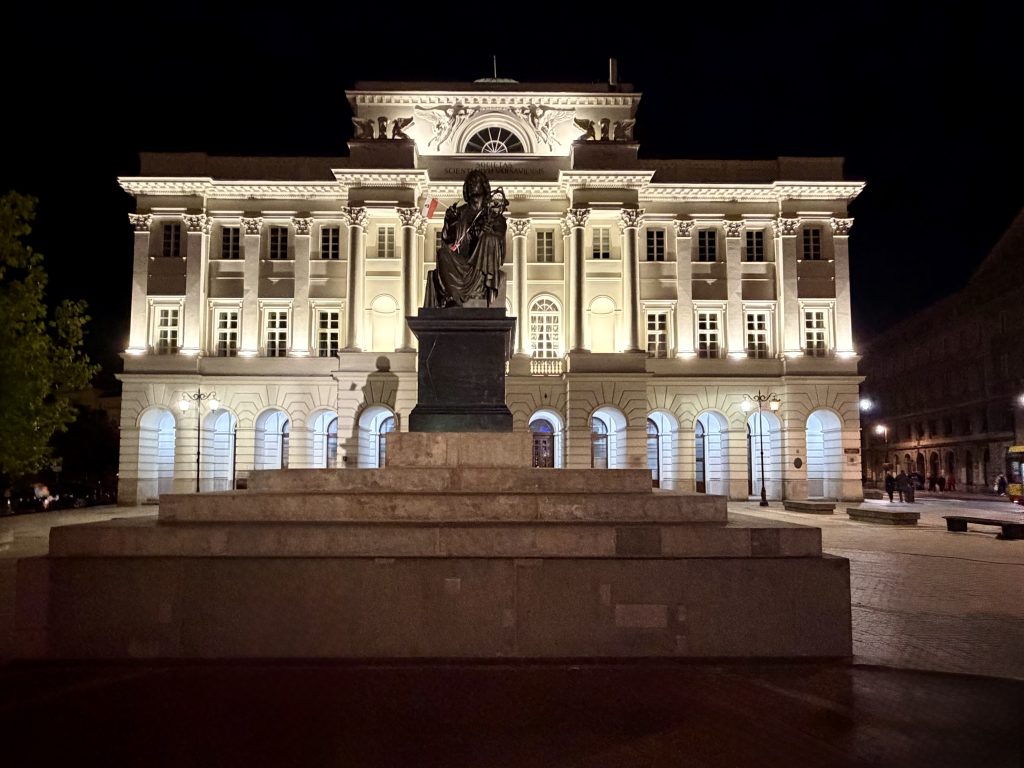
The Nicolaus Copernicus monument stands on Krakowskie Przedmieście in front of the Staszic Palace, now home to the Polish Academy of Sciences.
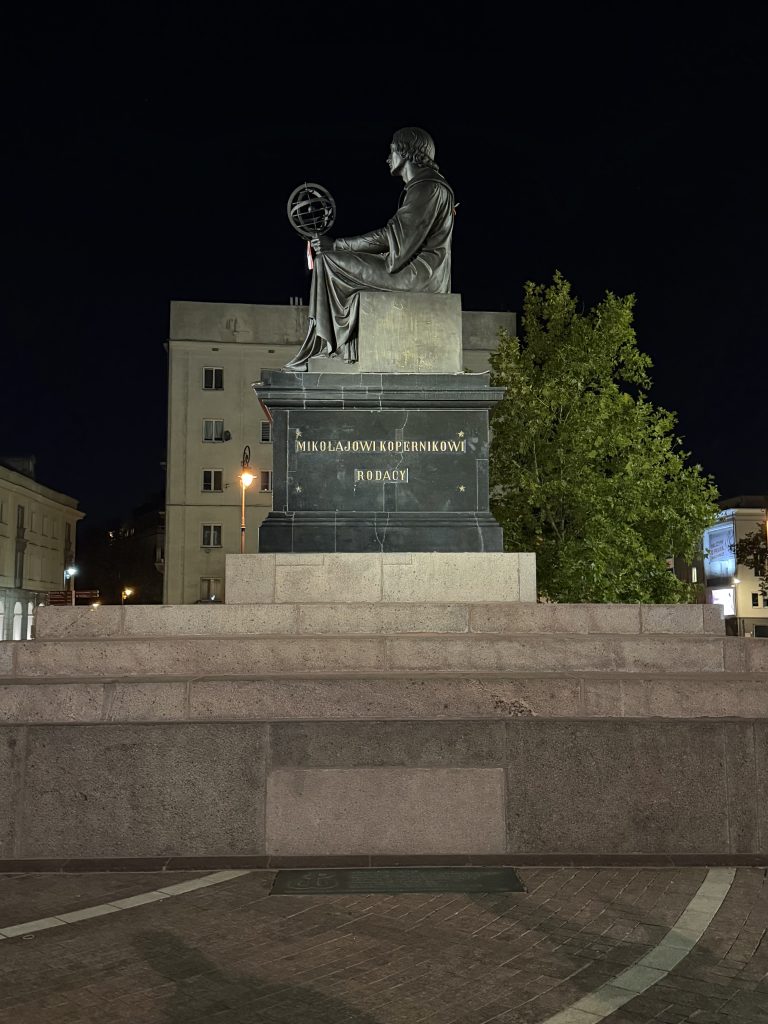
Bertel Thorvaldsen designed the bronze seated figure, holding a compass and an armillary sphere, and it was unveiled in 1830 after a public subscription begun by Stanisław Staszic. The Nazis took it down in World War II; it was recovered and put back in 1949. The pedestal reads, in Latin and Polish, “To Nicolaus Copernicus, from his compatriots.”
The Visitationist Church
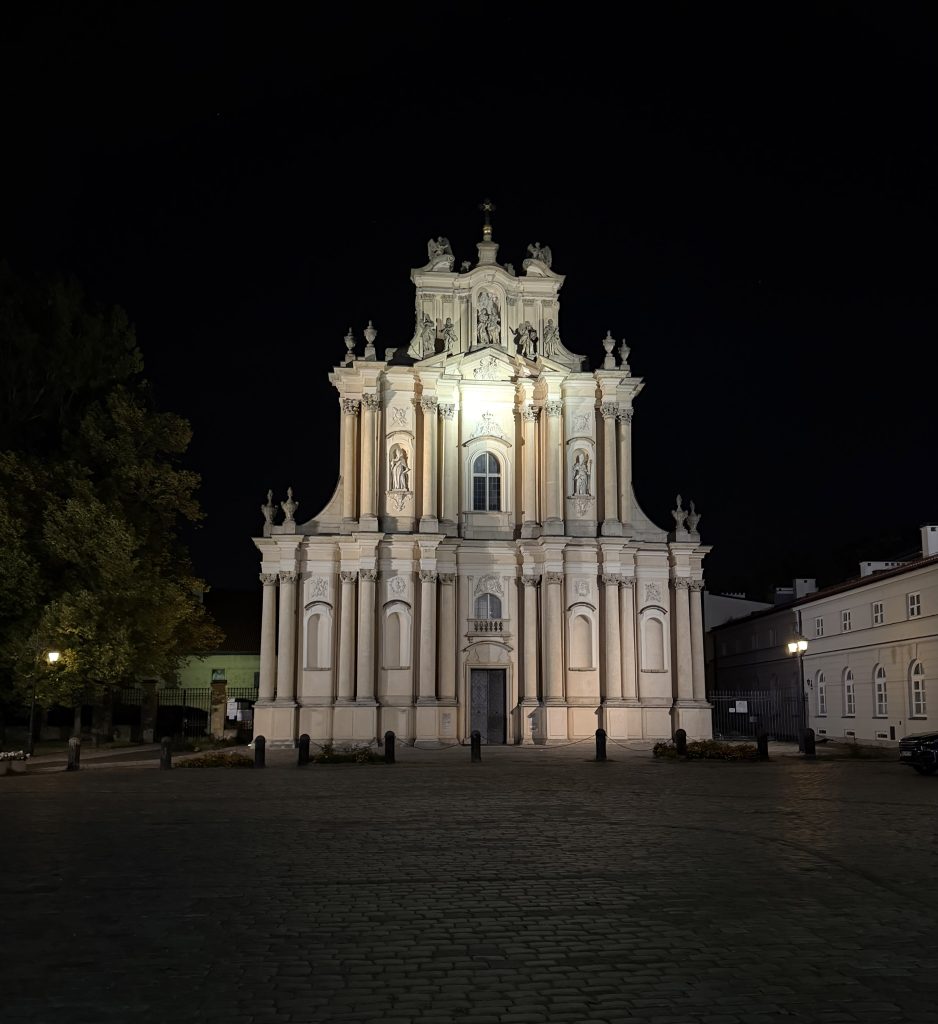
It was built from 1728 to 1765, is one of Warsaw’s finest late-Baroque facades, with a rippling wall, paired columns, and a crowning Visitation scene. It survived the Second World War largely intact. Fryderyk Chopin played the organ here as a boy.
The Holy Cross Church
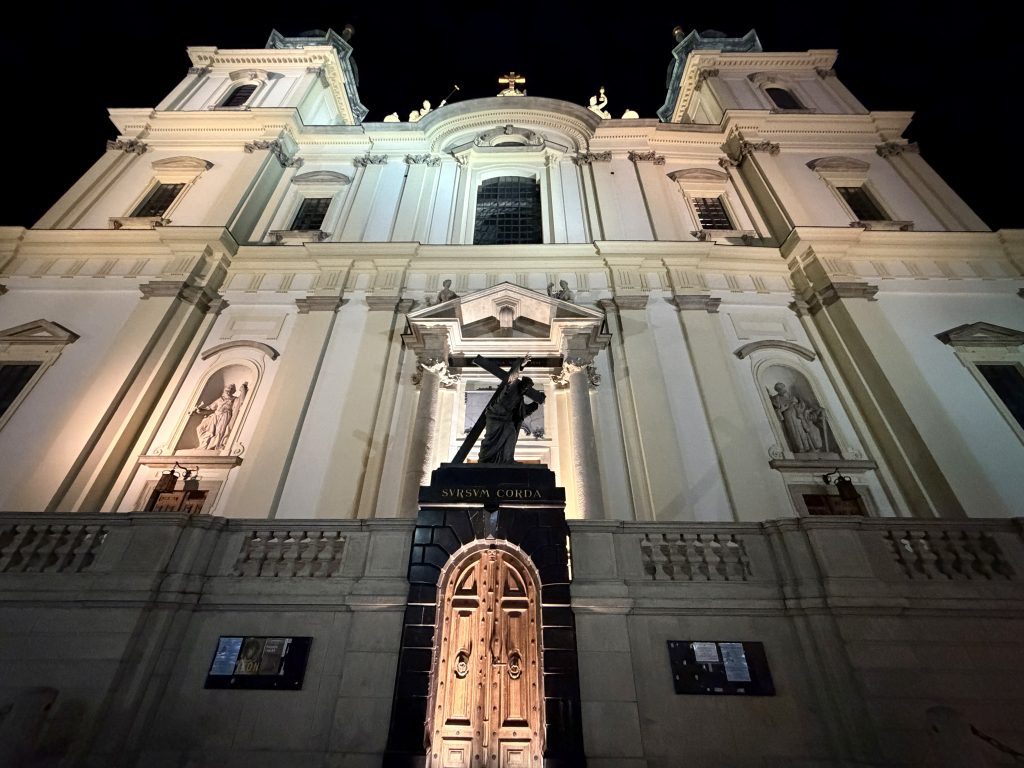
This is the Holy Cross Church (Kościół św. Krzyża) on Krakowskie Przedmieście in Warsaw, a short walk from the Visitationist Church.
The figure over the door is Christ carrying the cross, set on a pedestal inscribed SVRSVM CORDA — “Lift up your hearts.” Andrzej Pruszyński carved it; it was placed here in 1858. The late-Baroque church itself, with its twin towers, was built from 1679 to 1696 and later rebuilt after wartime damage.
It is best known as the resting place of Fryderyk Chopin’s heart. At his request it was brought from Paris and sealed in a pillar in the left nave; the urn is marked by a plaque.
University of Warsaw
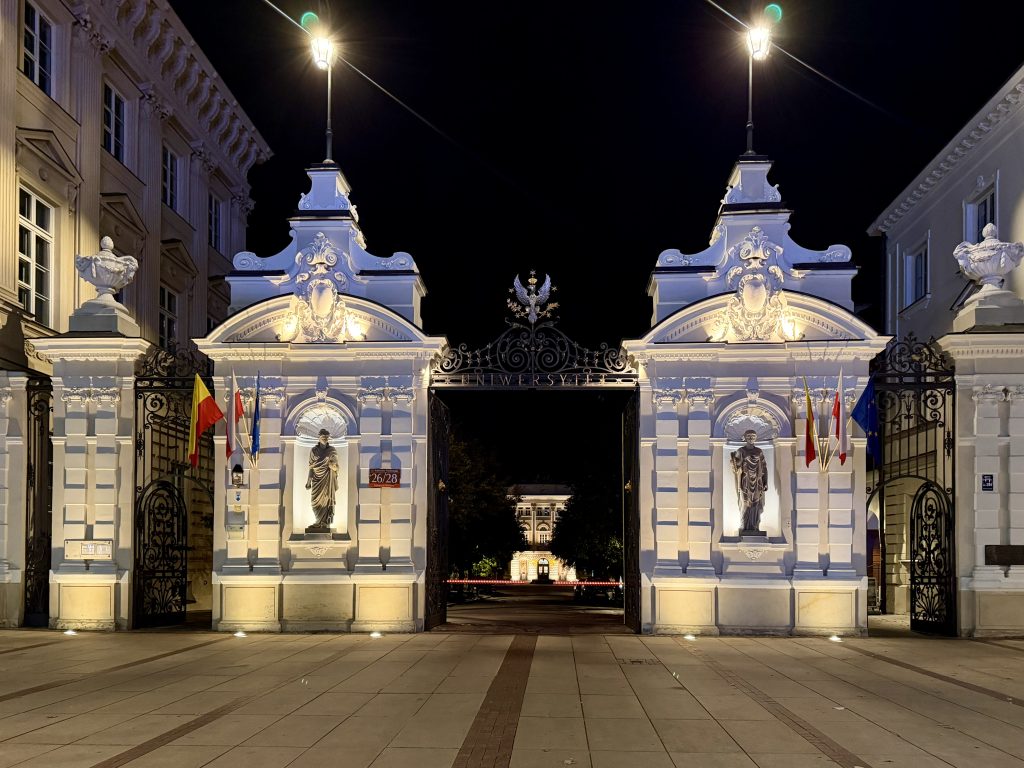
The University of Warsaw, founded in 1816, is Poland’s largest university. Its main campus runs along Krakowskie Przedmieście, between the Visitationist Church and the Holy Cross Church, with the old Kazimierz Palace at its center and the main gate opening onto the Royal Route. The Warsaw Lyceum, where the young Chopin studied, was housed in that palace.
Wilanów Palace.
Baroque palace on the south edge of town—sometimes called the Polish Versailles. Half-day trip, not a walk from the Old Town. We skipped!
Day 2
We started with breakfast at the Hotel Bristol on Krakowskie Przedmieście — a full buffet, plus eggs Benedict, Turkish eggs, and two Greek yogurt, berry, and granola bowls. Hard to imagine a better start.
The Bristol opened in 1901, backed in part by pianist and statesman Ignacy Paderewski, and it is one of the few landmarks on this stretch that came through the war with its walls still standing.
From there we walked the Royal Route toward the Old Town – passed the Presidential Palace next door, the University, Holy Cross Church (where Chopin’s heart rests in a pillar), and the Copernicus monument, the Res Sacra Miser chapel, on to Castle Square and Sigismund’s Column.
Presidential Palace
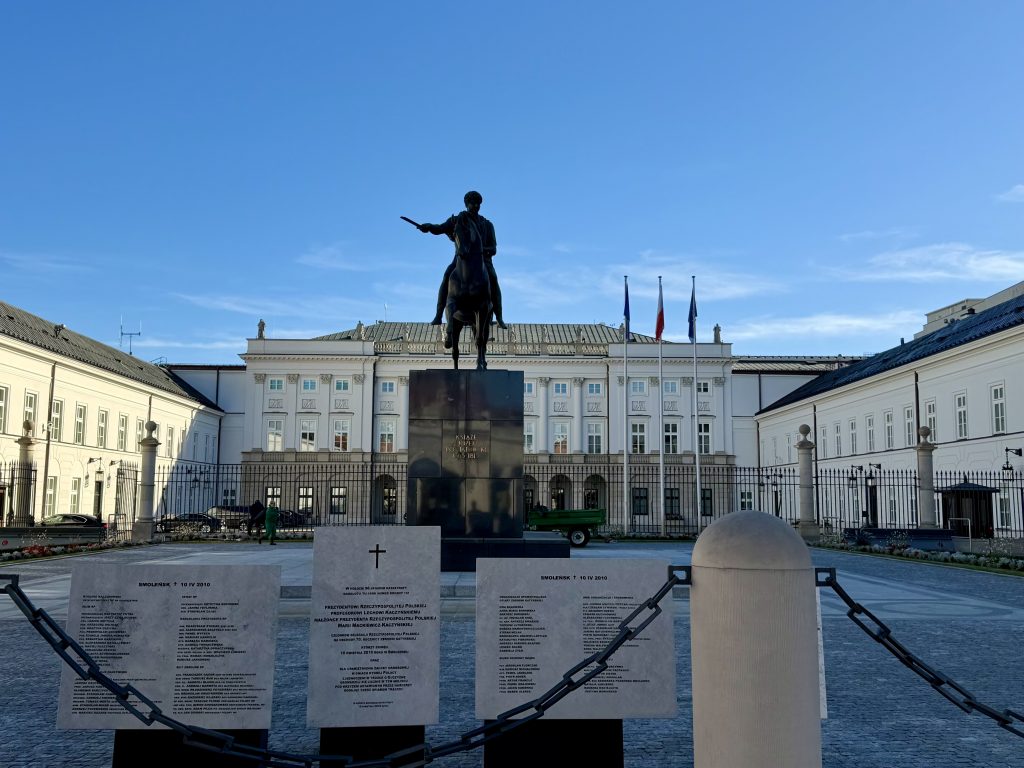
The courtyard side of the Presidential Palace, seen from Krakowskie Przedmieście. In front of the fence is Bertel Thorvaldsen’s equestrian bronze of Prince Józef Poniatowski, nephew of the last king and a Napoleonic marshal killed at Leipzig in 1813. The statue was cast in 1832 and set here in 1965.
The three stone tablets in the foreground are the Smolensk memorial. They name the 96 people killed when the Polish Air Force Tu-154 crashed near Smolensk on 10 April 2010, including President Lech Kaczyński and his wife, Maria Kaczyńska.
The building began in 1643 as a residence for Crown Hetman Stanisław Koniecpolski, later passed to the Radziwiłł family, and was rebuilt in its present form in 1818–19 for the Russian viceroy of the Kingdom of Poland. After independence it housed the Council of Ministers. In 1994 it became the president’s official seat, taking that role from the Belweder.
Unlike most of this street, the walls came through 1944. The interior burned in 1939 and again in the Uprising; the shell was restored between 1947 and 1952.
The Holy Cross Church
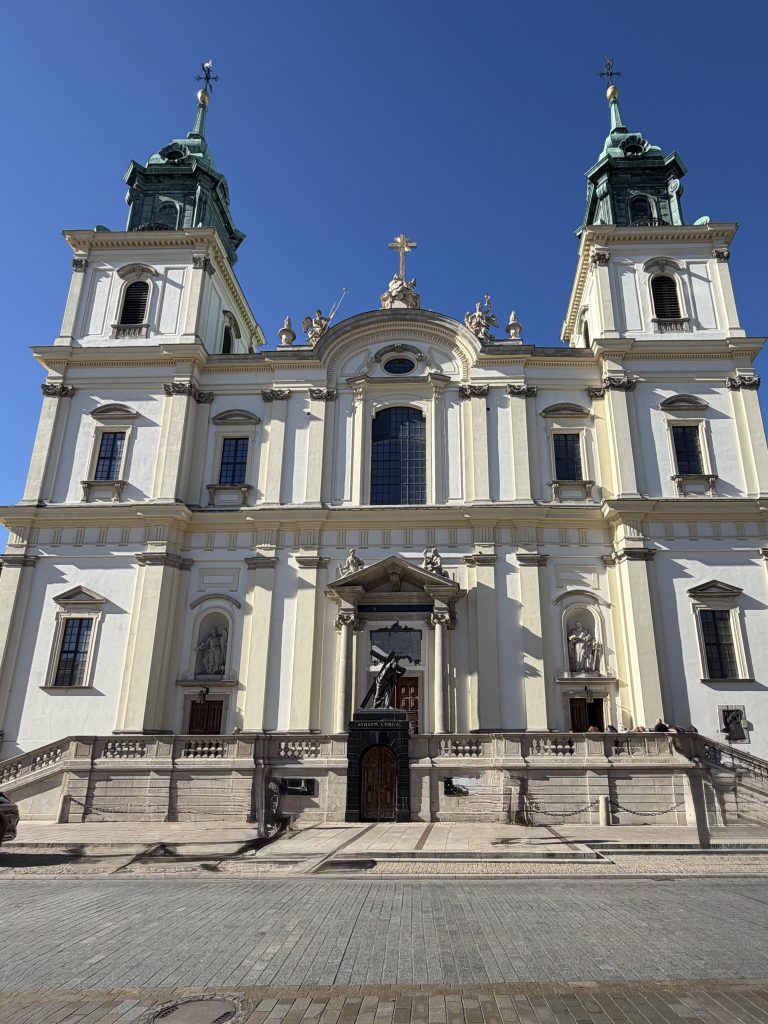
A contrast from the night view yesterday …
The late-Baroque façade, the green cupola, and the two side towers are the giveaway. It was built in the late seventeenth and early eighteenth centuries for the Congregation of the Mission, and the front you see was finished in the 1750s.
It is best known for what is inside: Chopin’s heart, sealed in an urn and set in a pillar of the nave. He died in Paris in 1849 and asked that his heart be brought home. The church was badly damaged in 1944 and rebuilt afterward; the urn was recovered from the ruins and returned to the pillar.
The Carmelite Church in Warsaw
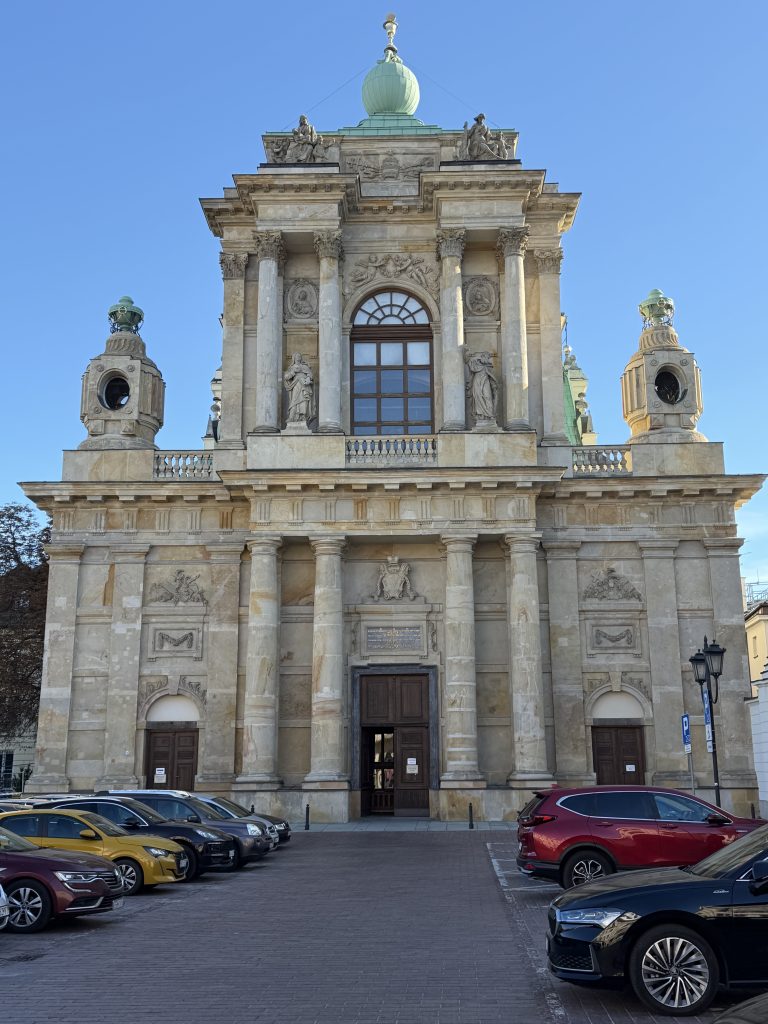
The Carmelite Church in Warsaw (Church of the Assumption of the Virgin Mary and of St. Joseph) stands on Krakowskie Przedmieście, part of the Royal Route. The church was begun in the 1660s; the pale stone façade you see was added in 1761–83 for the Radziwiłł family by the architect Efraim Szreger, and is one of the best neoclassical church fronts in the city.
Its landmark is the green copper sphere on the roof — the “Carmelite vessel” — flanked by two bell towers shaped like incense censers. Above the main door is the Radziwiłł coat of arms; the statues beside the central window are St. Teresa of Ávila and the prophet Elijah. The interior remains baroque. The building survived the Second World War in better shape than much of central Warsaw and still serves as a parish church.
Dom Polonii
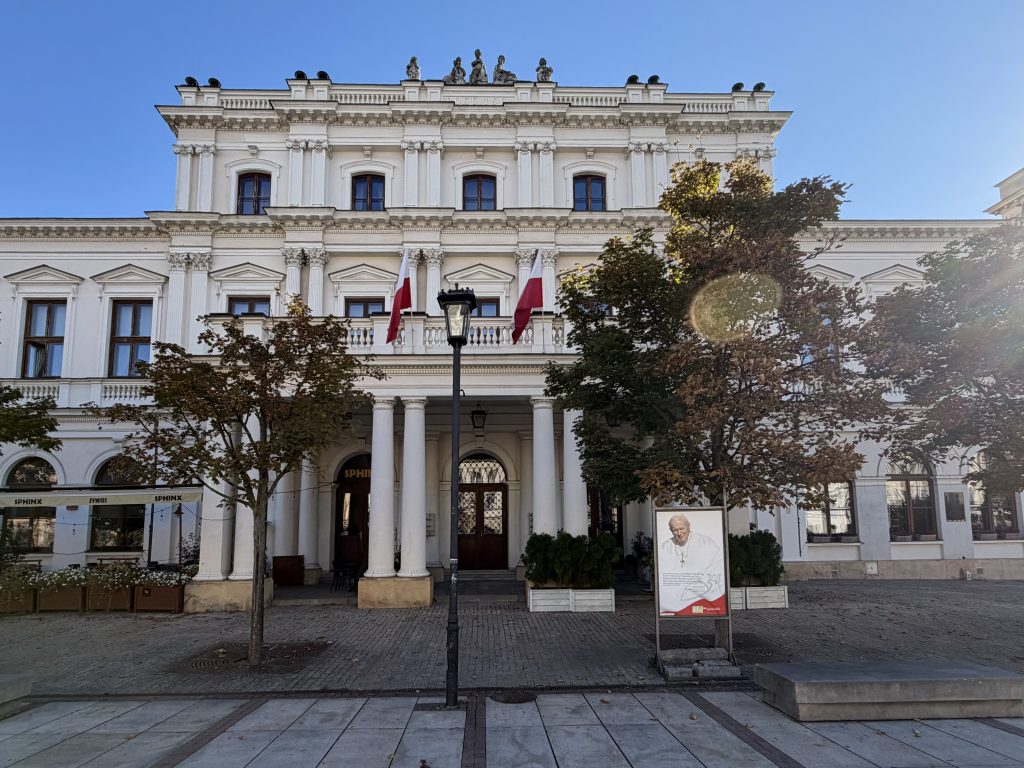
Dom Polonii stands at Krakowskie Przedmieście 64, on Warsaw’s Royal Route, a short walk from the Carmelite Church. It was built in 1860–61 as the Resursa Obywatelska, the city’s citizens’ club, and later became a home for Polonia organizations — the Polish diaspora.
The white neoclassical façade, columned porch, and statues along the roofline are the street front you see. A Sphinx restaurant now occupies the ground floor; the Polish flags and the John Paul II poster are later additions to the square in front.
The Res Sacra Miser chapel
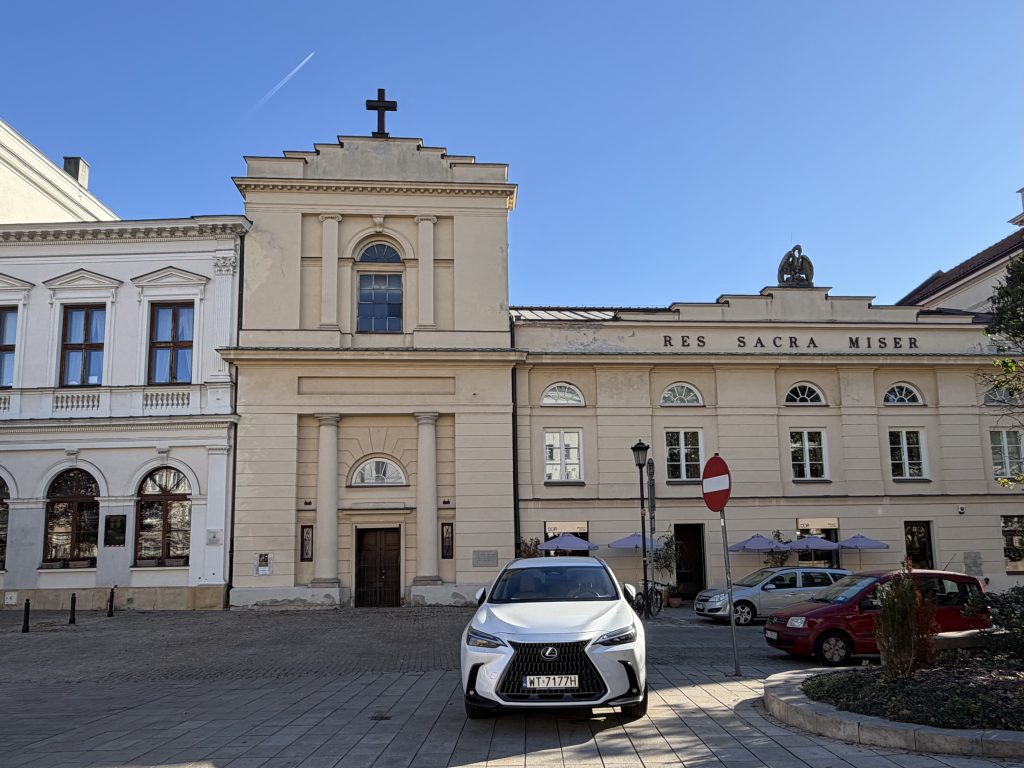
This is the Res Sacra Miser chapel on Krakowskie Przedmieście, a short walk from the Bristol toward Castle Square. The cross, the stepped gable, and the words on the long wing beside it are the markers.
The Latin line means “a poor person is a sacred thing.” It was the motto of Father Gabriel Piotr Baudouin, a French missionary priest who in the 1730s opened a house here for abandoned and orphaned children. The foundling hospital grew into one of Warsaw’s main charities, and the chapel was built for it in the early nineteenth century.
The longer wing is the old hospital building. The eagle on its roof is a later Polish state emblem. The complex was damaged in 1944 and rebuilt; the chapel is still consecrated.
Castle Square
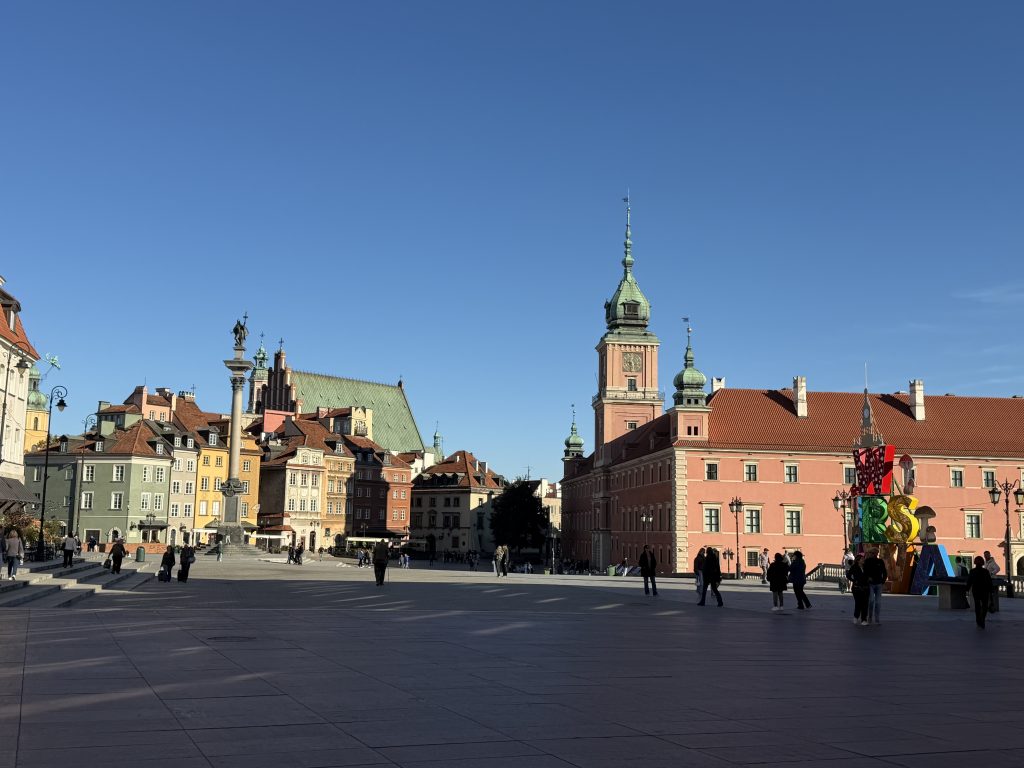
Castle Square is the open space where the Royal Route meets the Old Town, with the Royal Castle on one side and the streets of the Starówka opening on the other. Almost everything around it was leveled in 1944 and raised again afterward.
Sigismund’s Column
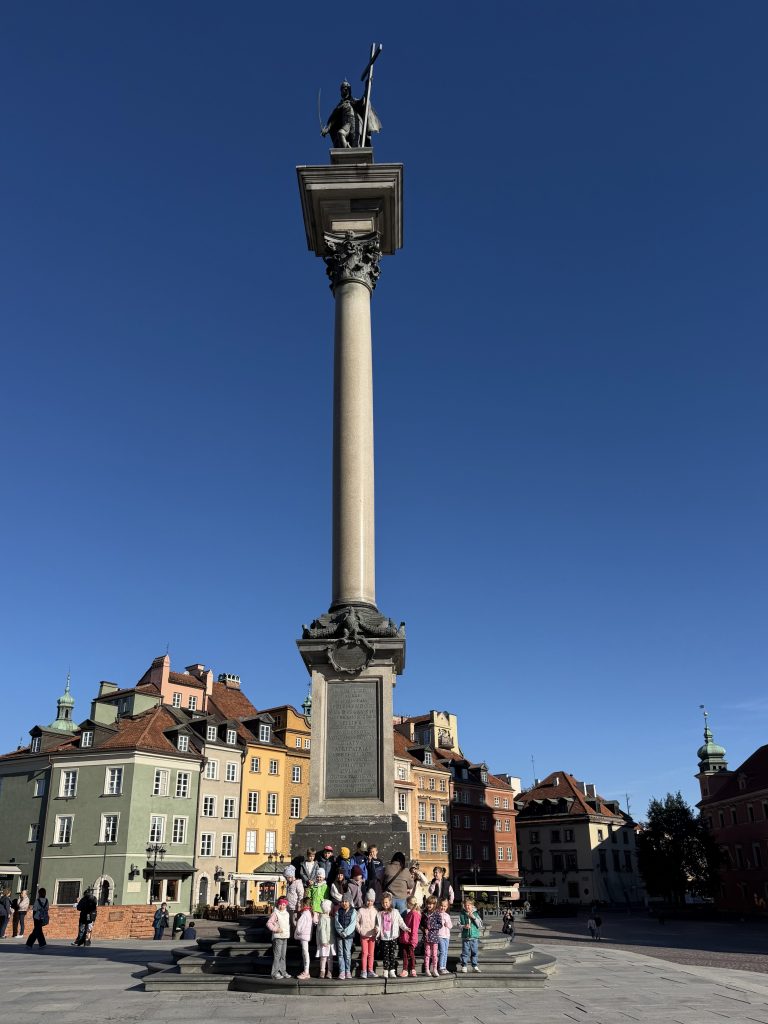
Sigismund’s Column stands in the middle. King Władysław IV raised it in 1644 in honor of his father, Sigismund III Vasa, who moved the capital from Kraków to Warsaw in 1596. It is the oldest secular monument in the city: a Corinthian column with the king in coronation robes, sword and cross in hand.
German forces blew it down in September 1944. The broken shaft and the original bronze were recovered from the rubble; a new column went up in 1949, and the figure on it now is a copy. The first statue is in the Royal Castle.
The façades look ancient, but almost none of them are. After the 1944 Uprising the Germans systematically destroyed the city, about 85 percent of Warsaw was gone. What we walked through was rebuilt, brick by brick, from photographs, Canaletto paintings, and sheer stubbornness.
We passed the Column into the Old Town, then St. John’s Cathedral and the Market Square. The square was rebuilt after 1944 and is a UNESCO site; mornings before about 10:30 are quieter.
St. Anne’s Church
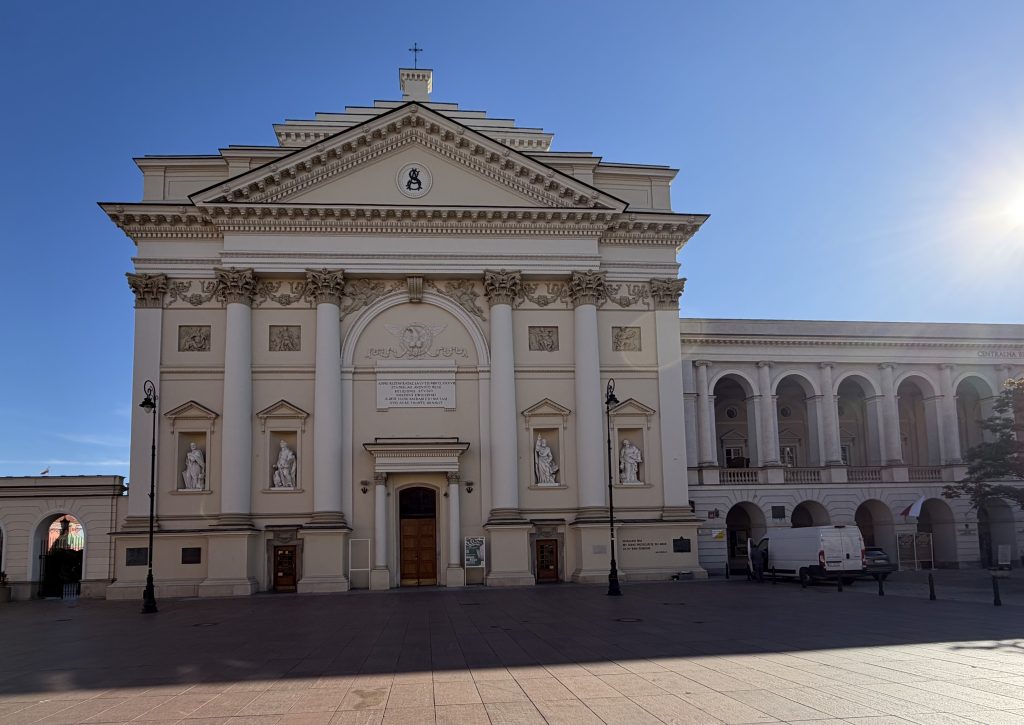
St. Anne’s Church (Kościół św. Anny) at the Castle Square end of Krakowskie Przedmieście, the last church on the Royal Route before the Old Town.
The Gothic church behind this front was founded in 1454 for the Bernardines. This is the neoclassical façade added in 1788 under King Stanisław August Poniatowski, with the Latin tablet recording that rebuilding. The statues in the niches are on the later front; the older brick church is inside.
It was burned in 1944 and restored afterward. From the terrace beside it there is the classic view down over the Vistula. The colonnade to the right belongs to the old Bernardine monastery, now part of the University of Warsaw.
St. John’s Arch-Cathedral
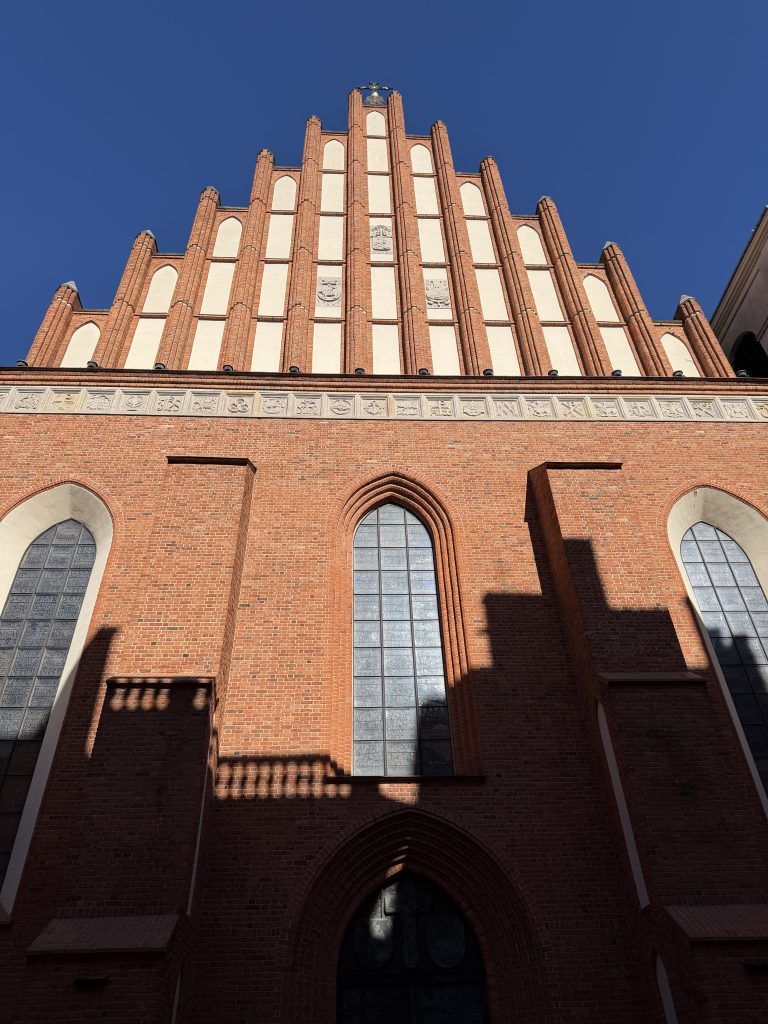
St. John’s Archcathedral is on Świętojańska, just off Castle Square, and it is the oldest church in Warsaw. Duke Janusz I of Masovia founded it around 1390. It became a cathedral in 1798 and the archcathedral in 1818.
Stanisław August, the last king of Poland, was crowned here in 1764. The Masovian dukes lie in the crypt, and so do Gabriel Narutowicz, Ignacy Paderewski, and, after Smolensk, President Lech Kaczyński and Maria Kaczyńska.
The Germans blew the nave apart in August 1944. Rebuilt by the mid-1950s, the façade is closer to the original Masovian Gothic than the nineteenth-century front that stood before the war.
Old Town Market Square
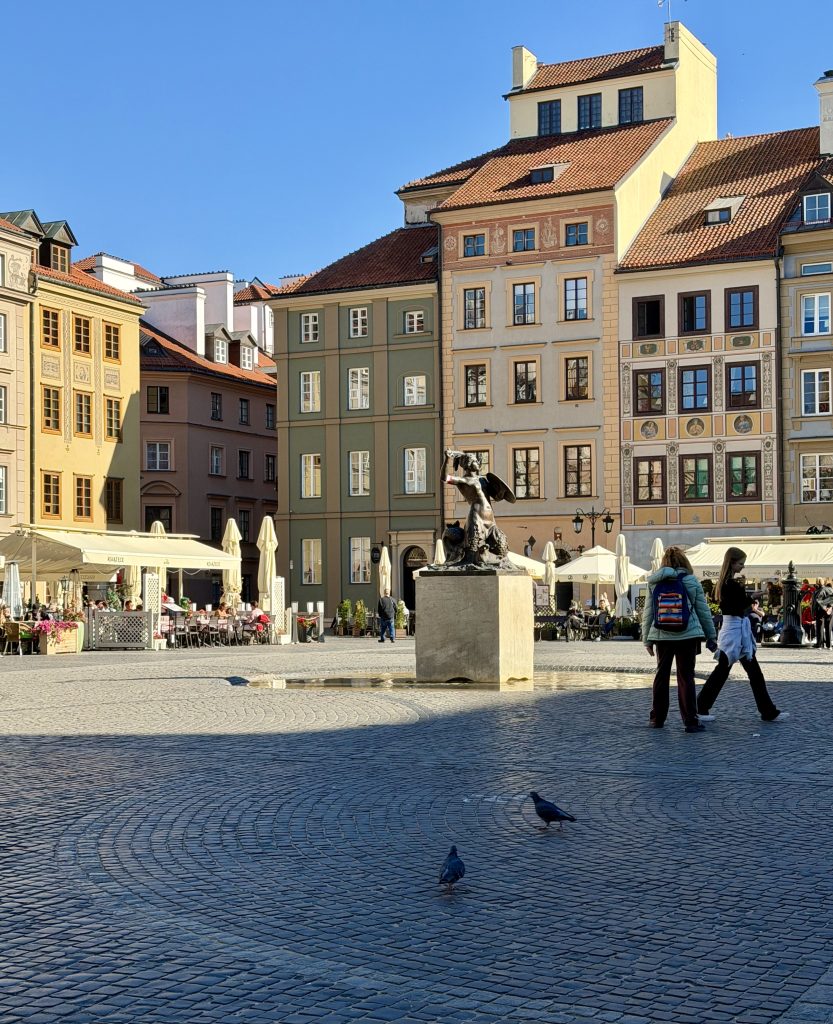
The Old Town Market Square is the center of the Starówka, a few streets in from Castle Square. The town hall that once stood in the middle is gone. What remains is the open square, the four blocks of burgher houses, and the bronze mermaid a little off center.
The houses look seventeenth-century, but almost all of them were rebuilt after 1944 from photographs, Canaletto’s views, and measured drawings. Work began in 1949, and the square was largely handed back by the mid-1950s. UNESCO listed the Old Town in 1980 because that rebuilding was judged an act of culture, not only of architecture. Mornings before about 10:30 are the quiet ones.
The mermaid is Syrenka, Warsaw’s emblem, sword and shield in hand, set here in 1855. The figure on the square now is a copy. She is the same creature as on the city coat of arms: by the old legend, a river maid who came out of the Vistula and told the fishermen to found a city on the bank.
Mid-morning we met Kevan’s sister Jodi back at the hotel. She had just landed from Phoenix via Zurich. Jodi was an LDS missionary in Poland in the early 1990s and arrived with a nostalgia list, starting with the Church office building for Poland — which was closed.
Church Office Building for Poland
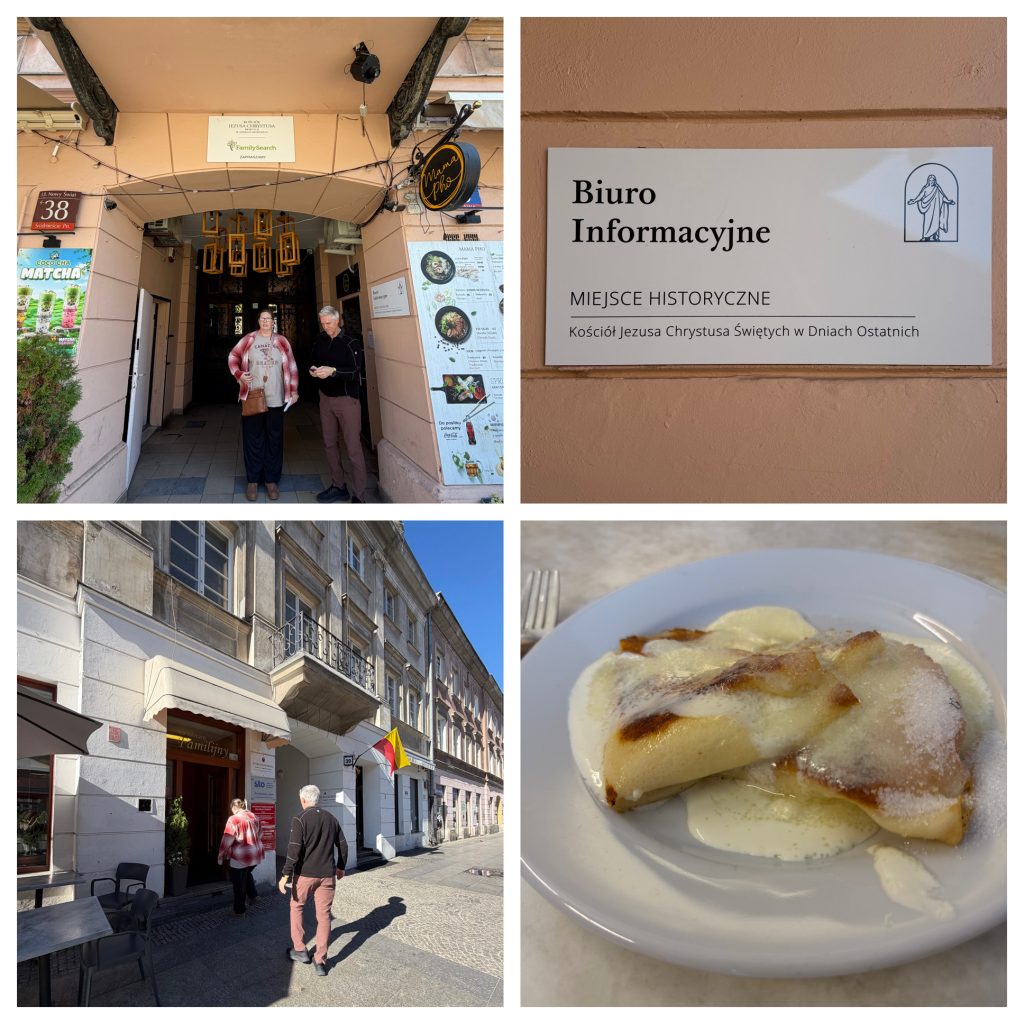
Bar Mleczny
Next on her list was a bar mleczny, a milk bar, right across the street. These began in Warsaw in the 1890s as cheap dairy canteens and became the everyday cafeteria of the communist years: pierogi, żurek, kotlet, kompot, prices kept low by the state. For Jodi it was an instant return to her mission, right after Solidarity and the fall of communism, when these rooms were still how people ate and a daily staple for missionaries.
Museum of Life under Communism
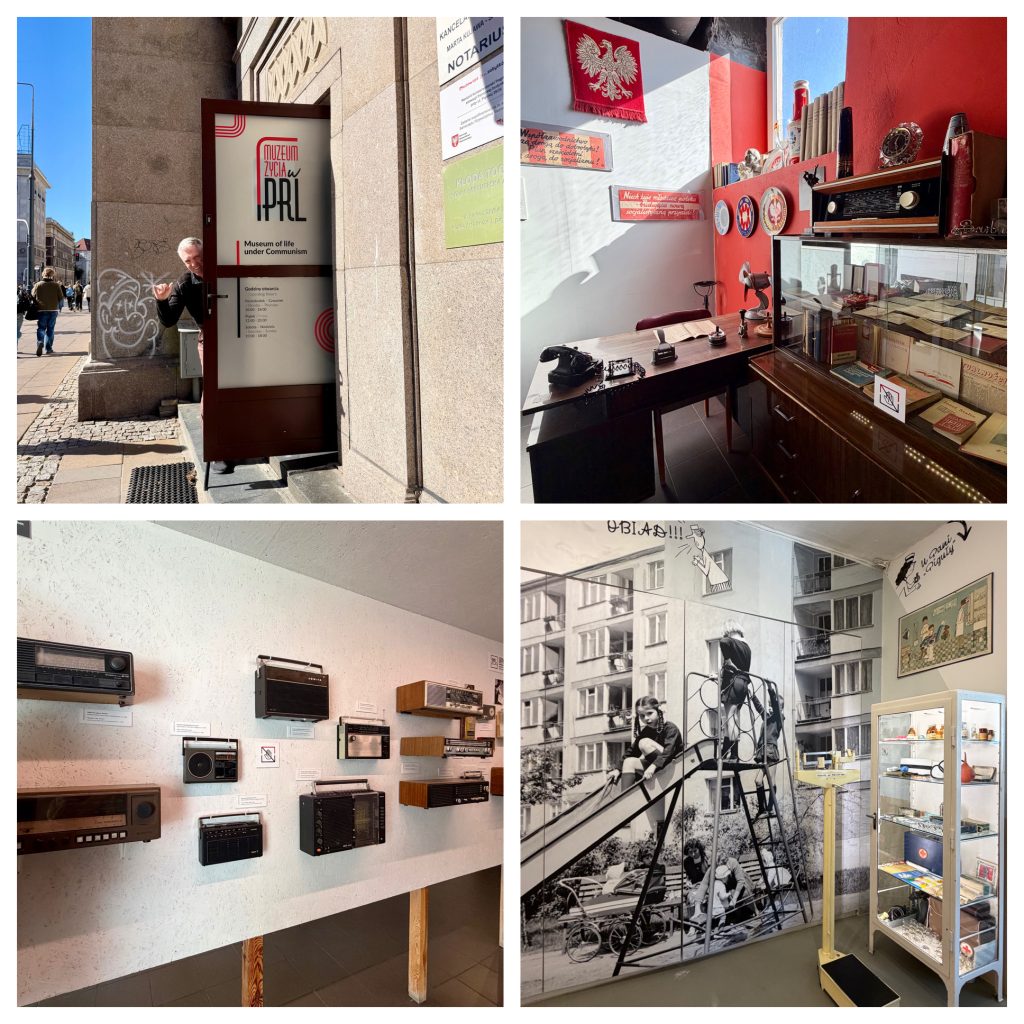
That set up the Museum of Life under Communism, near Constitution Square.
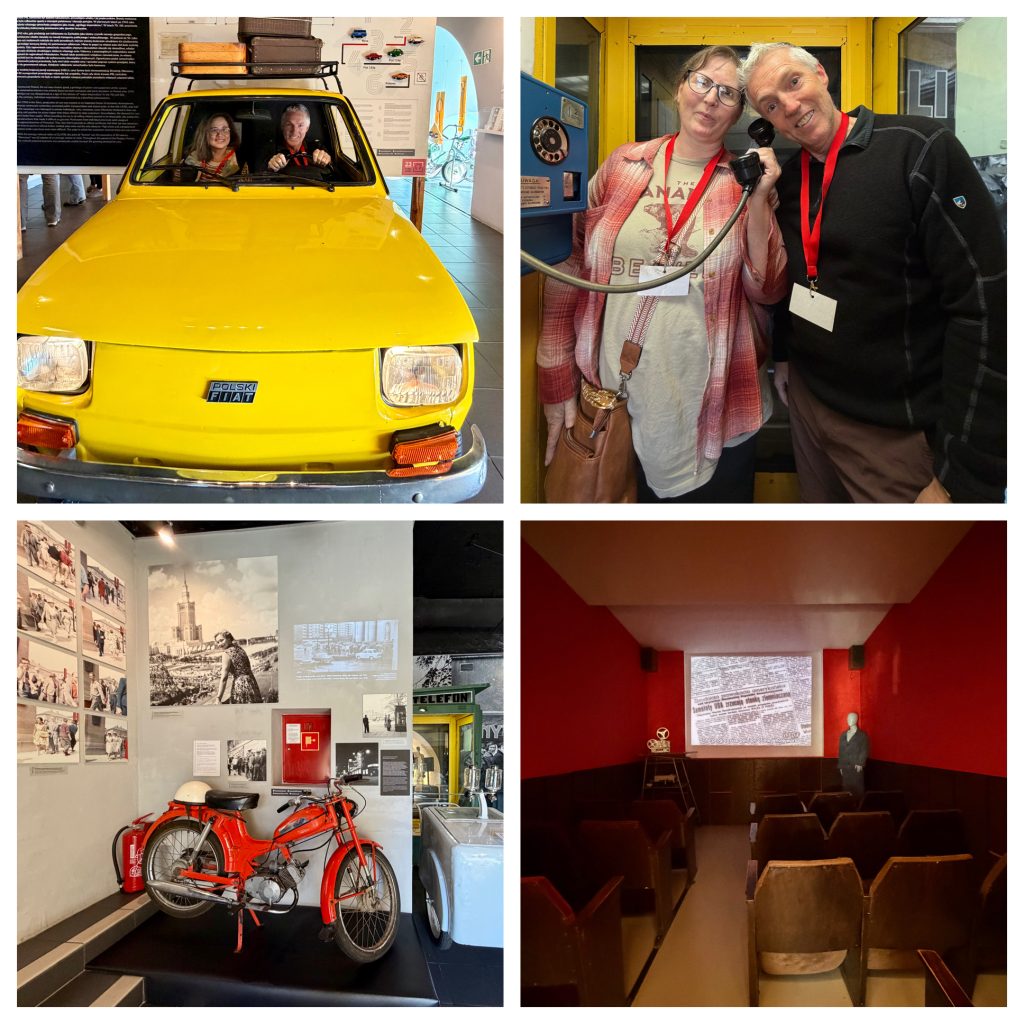
You enter in 1989 and walk backward through the decades to Stalinism: a Fiat 126p “Maluch,” a Frania washing machine, period living rooms, radios, propaganda reels, the ordinary objects of a shortage economy. For Jodi it was the Poland she remembered as a missionary, just after that world had begun to come apart.
Also encountered this building on Nowy Swiat (Café and restaurant stretch of the Royal Route south of the hotel) somewhere along the way …
Zamoyski Tenement (Dom Interesów Andrzeja Zamoyskiego)
Built in 1843–46 for Andrzej Artur Zamoyski by Henryk Marconi, it is Neo-Renaissance, modeled on Rome’s Palazzo della Cancelleria, with a pediment sculpture by Paweł Maliński. In 1863 a failed bomb attack on the Russian viceroy was launched from its windows. In retaliation the building was looted and a Chopin piano was thrown into the street. Later the Ministry of Internal Affairs, it was destroyed in the 1944 Uprising and rebuilt in 1948–50.
It is now part of the University of Warsaw, home to the faculties of Philosophy, Journalism, and Artes Liberales, on the Royal Route just so
Museum of Warsaw
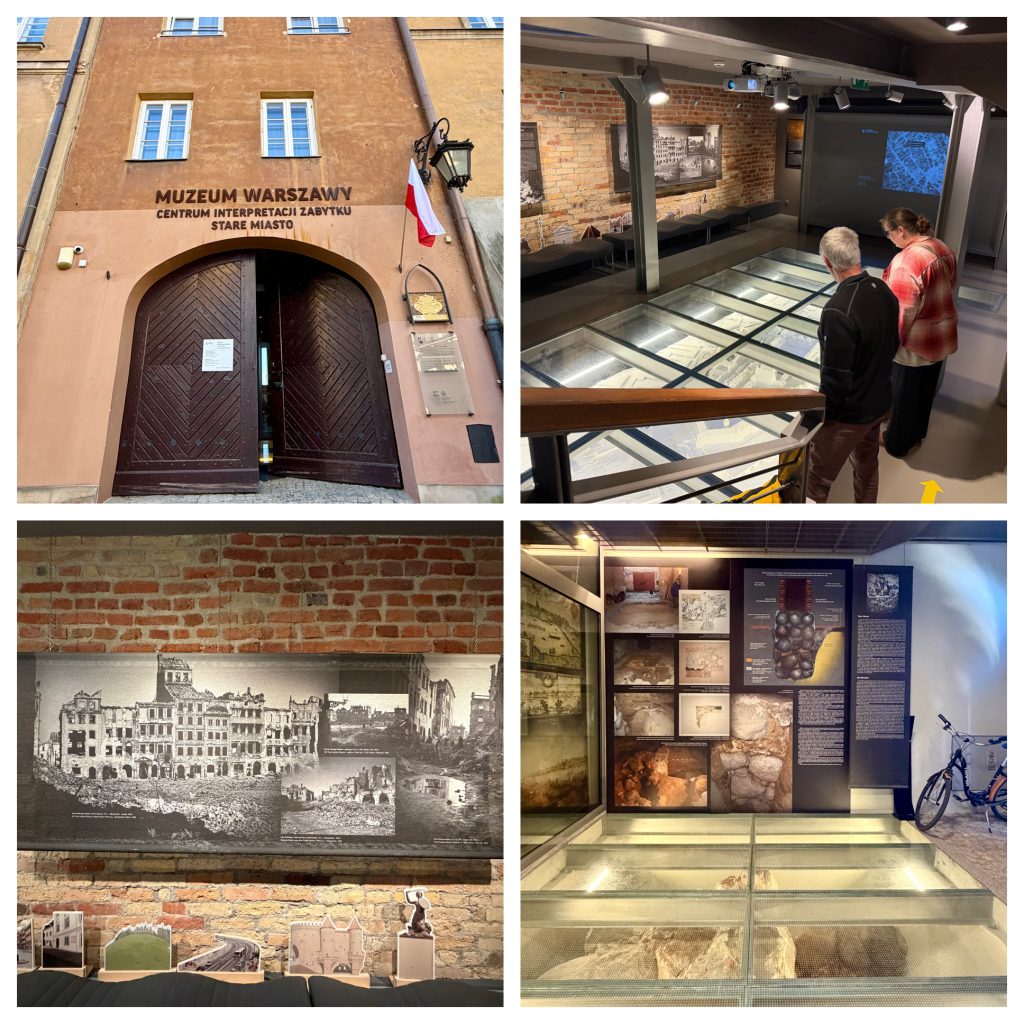
Jodi then led us to a place she remembered from her years here — the Heritage Interpretation Centre on Brzozowa, a branch of the Museum of Warsaw, in a rebuilt tenement on the escarpment above the Vistula. Its permanent exhibition, Destruction and Reconstruction of the Old Town, tells the Starówka before the war, during it, and after: the leveling in 1944, the Warsaw Reconstruction Office, the architects’ studios, photographs of the rubble and of the raising, a stretch of the old town wall uncovered by archaeologists. Rebuilding began in 1949, and the Old Town was largely handed back five years later. In 1980 UNESCO listed it specifically because reconstructing an entire historic center was considered an act of culture, not just architecture. Standing in those rooms after walking the streets they describe is a strange, moving loop.
The Barbrican
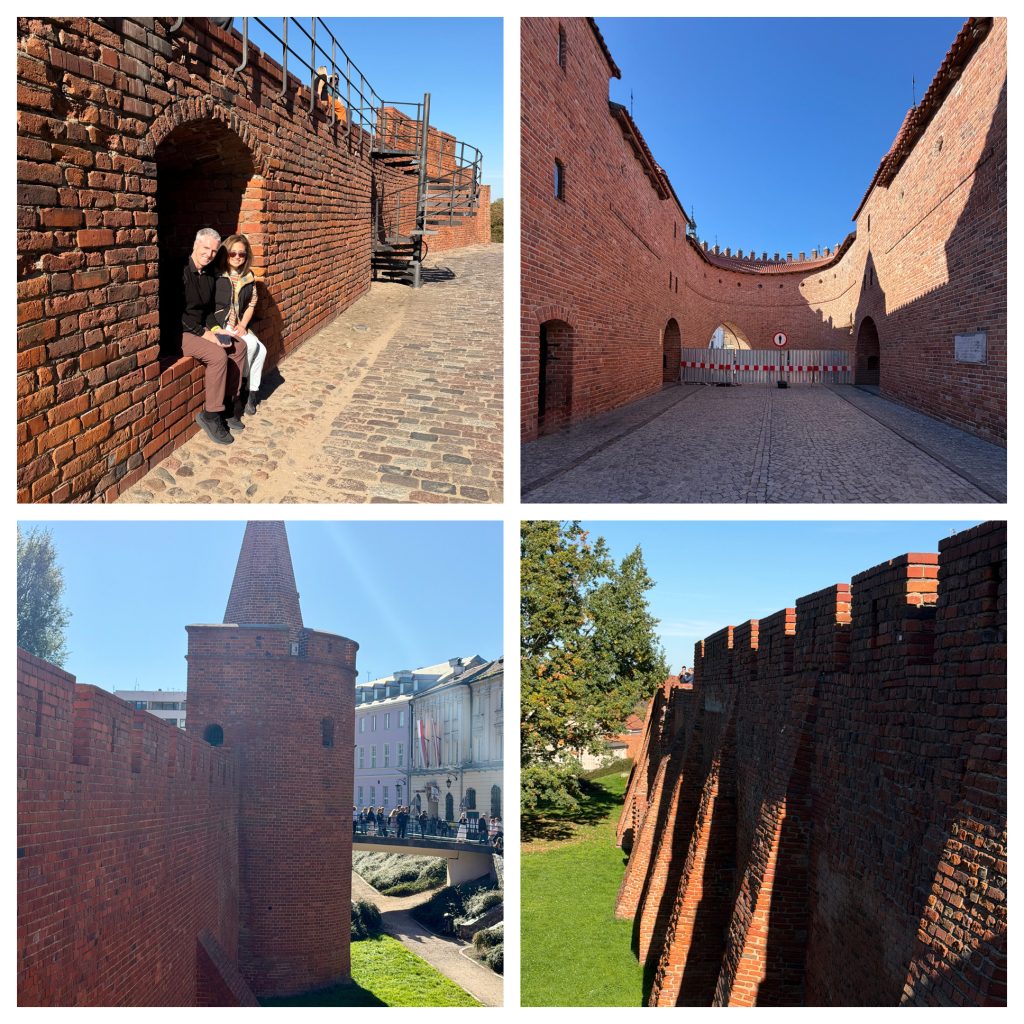
Back in the Old Town we walked the old fortress walls and the Barbican, then took a long tour of the Royal Castle. It was the seat of the Masovian dukes, then of the Polish kings and the Sejm after Sigismund III moved the capital from Kraków. German forces blew it apart in September 1944. Poles rebuilt it between 1971 and 1984, much of it with public donations collected in a box on Castle Square, and opened it as a museum in 1984. The rooms are furnished again; the cellars underneath are still the medieval ones.
Gościniec Polskie Pierog
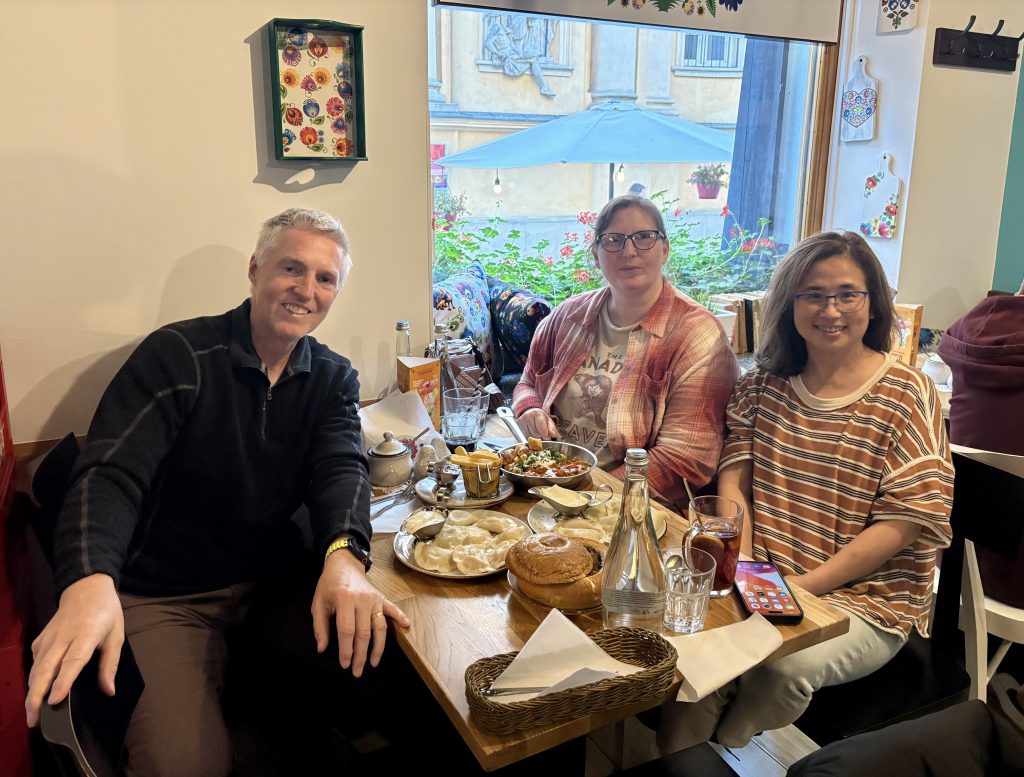
Dinner was at Gościniec Polskie Pierogi on Podwale, right against the old city wall, staff in folk costume.
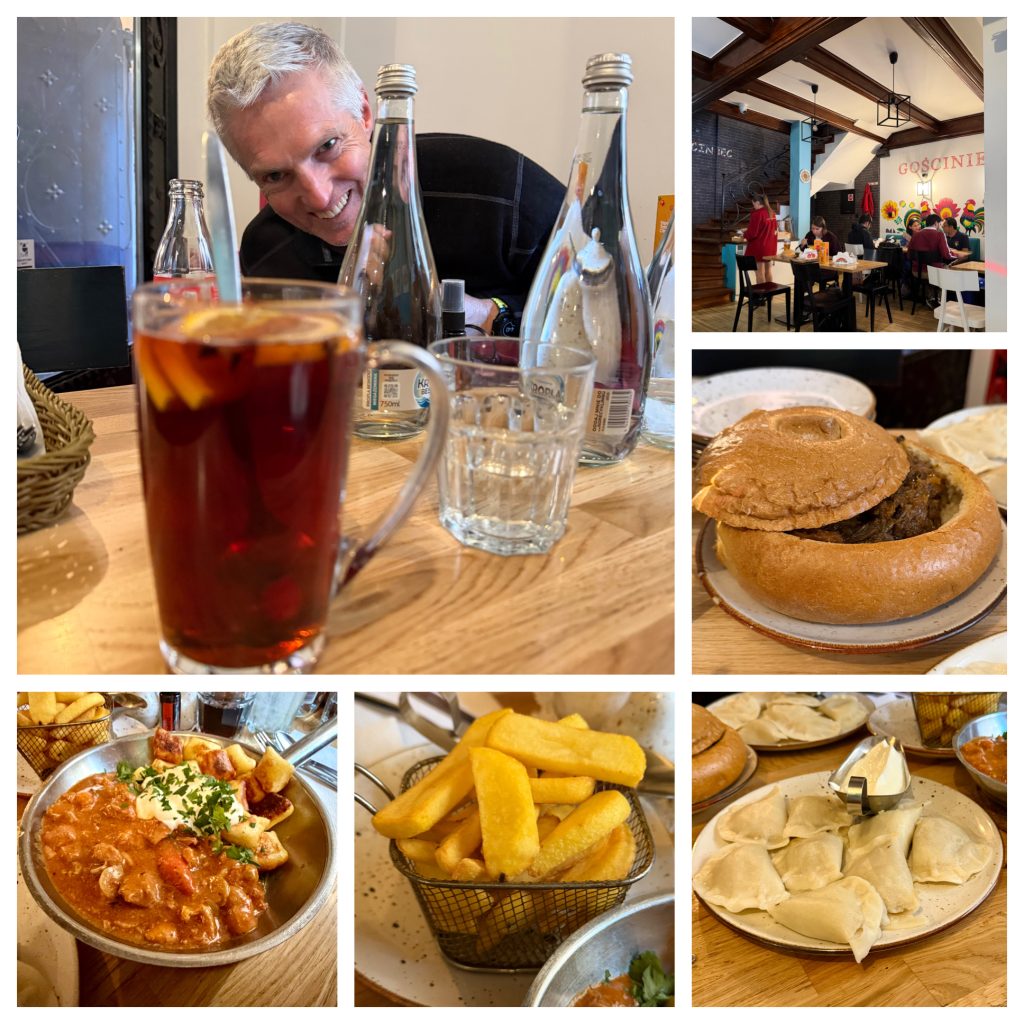
We split two kinds of pierogi, bigos — the hunter’s stew of cabbage, sauerkraut, and meat — served in a bread bowl, fries, and the kopytka: pan-fried potato dumplings with pork stew, peppers, and mushrooms.
Chopin Piano Recital
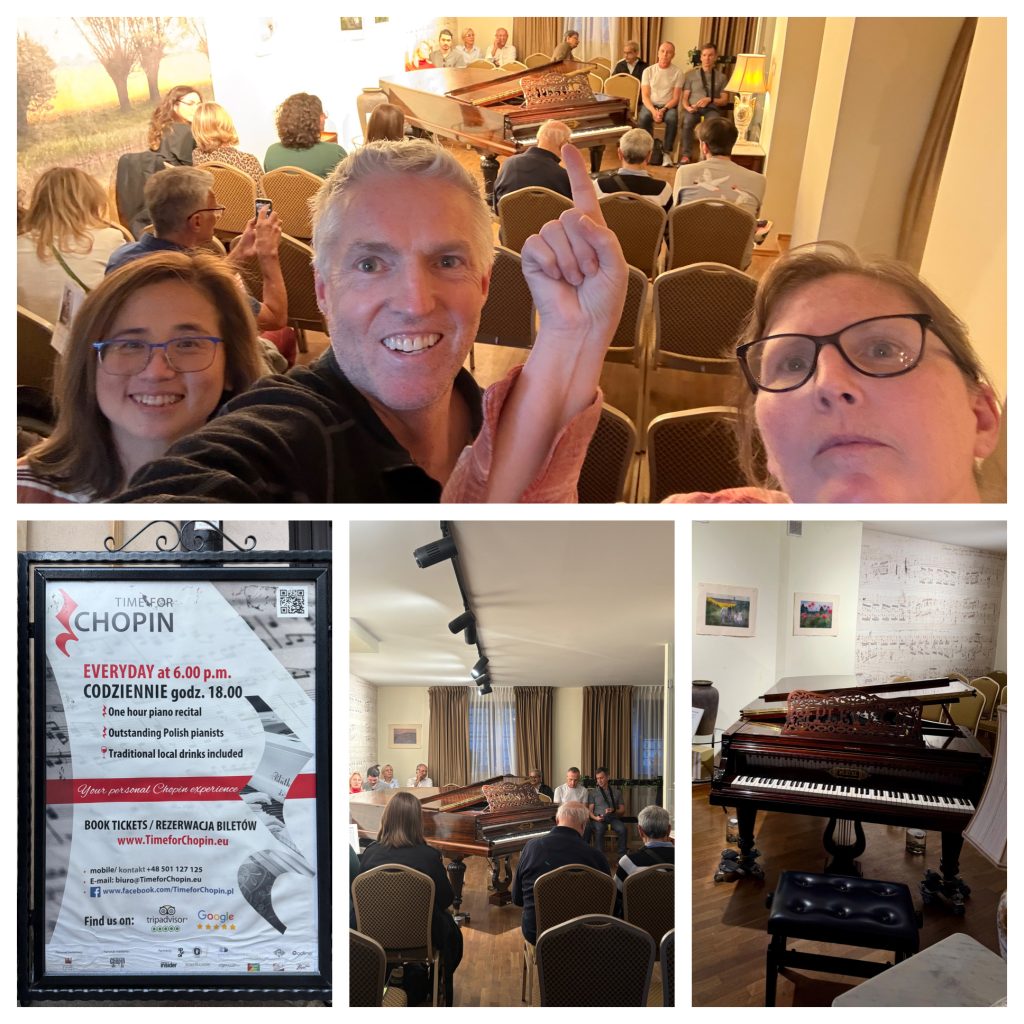
A Chopin piano recital closed the day.
A luxurious breakfast in a building Paderewski helped raise, a milk-bar lunch that still tastes like 1989, a castle and an Old Town that exist because people refused to let them stay ruins, and pierogi under the wall that was rebuilt around them. Another wonderful day in Warsaw.
Day 3
Left for Krakow by train at 7:40am