 Swan Bradshaw
Day 1
Auckland
Arrived Auckland!
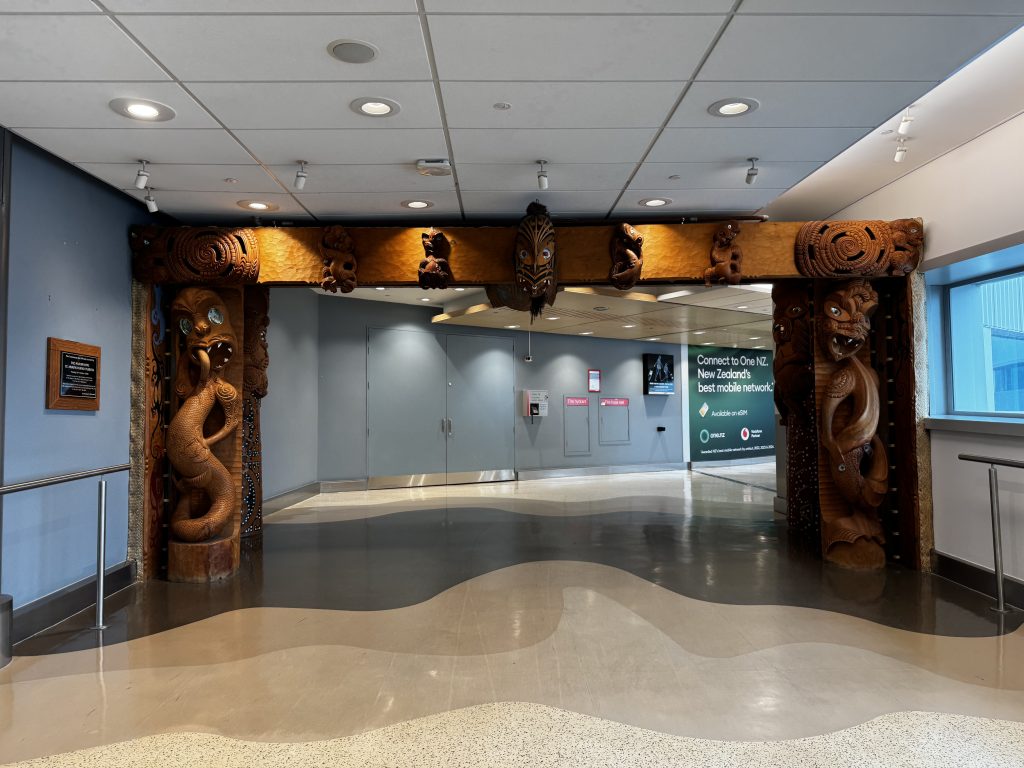
We filled out the travel declaration online before we landed, and we were 100% honest on all of our declarations which led to us getting filtered into the highest risk customs line. Ultimately, the main declaration item we had to deal with was currency because we had brought cash to pay for hotel/tour/car and that exceeded the minimum cash amount required to declare. So we had to spend close to an hour with a customs agent, going through financial disclosure forms and counting the cash, and making sure everything was legit, and the source of funds had nothing to do with Drug sales, money, laundering, human trafficking, and a number of other items. It was quite the investigation.

Ultimately, we cleared through customs and were able to meet our friend Kim Ying in the airport, got to our rental car and our first stop was the open house at the new Auckland, New Zealand temple of the Church of Jesus Christ of latter-day Saints.
Auckland LDS Temple

Our friend, who is not a member of the church, had previously asked us if we wanted to go to the open house and we said yes. She then ran into an older missionary couple who talked to her about the church and also invited her to the open house so she arranged a reservation for us right after we landed and we all went together. It was a fantastic visit, the temple is beautiful inside and out, and the tour was great.
Highly recommend it to anyone who has an LDS temple opening up in their area, check out the open house ticketing system online and make a reservation. It’s a pretty quick tour and it’s a wonderful way to visit a holy house and get introduced to the teachings of the Church of Jesus Christ of Latter-day Saints.

After the temple tour, we went to Kim Ying‘s house as she had offered to host us there. She has a beautiful home right on Lake Pupuke in Takapuna and the room we stayed at was absolutely a 5-star rating. Such a lovely place and an even lovelier friend.

Kim Ying and Geoff took us to an Asian fusion restaurant Tok Tok, all the dishes ordered were fantastic particularly the popping shrimp was one the curry fish.

Day 2
Hobbiton

We left Auckland for Rotorua and on the way stopped at the Hobbiton visitor site where the Lord of the Rings was filmed. The hobbit village production set is completely intact and we had a guided tour of the entire area, including all the hobbit homes and villages and all the major sites associated with hobbit life across the entire shire.

We had a great visit to Hobbiton and the Shire, we walked through all of the little hobbit holes, all 44 of them! We also learned about some movie techniques that allowed them to make some of the characters look much larger, like Gandolf, the wizard, while other actors who were actually similarly sized, like Frodo, looked significantly smaller.
One way they did this was positioning them in different locations in front of the camera, so for example when Frodo and Gandolf were on the wagon together, Gandolf was in the front while Frodo was 3 m behind even though it looked like they were sitting right next to each other. This allowed an actor who was 5 foot 10 and another actor who was 5 foot 6, to look like one was over 7 feet tall and one was under 4 feet tall.
There were a number of other stories they told us, particularly about the perfectionist nature of the director, Peter Jackson. One story indicates that because in the book The Hobbit gathered under the expansive shade of a peach tree, because in New Zealand they could not grow a peach tree, they grew egg an apple tree and then extracted all of the apples and manually hung over 200 peaches, just so they could have the realistic tree that was true to form with the book.

Another story was about the tree that’s on top of Frodo’s house, which is one of the only artificial trees in the entire Shire. They originally used silk for the leaves, but when Peter Jackson arrived many months later, the silk had faded. That was one of the first things he noticed. So to rectify the situation, they hired a bunch of students from the local film academy, who came in and manually painted every leaf, 200K in total, on the tree to get it to just the right shade of green. Both of these resulted in more true to character props, but for only seconds of the movie.
This yellow house is Samwise Gamgee’s hobbit-hole.

These are some of the things the hobbits like to do!

It was a great visit, recommend this if you are traveling south from Auckland. It’s not too far off the road if you are headed to Rotorua and the entire tour takes about two hours.
We even toured inside one hobbit-hike. One of the things that they have recently done at Hobbiton is build out two of the hobbit houses so you have fully decked out homes inside the hobbit houses, not just doors outside as props for movies. We toured one of these homes, it included everything you would expect, from dining room to bedrooms to a kitchen to a sitting room to a study, all fully equipped with hobbit sized tools, books, scrolls, pens, glasses, kitchen equipment and everything else.

They just finished this in 2024 so have only recently started running people through these internal hobbit home tours. Quite interesting!

Hobbiton has grown quite popular. Our guide told us that they bring through over 500,000 visitors every year. They have 10 full-time groundskeepers, gardeners, guides, bus drivers etc. Over the past 20 years, they have turned this into quite a tourism enterprise.

Our guide took this picture and commented that “we have a hobbit and a wizard here!
As the hobbits love to drink as much as to eat, we were treated with complimentary ale at the end of the tour. Kevan and I had the only non-alcoholic ginger beer, it was very good!

More pics from Hobbiton…


Regent Boutique Hotel
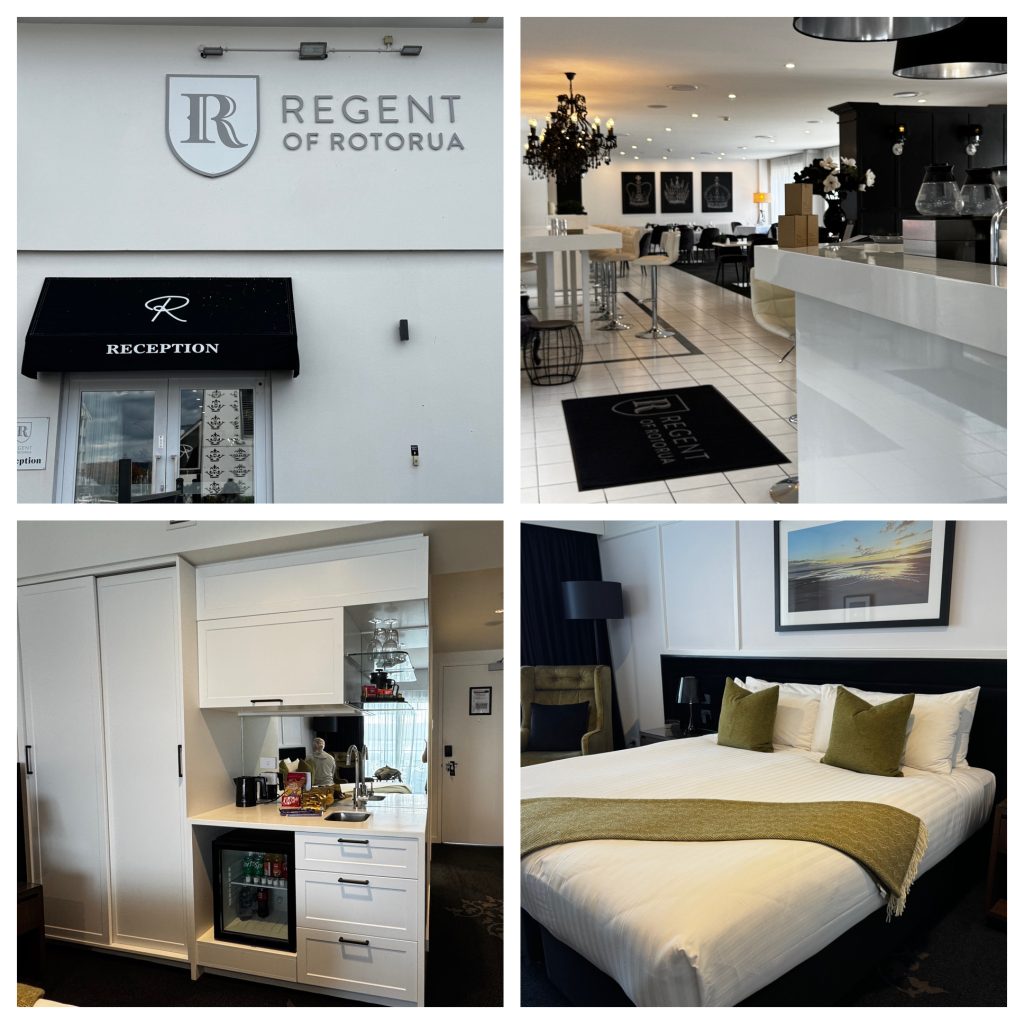
We drove for an hour to get to Rotorua from The Hobbiton, checked into the hotel, and rested a bit before dinner.
Eat Streat

We had dinner at Eat Streat, a local r food center with a bunch of different restaurants, mostly neat and fish and chips, restaurants, but also a few others like Indian and Thai food. We ate at a restaurant, called SoBar Surf and Turf. They had amazing salmon and the fish and chips were great as well. Wonderful meal! We started with Prawns Tonkatsu as an appetizer.

Kevan order Garlic Butter Salmon and I went for the famous Fish and Chips!

That salmon was heavenly!

And the fish was fresh and well prepared. The French fries were crisp on the outside and moist inside, the coleslaw was so good. I love it!
War Memorial Park
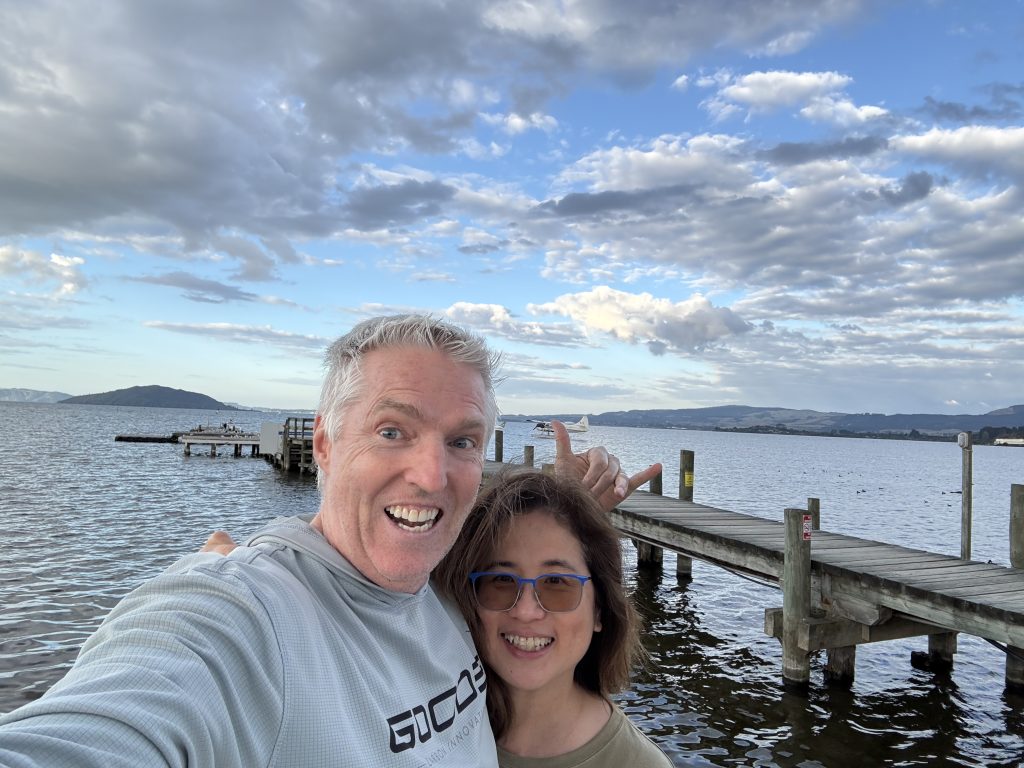
After dinner, we went for a walk by the lake, beautiful scenery!
Polynesian Spa
The Polynesian Spa in Rotorua New Zealand is a geothermal bathing spa retreat, which is located right on the shore of Lake Rotorua. It is sourced from a natural geothermal fissure and offers a number of different pools of various chemical composition and temperature. Apparently the spa goes back to the 19th century when settlers realized the mineral rich hot springs could be used for therapeutic benefits, although I’m sure it was used by indigenous people as well before then.

This actual spa was established in 1972 and gets tons of visitors. It draws water from two different natural springs, the Priest Spring, and the Rachel Spring. One of these is slightly acidic and rich in sulfate and is supposed to relieve muscle tension, aches and pains. The Rachel Spring is more alkaline and rich in sodium, which is supposed to nourish the skin and leave it soft and smooth. There are 28 different hot mineral pools at the spa across four main areas with temperatures ranging from 100°F to 108°F. We tried all of the five main pools, the first at just under 100°F didn’t seem very hot at all, but by the time we got to the hottest one, it was relatively hot, but not overwhelming. A good place to visit, we enjoyed the soak, And Kevan says his skin has never been smoother!
Day 3
Rotorua
Agrodome
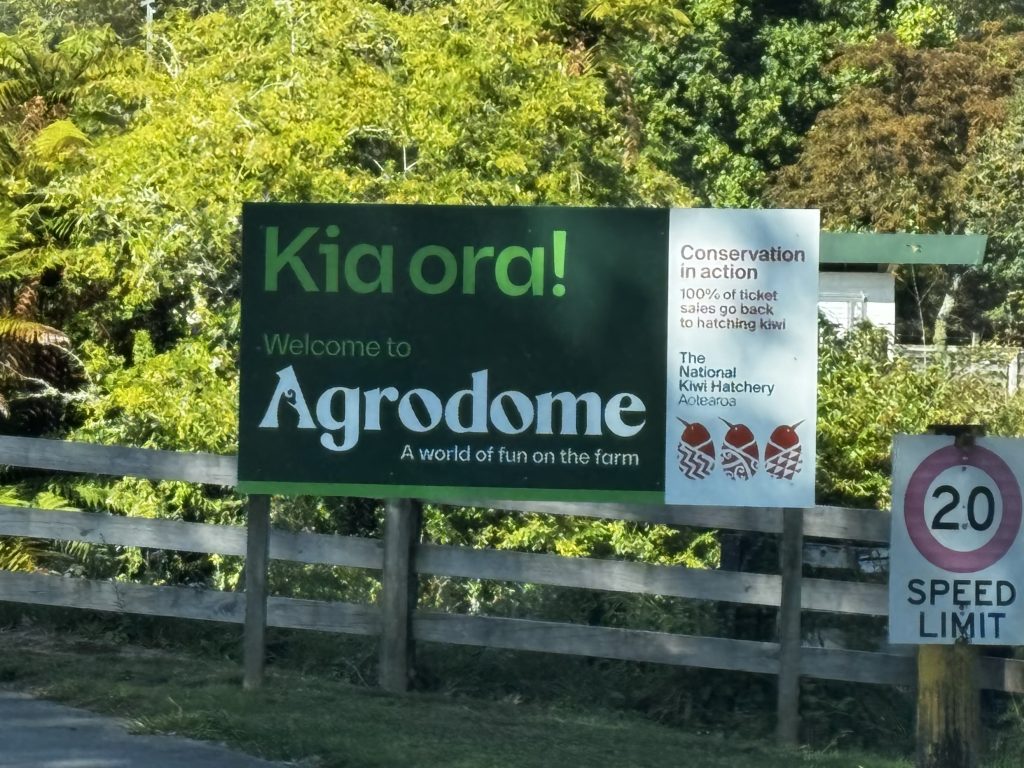
Today in Rotorua, New Zealand, we visited a working sheep and cow farm. They showed us all the different breeds of sheep that they raise, 19 different breeds with different products generated by each from breeds which are good for meat production to those which are good for different types of wool production.

They even showed us how they sheer sheep by doing a live demonstration and shearing a sheep for us.
They also brought in a cow to demonstrate milking technique including audience participation. Despite the fact that we were sitting 30 feet away, the guide was able to hit us with a single stream of milk. Luckily, the man in front of me blocked most of it but still very impressive range!
They also brought out three of their working ranch dogs and showed us how they herd the sheep, different dogs have different talents, including those that can herd up to 3000 sheep with just one dog using barks and herding techniques and others which herd smaller groups using more specific directional techniques.
Lunch at Patrick’s Pie

Our friends that we have been visiting in New Zealand have encouraged us to try New Zealand meat pies, a distinctively New Zealand dish. They recommended that we try Patrick’s pies in Rotorua. So today for lunch we went to Patrick’s Pies.
They have over a dozen different types of pies, typically with a meat or chicken or lamb filling, basically minced meat and gravy sometimes with onions, mushroom or cheese as filling and the outside a flaky pastry pie in an individual sized portion.
We were looking at all the options and there was an elderly man waiting behind us, so we told him to go ahead and I also asked him what his favorite pie was. He said you can’t go wrong with any of the steak varieties so Kevan got the steak and mushroom and I got the chicken and mushroom. They were delicious.

As we walked out of the restaurant, Kevan started talking to the man and he mentioned that he actually used to own Patrick’s Pies, but then sold it to Patrick, and Patrick still uses the family recipes passed down from his father. He also said that he sits on the judging panel for the New Zealand Supreme Pie Awards, an annual pie competition in New Zealand. So not only did we get to taste great pies, we met the son of one of the guys who apparently originated New Zealand pies in the early 70s. What a day!
Tepui New Zealand

This is a Māori arts and culture center. Here we were introduced to the Māori culture, dance, songs, architecture, village life, and food.

We were first introduced to the Big House, also known as the Carved Meeting House where council elders convene, most of the entertainment occurs and where visitors were welcomed.
Maoritanga or Māori cultures, also known as Māori way of life, is intertwined with New Zealand culture due to the vast diaspora or influx of Polynesian motifs into the culture. Māori arts include whakairo or carving (into woods, bones, and stones), raranga or weaving using plaiting technique for weaving baskets and mats; fiber technique for making fishing/bird nets, poi, building structures, kites etc., kapa haka or group dance where Māori people express their heritage and culture through songs and dances using props such as weaponry, poi, moteatea (traditional Māori songs) etc., whaikorer or oratory, whakkapapa or genealogy where they pass on their genealogy and identity orally from generation to generation linking to one’s ancestral heritage, land, and one’s mana (supernatural force), and tattooing which tells stories of one’s heritage and family history.
After the assembly at the Big House, we were introduced to some of the buildings and other village features of the Māori people.
Cooking Pit

Generally men are assigned the task of cooking in this pit. They cook everything from meat to chicken to vegetables in this pit, often taking 4 to 6 hours to prepare. The men were responsible for this cooking, the women had other cooking responsibilities, but not in the underground pit.
Apparently the buffet dinner that our group ate had been cooked in this pit and our guide showed us the hot rocks that we’re still in the pit that had been used to cook our meal. We can certainly attest to the high-quality of food that comes out of this style of cooking.
New Zealand Kauri

Kauri is one of the largest trees in New Zealand and often lives over 1000 years. Kauri gum oozes from the tree, hardening and sealing the tree surface which protects the tree from damage. Kauri trees are generally used for building canoes but are not suitable for carvings. Its gum has medicinal uses and burnt gum is also used for tattooing.
Store House (Patak)

Learning House

Dinner Buffet

Our dinner was fantastic! Everything from salmon to beef to lamb chops to vegetables, an amazing meal! Kevan tried the lamb, steak, and I had chicken and Salmon. I even had two huge servings of Pavlova dessert, my favorite!
After the dinner buffet, we were brought back to the Carved Meeting Room for the night show.
Carved Meeting Room

Prior to the night show at Te Puia, a formal welcoming ceremony was performed where the men danced and the women sang. The men came out one by one and performed a dance, similar to a haka, but what they were generally doing, was coming out and using their war staff to point and chant at the incoming visitor. They rotated through individual warriors, until the last warrior brought a large palm frond and laid it on the ground in front of the visitor. The visitor was then able to pick up and accept the palm frond, signifying that he came in peace with no ill intentions towards the tribe. Once he did this, he backed away, never turning around, until he reached the entire incoming visitor party, at which point the group was welcomed into the large house by the Māori tribe, signifying their acceptance into the camp as peaceful visitors.

We absolutely enjoyed the performance incorporating kapa haka, moteatea, whaikoreror in the carved meeting room!
Pohutu Geyser
After the Māori cultural performance, we were able to go to the Pohutu geyser which is the biggest geyser in the southern hemisphere. It sits on top of the point where the pacific and Australia tectonic plates intersect, creating magma which heats the underground water, causing it to periodically erupt when it boils and turns to steam at the surface, resulting in a geyser eruption approximately every hour. When we arrived, there was steam coming up out of the rocks on top of the streams and pools surrounding them, Eventually leading to an eruption with water spewing 100 feet into the air and dropping back down to drench all of us, pretty amazing.
The rocks around the outside of the pools were flat so we could sit on them and they were very hot from the geothermal heat below. It was a very impressive display.
What a fantastic day!

Day 4
Waitamo

This morning we drove for about 2 1/2 hours from Rotorua to Waitamo to visit Ruakuri caves west of Rotarua.
This is a network of over 300 limestone caves formed over 30 million years ago when the area was underwater.

To enter the cave, we walked down a spiral ramp that wound around and around, taking us down the equivalent of about 15 meters.
The tunnel at the bottom of the spiral staircase is accessed through large, heavy, mechanical doors on each end, which swing shut after you enter the caves, similar to an airlock. Our guide explained that the seals on these heavy doors help to prevent excessive outside air entering the caves, thereby reducing the potential for erosion from outside air and airborne chemicals.

The Ruakuri Cave is part of the Waitomo system and is named “Den of Dogs” in Māori (Te Ruakuri) because of the legend that it was discovered by Māori warriors who were bit by wild dogs outside the cave entrance about 400-500 years ago.

This is also a sacred burial site for the local Māori tribe as they believe caves symbolize the transition from this life to the next. But don’t worry, apparently that was at the original entrance and that entrance is no longer accessible to guests and is only used by Maori visitors so you won’t be in the area that they previously used as a cave burial site.
Tourism began in the early 20th century, but modern access accelerated in 2005 when they built this amazing spiral entrance to ascend and descend, making this the Southern Hemisphere’s only wheelchair-accessible cave.

The 90 minute guided walking tour covers 1.6 km of passages (you’ll get some steps in for sure!), with tons of limestone formations like stalactites, underground rivers, and glowworms up close.
Glow worms, about 1” long, extrude silk like threads from their larvae, then as minuscule insects fly around the caves, they get attracted to the photosynthetic light emitted by the glow worms and get caught on the threads and become food for the glow worms. The light emitted by the glowworms is also quite fascinating. Our guide told us that this light is 98% efficient, meaning that light is providing 98% of the energy and only 2% is heat, making it one of the most effective forms of light energy on the planet.
These caves are known for their glowworms which are unique to New Zealand and light up the caves like stars in the night sky. Apparently the light emitting glow worms are actually the larvae stage of a gnat, during this stage they live for 6 to 9 months, after they hatch, they only live for four or five days, mostly to reproduce and create new larvae.

We also saw fossils of mollusks and clams and scallops from its oceanic past as well as a bunch of living glowworms.

Limestone is the main rock in these caves which is a sedimentary rock made of calcium carbonate (CaCO₃). These limestone formations build up over millions of years, typically in marine environments as tiny marine organisms like corals, shellfish, and plankton die and sink to the ocean floor. At that point, their calcium-rich shells and skeletons pile up and form layers. As the layers build and water pressure grows, the layers get more compacted and fuse together, forming limestone. In the case of the Waitomo region, this process began around 30 million years ago when the area was submerged under the sea.
After the limestone formed, tectonic plate movement lifted up the land above sea level. Rainwater (usually slightly acidic due to dissolved carbon dioxide) started seeping through cracks in the rock. This weak acid dissolves calcium carbonate in the limestone, slowly carving out underground cavities and tunnels over thousands to millions of years. This is how the Waitomo Caves took shape.
Stalactites hang like icicles, these are formed as rainwater percolates through the limestone above the cave, it dissolves small amounts of calcium carbonate which drips from the cave ceiling and builds up over centuries and form the stalactites.

There is huge variety in the shapes and sizes of these stalactites in the Waitomo Caves and where drips hit the cave floor, stalagmites grow upward from similar deposits, and sometimes the two meet to form columns.

This sign was placed in the cave by James Holden, a farmer who owned the land above the cave. The Holden family, upon discovering the caves underneath their farm, started opening it up to tourists to take them down to explore the caves, using an intricate system of ladders and ropes. The government, when they found out the Holdens were doing this, expropriated the caves and said this was a national treasure that needed to be run by the New Zealand government. So they took it over and started running the tourist access to the caves. Before that happened, the local Maori iwi or tribe also claimed rights over the cave, indicating that this was a sacred spot because they believe that members of their tribe passed from this world to the next through the cave. Holden sued the government, and eventually won. The court held that the cave underneath his farmland was owned and controlled by him. Since some of the caves were under national forest land owned by the government, they had rights to that portion of the cave. Also, some of it existed under Maori land so they had rights to it. Ultimately The cave tourism business was placed in a trust, owned by three parties, with Holden owning 80%, the government 10% and the Maori tribe 10%, this is apparently how it is still run today.
The variety and beauty of the inside of the caves was spectacular!
We drove back to Auckland after the cave visit, stopped for dinner at Bushman’s Grill, apparently South African restaurant!
Bushman’s Grill
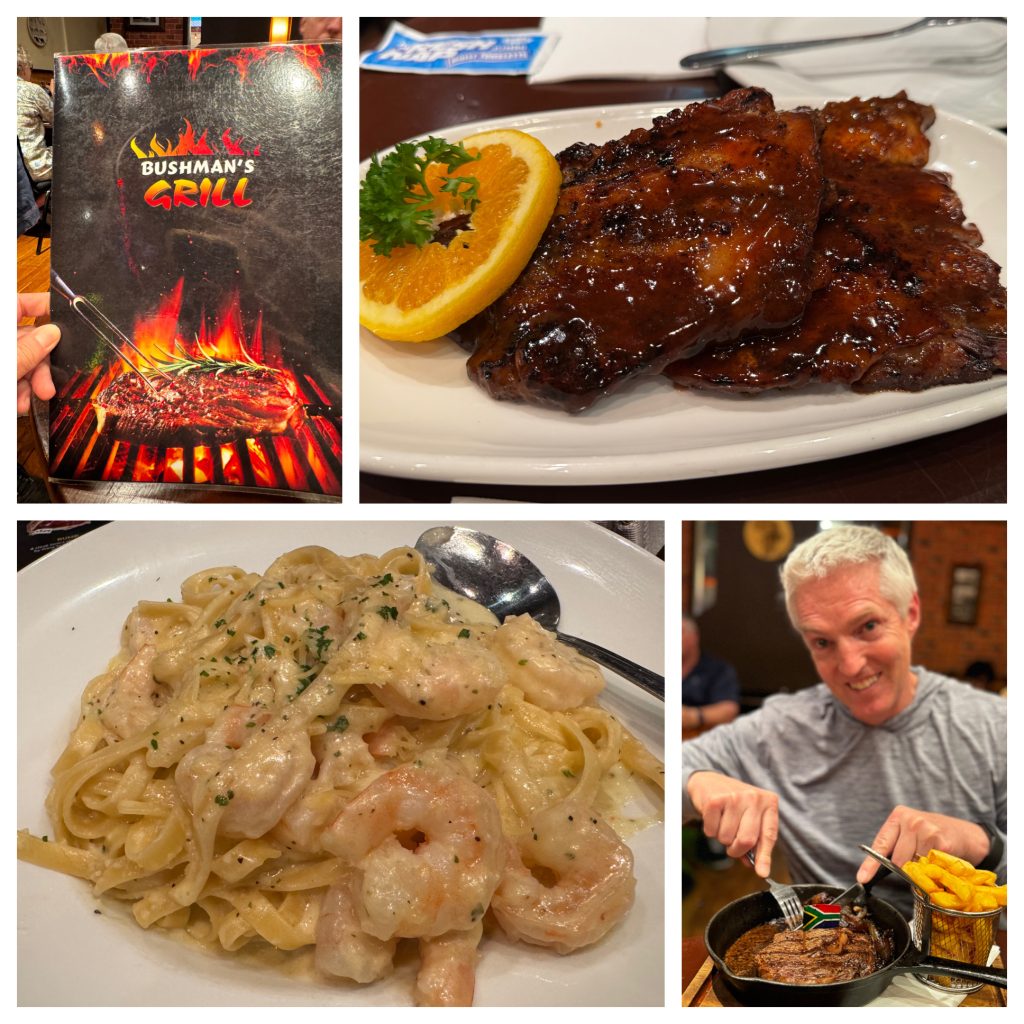
We had baby back ribs for appetizer, it was so moist and flavorful! Kevan ordered steak and I had the garlic shrimp Alfredo, it was so good. The Alfredo was perhaps one of the best I’ve eaten. Travis would have enjoyed it!
Day 5
Auckland
Today is a fun-packed day! Primarily sightseeing and eating, my kind of day! Our friend Kim Ying, one of my high school besties, drove us around Auckland for some amazing tourist spots.
Westhaven Marina

Beautiful harbor! Kevan and I enjoyed the little stroll along the harbor before darting to the next stop!
Auckland Harbor Bridge in the backdrop!

Rangitoto Island, a dormant volcano, in the backdrop. Rangitoto erupted about 600 years ago creating a spectacular lake today and beautiful surroundings in Auckland!

Origine
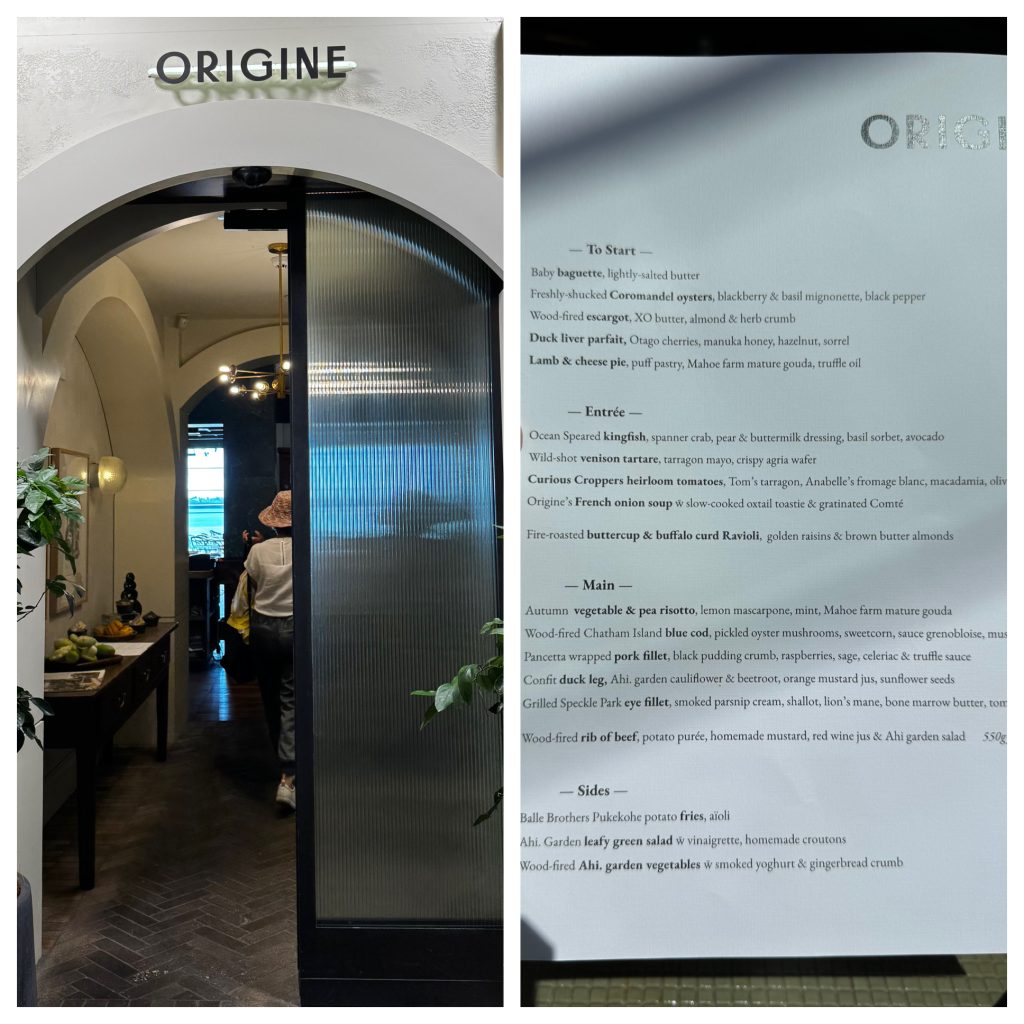
We had lunch at Origine, a French fine dining restaurant, with Kim Ying and Geoff. It is actually located in the PwC Tower! The food was delicious. We had escargot, bread with pesto butter, lamb pie, and king fish as appetizers (referred to as entrees in New Zealand). Kim and I each ordered king cod as our entree ( or main course in New Zealand), and Kevan and Geoff ordered the filet. We had a fabulous time visiting visiting and eating over lunch!

Downtown Auckland
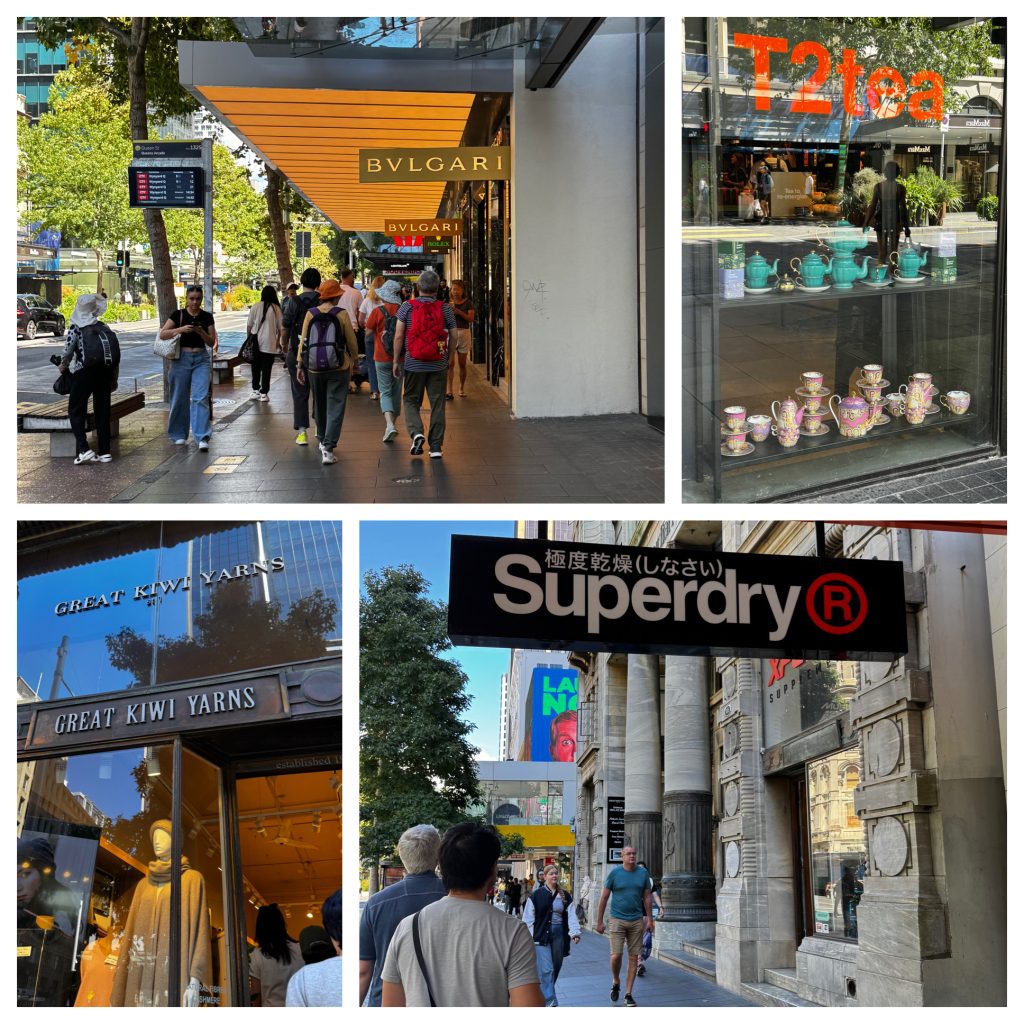
After lunch, we walked around downtown, checking out the various iconic building structures, did a little souvenir shopping, and of course, I had to buy a Starbucks mug to take home despite our having very limited luggage space.
Sky Tower Auckland

An old postal office converted to a train station

Dilworth Building, built between 1925-1927, in listed as historic heritage building by New Zealand.

Walking down Queenstreet
Auckland Memorial Museum
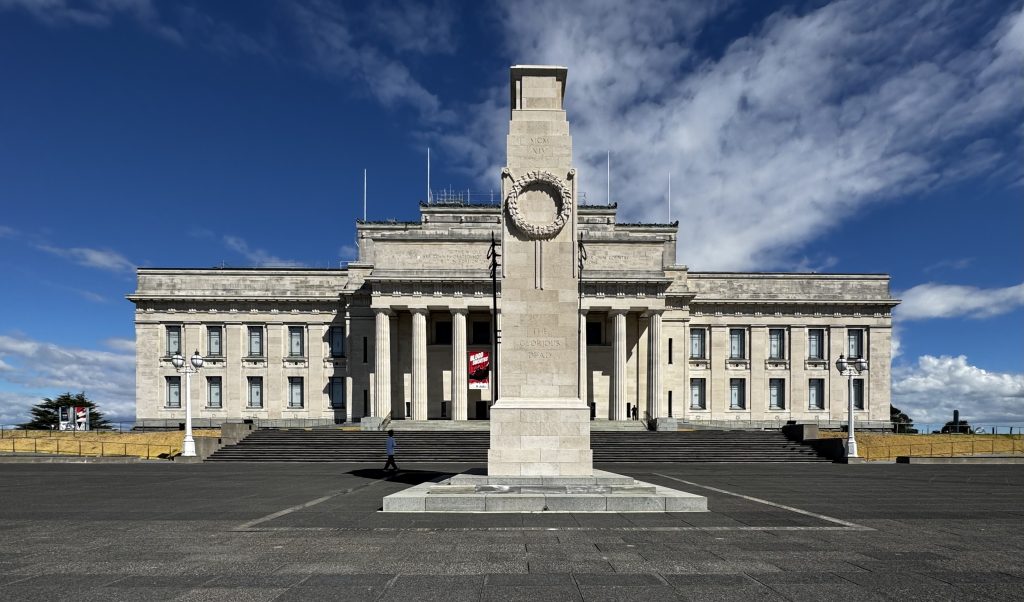
This building is dedicated to the lives of New Zealand military soldiers, principally from world war one and two, who died defending freedom. A beautiful building and wonderful memorial. Also a great elevated view of the city and the harbor.
PwC Tower

Dinner at Kim Ying and Geoff’s home was amazing. Kim Ying had already invited the couple missionary she met a couple of weeks before our arrival – the ones that invited her to the Auckland temple open house. Kim Ying marinated lamb and salmon as well as chicken sausage and Geoff cooked the meat on the grill. The Dewey’s brought pulled pork and salad. Kim Ying also made fruit salad and Pavlova – I probably had half of the entire cake! Great company! Great conversation!

Day 6
We left Auckland for Queenstown today. We were very conservative and arrived a couple of hours before departure time but were able to grab a quick bite before the flight.

The flight was smooth until landing… it was quite bumpy going through thick rain clouds and windy weather. And as I looked through the window, we were right next to the mountain. This is the first time that I had such a closeup view of the mountains as we landed through the middle of a mountain gorge…
We picked up our rental car at budget, very smooth process, and it only took us 8 mins to get to the hotel.
The Rees

Our room was fantastic with a great lake view – lake Wakatipu.

Stratosfare Restaurant from the ground!

We took the gondola ride at Skyline Queenstown that goes up to the top of Bob’s Peak where the Stratosfare Restaurant and Bar is located. It takes about 10 minutes one way and covers a vertical ascent of about 1500 feet in a pretty steep ascent. The gondola and restaurant views of Queenstown, Lake Wakatipu, and the surrounding mountains views are stunning.

The view from the gondola …

The food is amazing with lots of variety offered. And what can be better than dining with a stunning view!

I again outdid myself and had 3 servings of Pavlova dessert but this time they were mini size portions so I did not feel like such a glutton.

Night view going down the gondola.
Day 7
Milford Sound
Today, we continued our adventures on the South Island of New Zealand, travelling from Queenstown to Milford Sound for a cruise. Milford Sound is often called the eighth wonder of the world, it is a fiord carved by glaciers with dramatic cliffs, waterfalls (Stirling and Bowen Fall), as well as seals and dolphins.

There were countless waterfalls along the way to Milford, our bus driver/guide said there were about 1000 waterfalls, big and small, in the area.

Beautiful rivers jumping over the rocks with rigid glacier mountains in the backdrop were very picturesque.

On the way to Milford, we stopped at the lookout for Mt. Toikono – Tapuni lookout, which had a wonderful river, gushing below the bridge where the lookout was based.
After 5 hours of riding in the bus, we finally reached Milford Sound. The drive is actually 300 km from Queenstown so it’s about 4 hours one way without stops (we made stops for food and restroom breaks and scenic pictures which added about an hour of travel time on the way up), but the drive is spectacular, winding through Fiordland National Park, passing Eglinton Valley’s golden plains, the Mirror Lakes and the Homer Tunnel. An extremely scenic road with rivers and mountains at every turn.
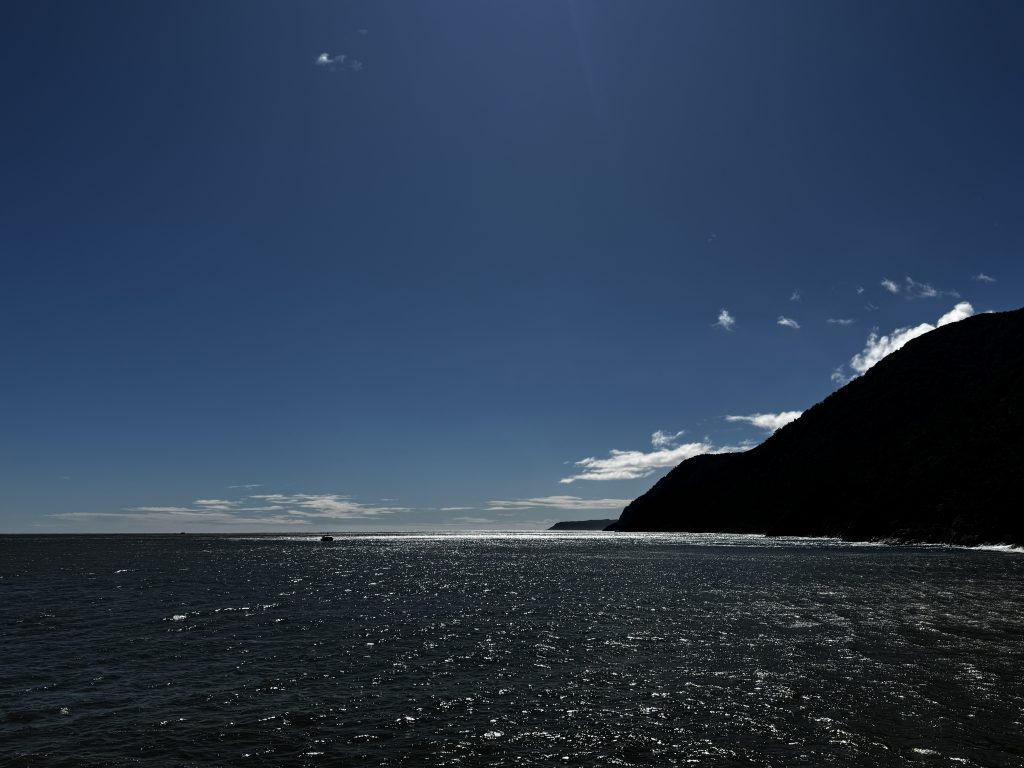
At Milford, we boarded our boat, and enjoyed the 2-hour cruise. At the end of the fiord, we reached the Tasman Sea, which separates New Zealand from Australia, at which point the rolling waves got huge and really rocked our boat around as we did a U-turn and headed back to port.

Best of all, we met a lady from Tokyo (Shitzuko) who was traveling without her husband today and so we asked her to join us on the cruise and became fast friends. Very nice person and helped me brush up on my Japanese and gave us a bunch of tips for places we need to visit on our next trip to Japan!
This huge waterfall splattered all over my face, hopefully it provides some magical facial benefits!

Milford Sound is a stunning fiord (often mistakenly called a “sound”) located in the southwest of New Zealand’s South Island, within Fiordland National Park. Despite its name, it’s not a true sound—a sound is a large sea or ocean inlet formed by the flooding of a river valley. Instead, Milford Sound is a fiord, carved by glaciers over millions of years, with steep cliffs rising dramatically from the water’s edge. The name “Milford Sound” comes from European explorer John Grono, who named it in 1823 after Milford Haven, a coastal inlet in Wales, and the term “sound” stuck despite the geological inaccuracy.
Milford Sound’s shoreline is rugged and nearly vertical in many places, with sheer rock faces soaring up to 1,200 meters (3,900 feet) or more above the water. These cliffs plunge deep below the surface too, with the fiord reaching depths of over 400 meters (1,300 feet) in some areas. The dramatic transition from water to rock is one of its defining characteristics, shaped by glacial erosion and framed by features like Mitre Peak, Lady Bowen Falls, and Stirling Falls. Its breathtaking edge is where dark waters meet towering cliffs, a natural wonder often called the eighth wonder of the world.
I enjoyed the scenery driving back in the bus just as much as at the sound. Simply beautiful!!!

There were also many herds of livestock along the way – alpaca, cattle, sheep, red deer, wapiti, and goats.

We did not waste any time! As soon as we got back to the hotel, kevan and I drove to town to check out some places. The scenery by the water was gorgeous.
Dinner
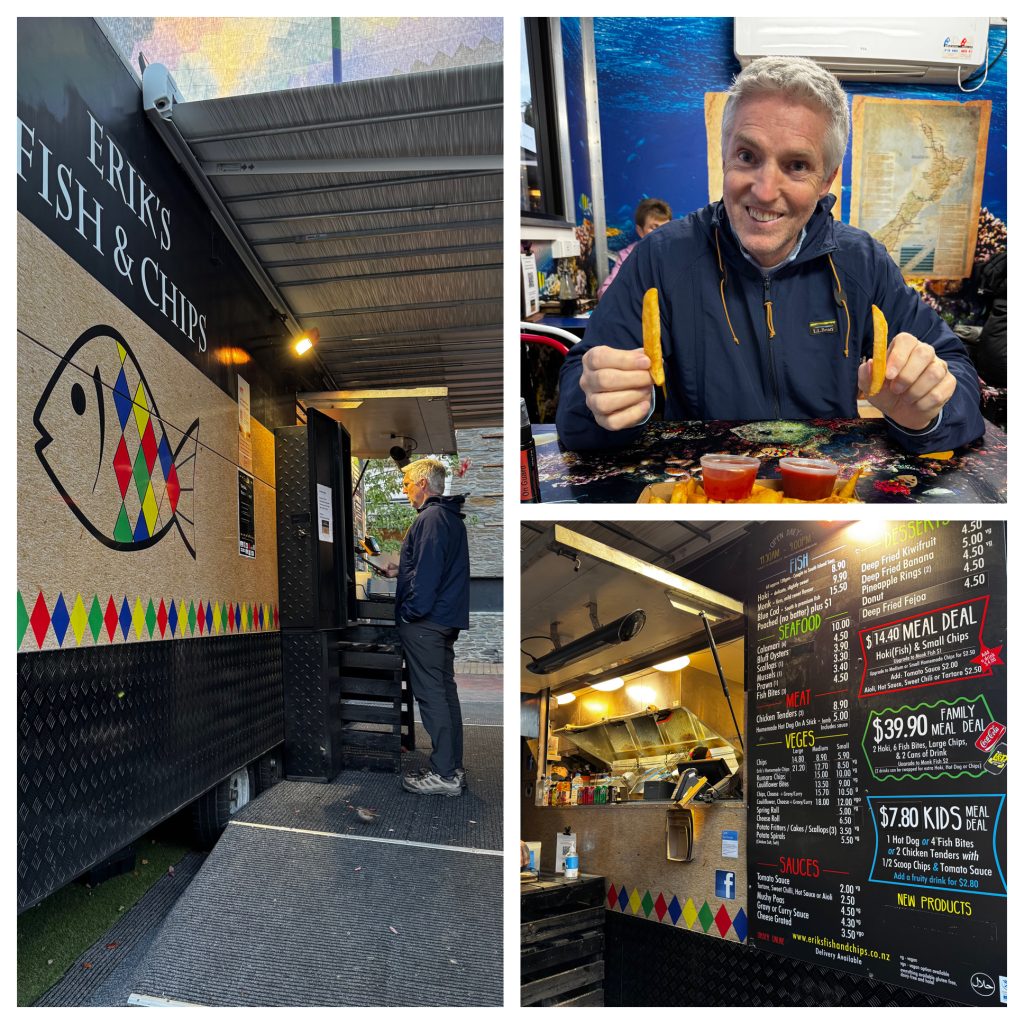
While on a wait list for Blue Kanu, Kevan and I grabbed some fish and chips at a foodstruck to share. What a pig!!!

We had a long and fun-filled day!
Day 8
We had breakfast at the hotel and we were off to Glenorky with Kevan taking the driver’s seat!

The route to Glenorky runs along Lake Wakatipu. The scenery was amazing. We stopped at Wilson Bay on the way for a short stroll, the air was crisp and fresh and the water crystal clear. It’s a beautiful day!

The road trip to Glenorchy and Paradise, New Zealand, through some of the South Island’s most stunning landscapes, was amazing. It was also great to see areas which were featured in the world of Middle-earth from The Lord of the Rings films.
Glenorky

The drive to Glenorchy from Queenstown is about an hour along the scenic Glenorchy-Queenstown Road. It’s a winding road right along the edge of Lake Wakatipu, offering great views of turquoise waters framed by the jagged peaks of the Southern Alps—which puts you right into the otherworldly feel of Lord of the Rings.

Glenorchy is a quaint village at the northern end of Lake Wakatipu, and you can see the landscape get more rugged as you leave the lake side and drive into the forests before the mountains. Definitely a natural and untouched beauty that tells you why this area was used as a key filming hub for The Lord of the Rings.

The backdrop is the snow-capped Mount Earnslaw, which was in the opening shots of The Two Towers. Glenorchy is tied to Isengard, the stronghold of Saruman, with its Dart Valley (which surrounds the tower) and craggy peaks providing the mystical setting for Gandalf’s ride to meet the wizard.

From Glenorchy, we drove another 10ish miles northwest toward Paradise, which is even more remote. The paved road changes to gravel (lots of sheep ranches here) and you enter the beech forests of Mount Aspiring National Park.

The beech forests close in on and over the road like an ancient tunnel along the road to Paradise (which was used as Lothlórien, the elven sanctuary of Galadriel).

The Dark River winds through the fields – the surrounding mountains were Amon Hen, the site of Boromir’s dramatic death and the Fellowship’s breaking in The Fellowship of the Ring.
The road trip was great – only a little over 2 hours compared to over 9 hours on the Milford Sound coach ride – with fresh mountain air, beech tree forests, crystal clear glacier lakes, and rushing rivers. Great scenery, and the tie in to Lord of the Rings landscapes added an element as you stroll through paths walked by hobbits, wizards, and warriors!
Queenstown Mall

We had a quick lunch at Madam Woo. Parking was tough during lunch hours but we managed to find a perfect spot right next to the bay. We walked around the bay and shared a strawberry Nutella crepes.
True South

Dinner at True South at the hotel with window seating was picturesque. The wagyu and salad were amazing, salmon was flavorful but a little salty. We enjoyed the desserts too!
We had a great time in Queenstown!
Day 9
We left Queenstown this morning!
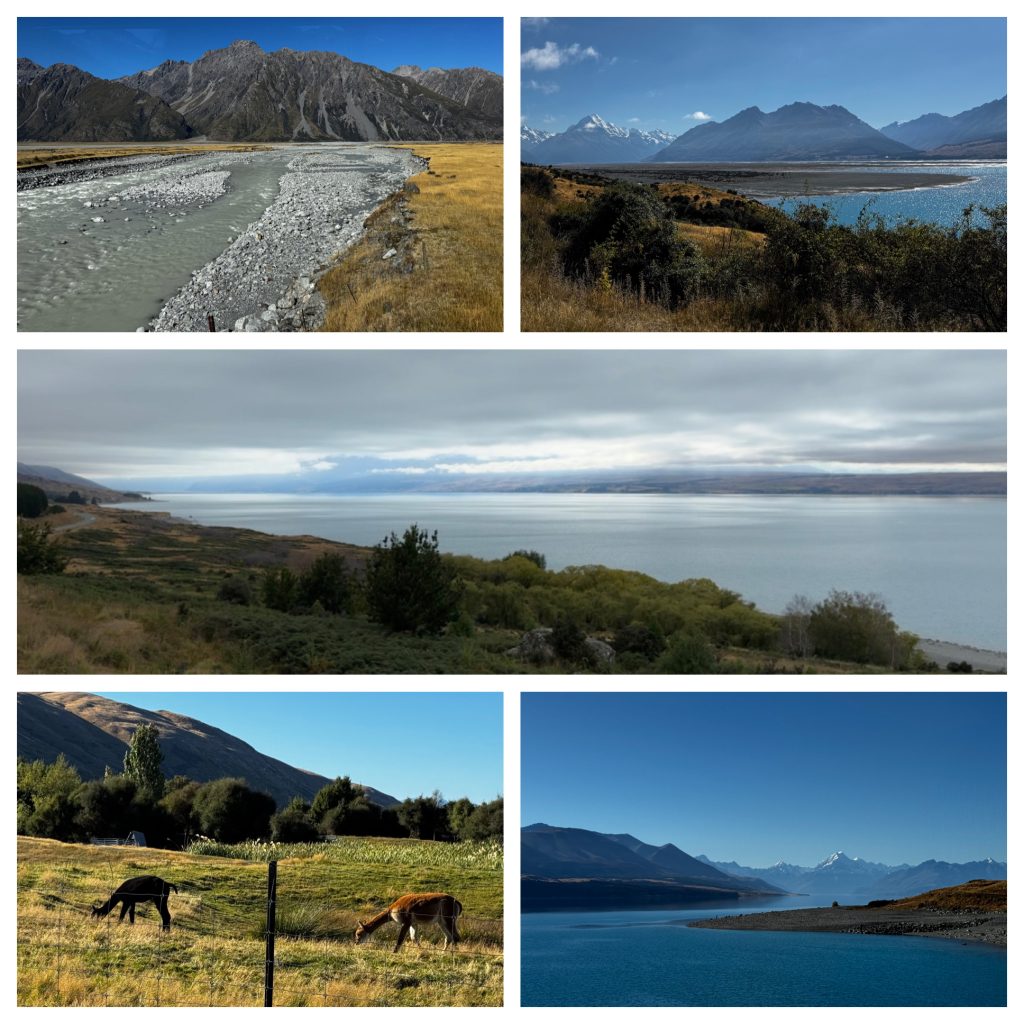
Today we went with the Glacier Explorers tour to explore Aoraki/Mount Cook, checking out New Zealand’s largest glacier, the Tasman Glacier (Haupapa) at Mount Cook, up close. The scenery along the way was stunning!

We first took a short bus ride to the Tasman Valley, about 10–15 minutes away. From the Blue Lakes car park, we hiked about a mile through Aoraki/Mount Cook National Park to the Tasman Lake jetty.

At the dock, we got on a custom-built MAC boat (kind of a blend between a rigid-hulled inflatable boat and a pontoon), designed for stability on the glacial lake. We spent about an hour cruising the Tasman Glacier Lake, weaving around icebergs of all shapes and sizes.

These huge chunks of ice have broken off the glacier’s face – which we saw up close and personal! Amazing to feel the scale of this huge iceberg. Touching small ice fragments is surreal – ice that’s been locked in the glacier for centuries. The Tasman Glacier is the longest glacier in New Zealand, spanning nearly 15 miles long and 3 miles wide and 1800 feet deep at its thickest point.

On our tour we rode around the glacier lake in a small power board that held about a dozen people. Our tour guide drove between and around the icebergs and for really close at times. The icebergs ranged from car-sized to multi-story giants. Our guide even picked up a huge chunk and passed it around so we could feel the compression and weight.

The guides taught us about the glacier’s history, the formation of the lake, and the Southern Alps, including Aoraki/Mount Cook, New Zealand’s highest peak at 3,724 meters.
The lower half of the glacier which is down by the lake is covered with thick layers of rock debris, which also creates sediment in the lake and the river resulting in a murky water color.

Icebergs break off the main glacier and float around the lake in a variety of shapes and sizes. We saw one of the icebergs flip over while we were there, another had a huge crack and looked like it would split up but never did while we were there.
The iceberg that flipped over exposed a fresh side of ice that was completely blue, due to tight compression of snow and ice over decades, squeezing out air bubbles and aligning ice crystals. This dense ice absorbs longer red wavelengths of light, reflecting shorter blue ones—creating a deep, almost glowing azure that’s mesmerizing up close. The other icebergs had much clearer ice on top due to having been exposed to the sun for longer periods, resulting in a translucent, glass-like look.
We spent about 2–3 hours total, including the bus transfer (15 minutes bus ride), walk (2 miles round trip hike), and boat ride itself. Amazing experience, the boat, and nature as we touched ancient ice!
Jade Chinese Restaurant

We had Chinese food dinner at Lake Tekapo. It’s surprising how big this restaurant is especially in a small town in Tekapo largely due to the huge number of Chinese tourists in the area. The food was good, better than New Dragon in Salt Lake City, no offense intended to my Utah friends.
Stargazing
We went to the Mt John Summit Experience tonight. This is a stargazing guided tour from the Dark Sky Project, based at Lake Tekapo, which is in the the Aoraki Mackenzie International Dark Sky Reserve. This is the world’s largest gold-tier dark sky reserve, which means this tour wasn’t just a normal look at the stars, it was a guided, immersive journey into the Southern Hemisphere’s night sky, held at the University of Canterbury Mt John Observatory, on Mount John (1,029 meters altitude).
The tour kicked off at the Dark Sky Project Base Building on the stunning lakefront. This modern hub was first opened in late 2019, and is located near the township’s edge, offering panoramic views of the turquoise lake and surrounding mountains by day. It’s a short walk from central Tekapo (we met our guide at the 4 Square supermarket).
The stargazing happens about 8 miles away at Mount John, which is a 15-minute shuttle ride from the base. The observatory’s hilltop position minimizes light pollution from town and maximizes sky clarity, which is huge for astronomy events.
The tour lasts about 2 hours (including shuttles) and started after sunset (about 8:30 PM). We dressed warm, temps on the summit get down to about 40 degrees F.
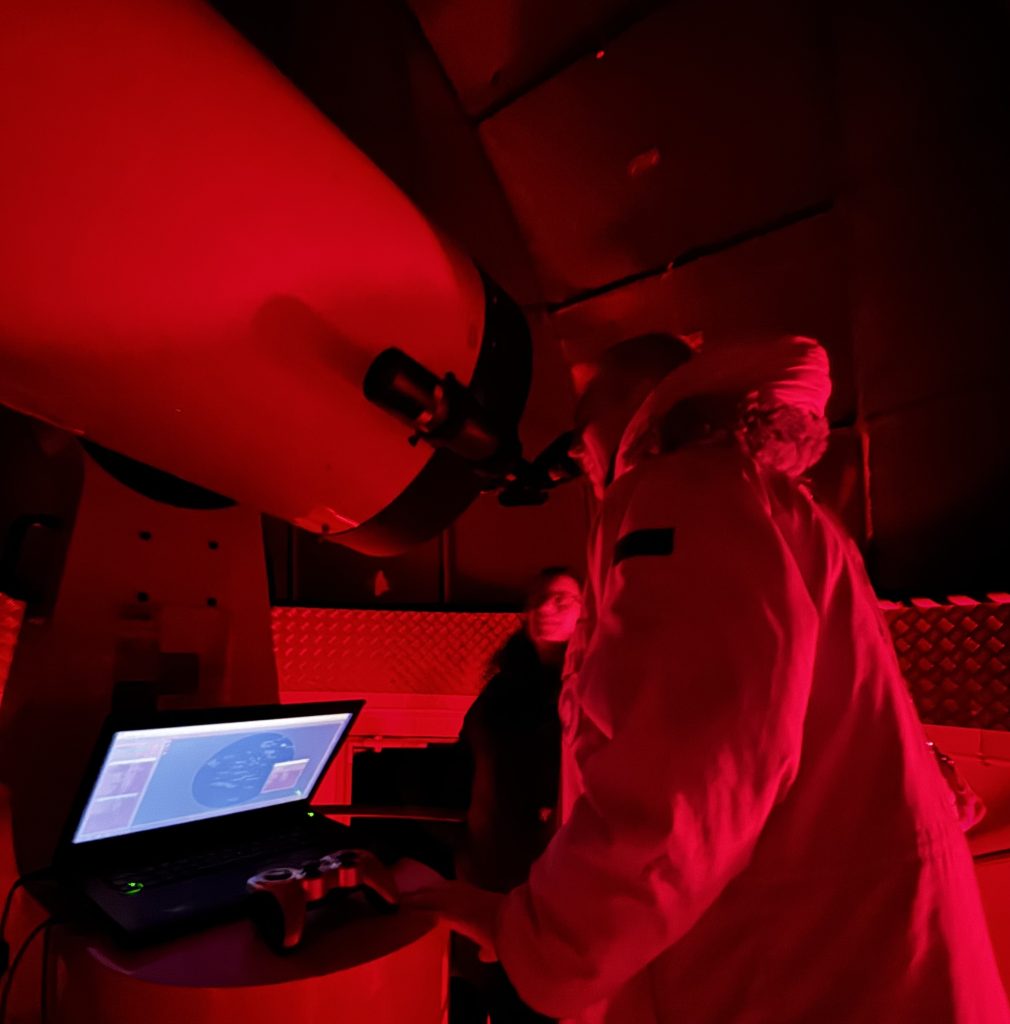
At Mount John, expert astronomy guides lead you through a two-part experience, 1st using regular sight and handheld lasers to point out constellations (e.g., Southern Cross), planets (like Jupiter), and the Milky Way, which blazes across Tekapo’s pristine skies. Then it was telescope time, using high-powered telescopes like a standout 16-inch telescope in a private observatory dome, which allowed viewing star clusters (e.g., Jewel Box which I got disoriented and feeling dizzy pretty quickly), nebulae (e.g., Orion), and even distant galaxies, depending on the night’s alignment.
Our guide shared the science and stories, including stuff about Māori astronomy and modern cosmology. I’m not a fan of astronomy but Kevan was extremely interested, so we came! We were educated on all the different stars, planets, constellations, the different galaxies, but all this information was too overwhelming. I simply can’t remember nor can I recognize most of the constellations even when pointed out with a beam. But I have to say I was very fascinated of the creation of the millions of stars and galaxies which, in my opinion, is grand evidence of a divine creator.
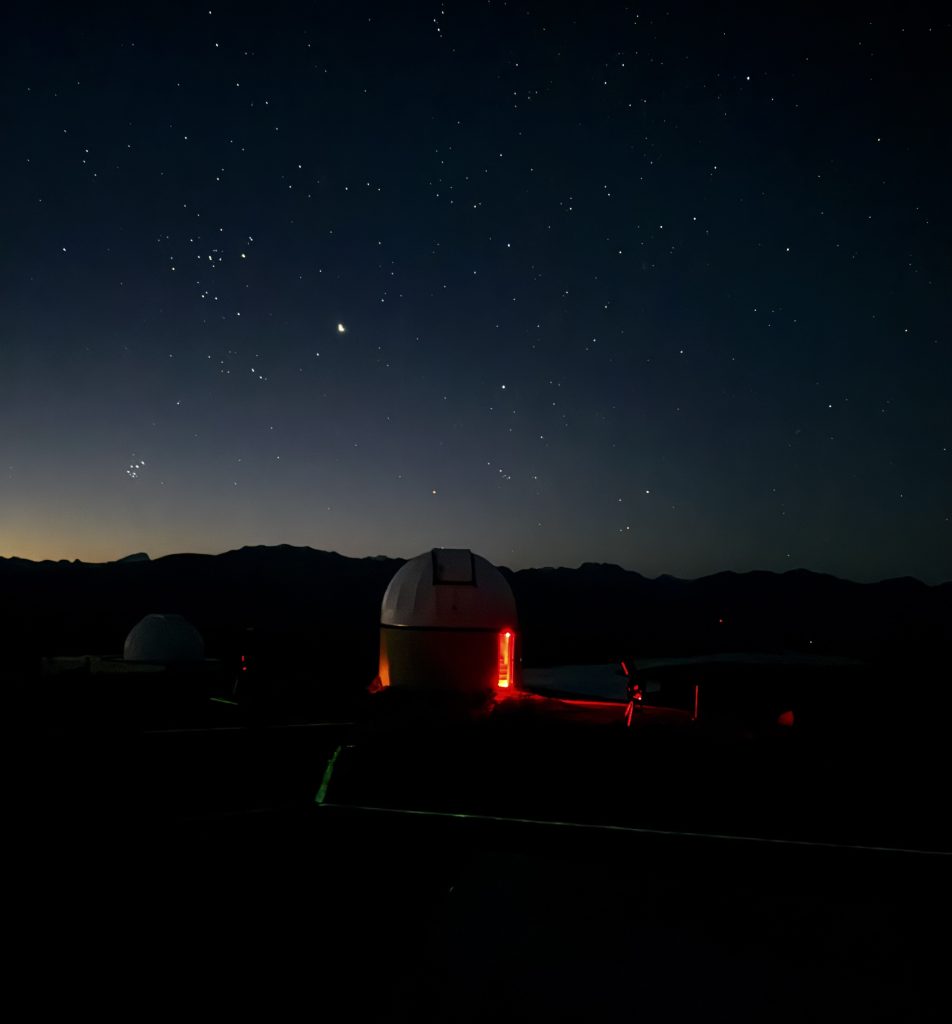
We were introduced to the biggest telescope in New Zealand from which we could clearly see the planet Jupiter. The planet was so bright accompanying with 4 smaller stars in a row. We could actually spot Jupiter with our bare eyes, one of the brightest stars on the bottom and Mars, a smaller reddish star northeast of Jupiter. We even saw some shooting stars so definitely made some nice wishes!

We also looked into another telescope to observe a cluster of stars, I felt a little disoriented and dizzy looking into the telescope but I did see a glimpse of the cluster (jewel box) but had to quickly withdraw. This experience further confirms that astronomy is not my cup of tea.
My favorite part of the night was to lay on the bean bags and gaze into the sky next to kevan and just enjoy the beautiful sky decorated with glimmering stars. So beautiful! I couldn’t even make out one or two constellations when not pressured to learn!
Our guide repeatedly commented on how people polluted the sky with white light which makes it more difficult to observe and study the beautiful stars in the sky. She encouraged all of us to work together to conserve light to make “the world a darker place” to see brighter stars, thought that was funny!
Whoosh! We had a long day today but very exciting!
Day 10

This morning Kevan went for a run around Lake Tekapo and took some beautiful pictures around the area.
Kohan Restaurant

We went to lunch at Kohan, a Japanese restaurant, recommended by our friend Geoff. The food was exceptional!
Christchurch
After lunch, we started our journey on a long a windy road to Christchurch.

We checked into Fable hotel, did the laundry in the sink, and had some time to wind down before the next activity.
Dinner on a Tram

Tonight, we joined the Christchurch Tramway Restaurant tour, a one-of-a-kind dinner experience aboard a restored 1920s heritage train. We enjoyed a 4-course meal while the tram took us on a sightseeing tour through the center of town. We left from Cathedral Junction right next to our hotel.
The tour lasted about 2.5 hours, starting at 7:30 PM and running 3-4 loops around town and past key spots like the Avon River, Botanic Gardens, the cathedral and Canterbury Museum.
The tram is a 36-seat dining car decked out in colonial style—mahogany, brass, crisp white linen—but pretty cozy, especially our table which had seats barely wide enough to sit on, but we were at a single side table, the double side tables looked a lot more comfy.
Dinner was a four-course meal, I had salmon and Kevan had venison for our main dishes and we both had pavlova for dessert.

Our hotel was right next to a party street where people drank and danced and generally went a little wild…it was especially crazy last night as they had a street party down regent street so the whole street was blocked off for the party.
Day 11
Our last day in Christchurch and in New Zealand. Tomorrow morning, we are flying to Cairns, Australia leaving the hotel at 3am for a 6am flight.
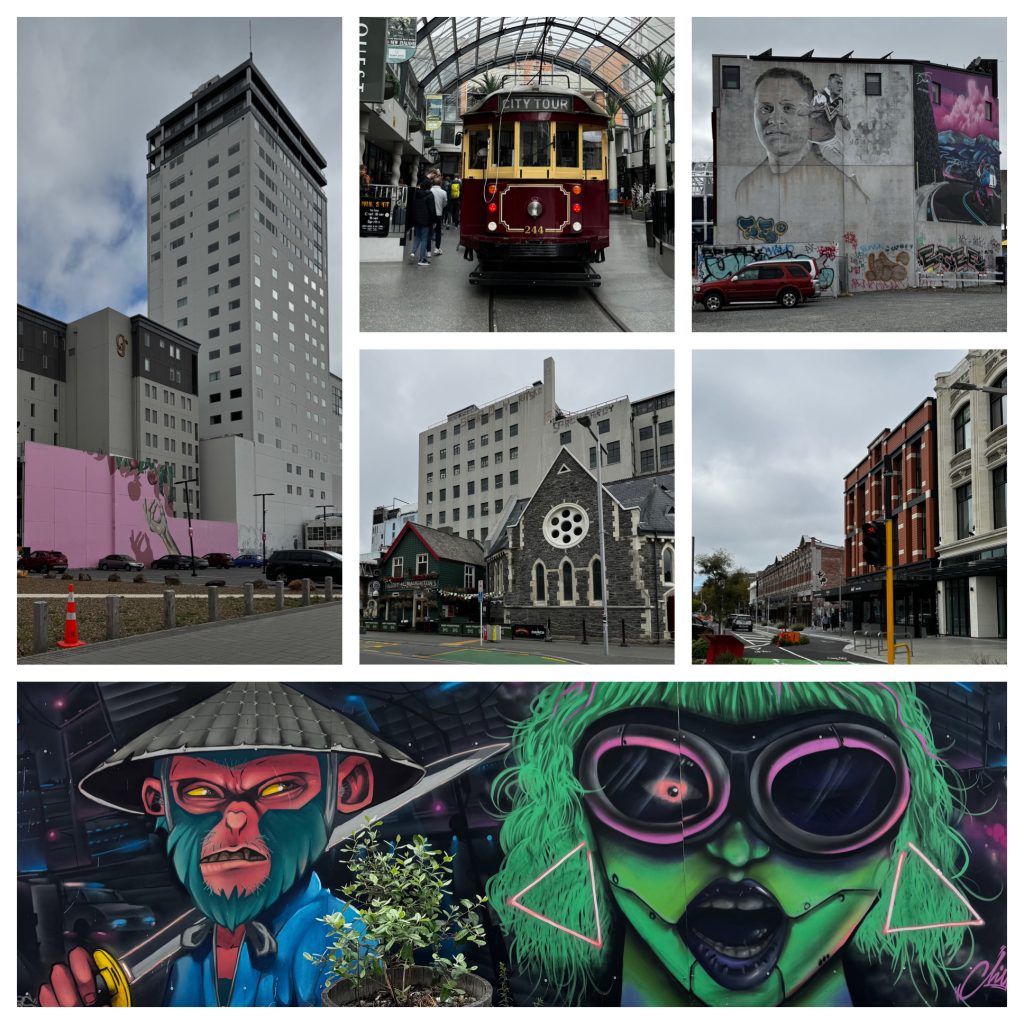
We walked around town this afternoon, great little town, lots of murals, nice little shops, great area to walk around …
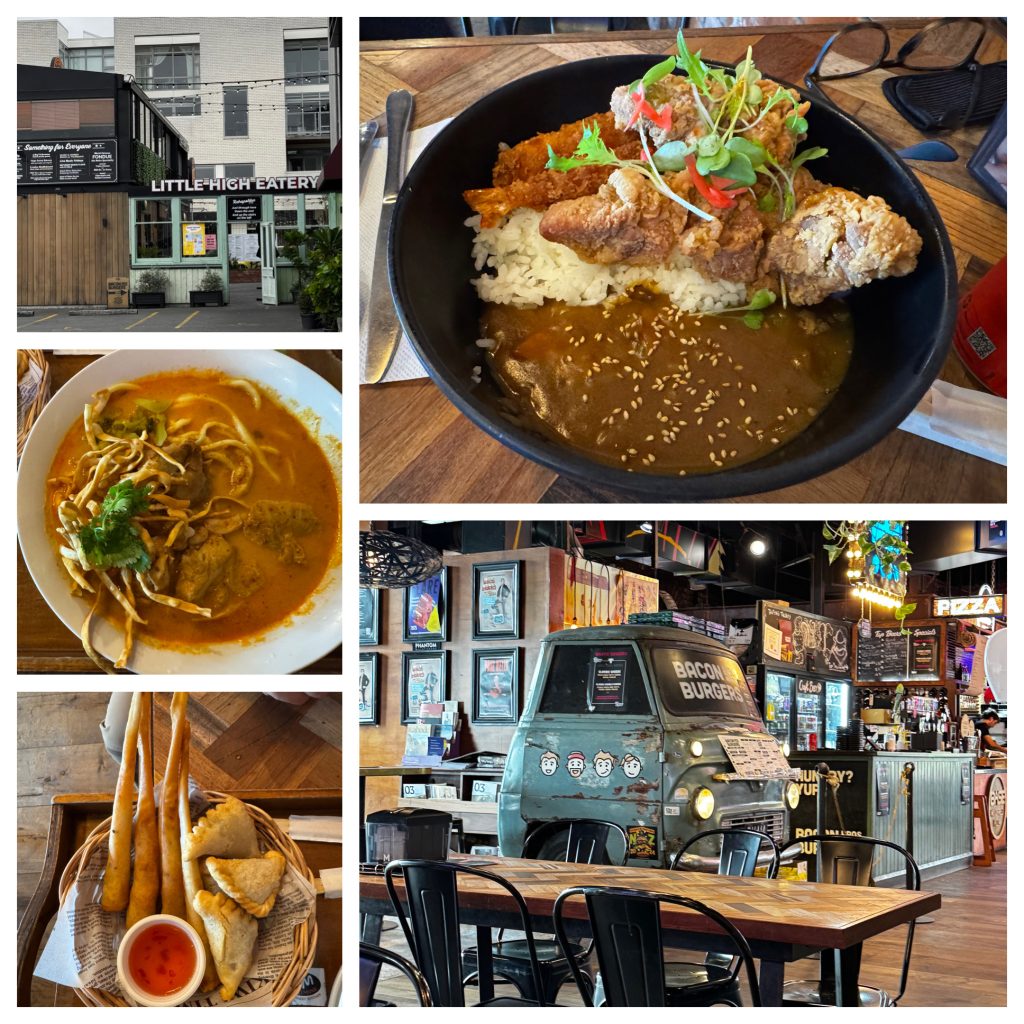
We had lunch at Little High Eatery, a quaint little food court serving all sorts of delicacies. And we chose Thai and Japanese food of all the choices we had for our last day in New Zealand.
New Regent Street
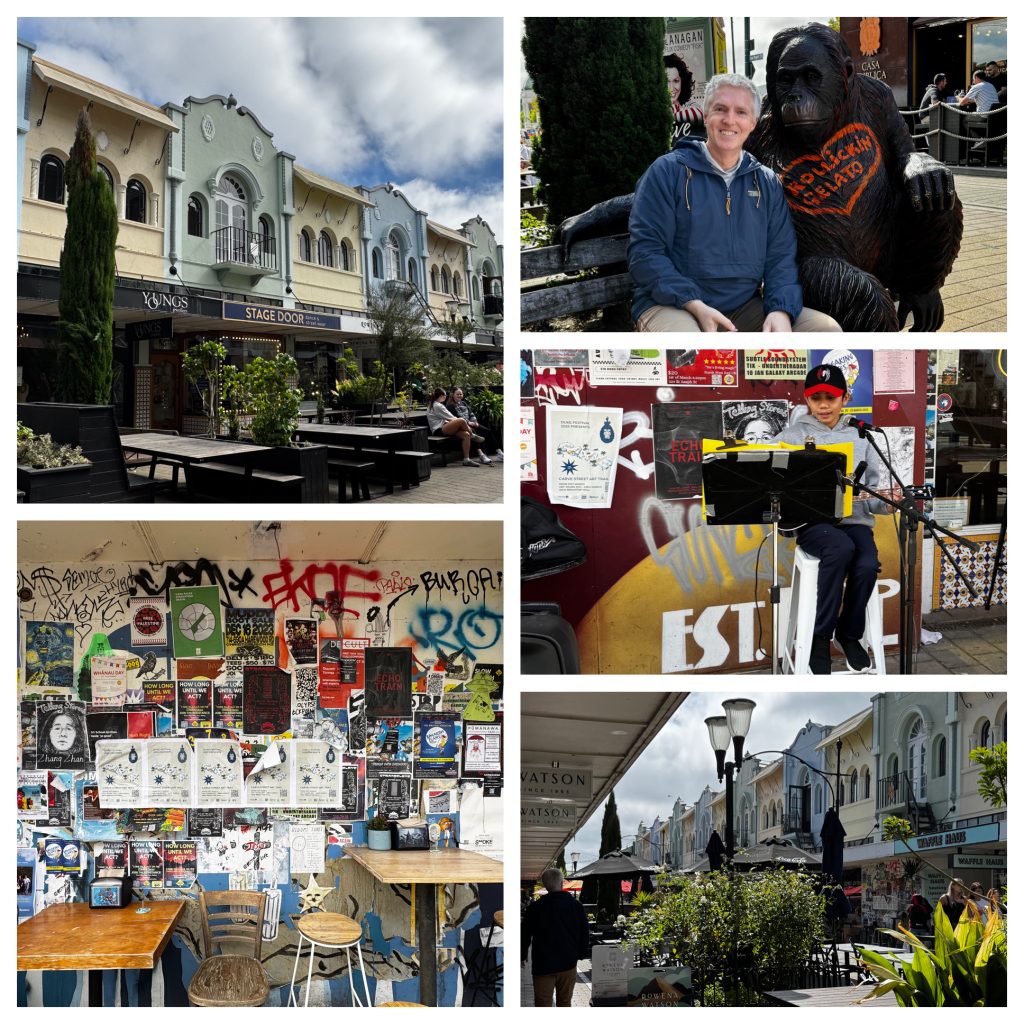
This street is quite different during the day compared to nightlife on the same street.

We were looking all over for Pavlova but found an ice cream/gelato parlor that Kevan couldn’t resist. There were many attractive flavors, I ordered a scoop of pomegranate flavor and coconut and Kevan had 3 scoops of Superman chocolate ice cream!
Sakimoto
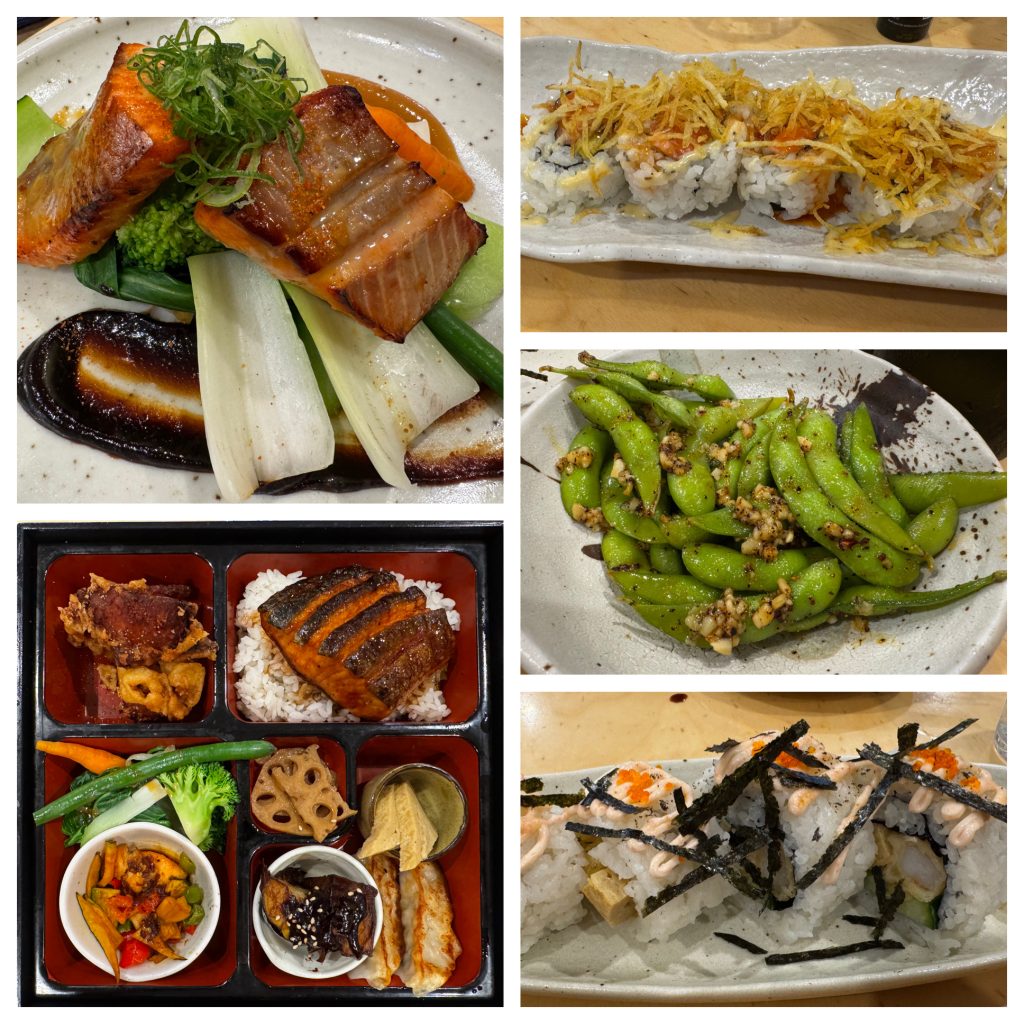
Dinner at Sakimoto, a Japanese restaurant right next to our hotel. The food was amazing especially the salmon. I haven’t yet disappointed with all the salmon dishes ordered in New Zealand. Very tender and flavorful!
After dinner, we went in search for some Pavlova at Sweet Soul Patisserie as the girl at the ice cream parlor earlier told us they should have it but again were told that Pavlova is a seasonal dessert that usually only offered during Christmas time. But the Riverside Market right across the street might have it. And so we went but again searched in vain.

The Riverside Market is a huge food court that offers many varieties of food ranging from Italian, Japanese, Indian, Western… I even found a Malaysian stall in the market. Literally everything but Pavlova.

And so we continued to explore downtown a bit … I’m rather intrigued by all the wonderful murals I’ve come across in Christchurch, especially the one with Kiwi and the flowers, truly representing the key symbols of New Zealand culture.
Bridge of Remembrance

This arch/bridge, designed by architect William Gummer and sculpted by sculptor Frederick Gurnsey, was constructed to commemorate the soldiers in the Canterbury region who fought and died during World War I (1914-1918). It is also a pedestrian pathway connecting the city center with Avon River precinct.
ChristChurch Cathedral Christchurch

This cathedral, built 150 years ago, which took 130 years to complete, is the physical and symbolic heart of the city. It is currently under significant renovation due to the damage incurred during earthquakes in September 2010 and February 2011.
Citizens’ War Memorial

This memorial was constructed to honor the citizens of Canterbury who died in the two world wars 1914-1918 and 1939-1945.
New Zealand is definitely one of my favorite countries to visit – amazing scenery, lots of history, and beautiful people!